Edi Durjana
RetroArch, the ubiquitous frontend for the Libretro API, has officially released version 1.20.0, marking a significant stride in the ongoing quest for authentic and enhanced retro gaming experiences. This latest iteration introduces two particularly noteworthy features: a revolutionary CRT beam simulation shader leveraging "subframe" capabilities for unparalleled motion clarity, and the integration of illuminance sensor support for Linux, allowing classic titles to interact with real-world light. The update, available for immediate download across various platforms, reaffirms RetroArch’s long-standing commitment to user-centric development, steering clear of in-app advertisements, monetization SDKs, or paywalled features, a philosophy consistently upheld since its inception.
The Evolution of Visual Authenticity: Subframe Shaders for Enhanced Motion Clarity
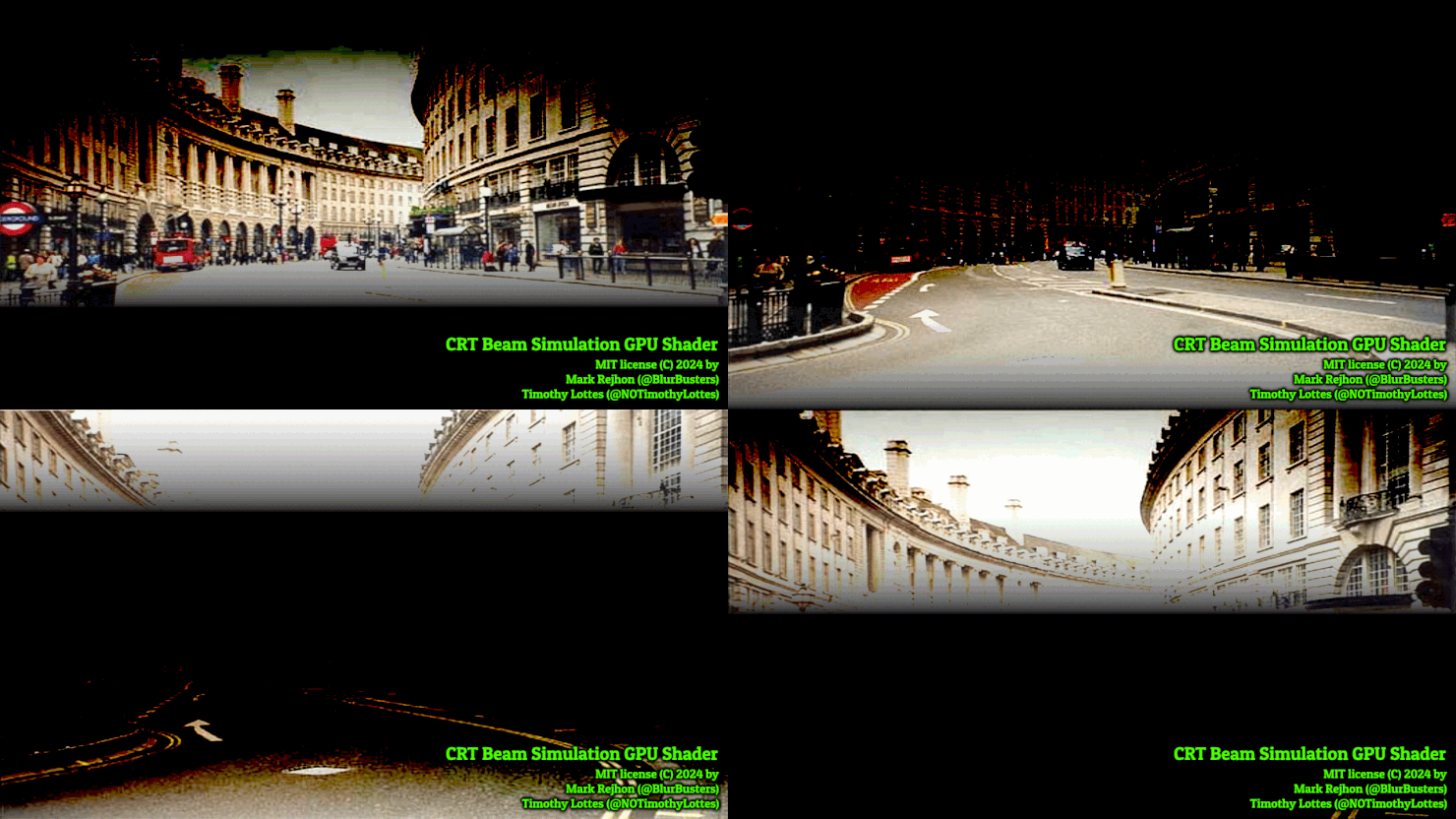
One of the most anticipated features in RetroArch 1.20.0 is the introduction of an advanced CRT beam simulation shader, meticulously crafted by industry luminaries Mark Rejhon of BlurBusters.com and Timothy Lottes, known for his pioneering work on the FXAA shader and the popular crt-lottes shaders. This innovative solution addresses a persistent challenge for retro gaming enthusiasts: achieving the crisp motion clarity characteristic of cathode ray tube (CRT) displays on modern LCD and OLED screens.
For decades, CRTs were the standard display technology, known for their near-instantaneous pixel response times and the way they drew images line by line. This inherent characteristic minimized perceived motion blur, a common issue on contemporary sample-and-hold displays where pixels remain lit for the entire frame duration, leading to a smearing effect during fast-moving scenes. While black-frame insertion (BFI) has been a traditional method to combat this on modern panels by briefly inserting black frames between rendered frames, it comes with significant drawbacks. BFI typically results in a noticeable reduction in screen brightness, dulled colors, and, critically, an increased risk of image persistence (often mistakenly called "burn-in") on many LCD panel types and even some OLEDs. This non-permanent yet concerning phenomenon involves residual images lingering on the screen, particularly after prolonged display of static elements.
The new CRT beam simulation shader in RetroArch 1.20.0 circumvents these limitations by leveraging the platform’s recently developed "subframe" shader capabilities. Rather than simply inserting black frames, subframe rendering allows for a more granular control over how each frame is presented. In essence, the display is refreshed multiple times within a single frame interval, enabling the shader to simulate the precise timing and luminance characteristics of a CRT’s electron beam scanning across the screen. This technique effectively reduces the "sample-and-hold" effect by minimizing the duration each pixel is illuminated, thereby drastically improving perceived motion clarity without the compromises of BFI. The visual result is a stunningly accurate replication of CRT aesthetics, complete with scanlines and dynamic beam behavior, providing an immersive and historically accurate visual experience that was previously unattainable on modern hardware without significant trade-offs. The collaboration with experts like Rejhon, a leading authority on display motion clarity, and Lottes, whose contributions have shaped modern graphics rendering, underscores the technical sophistication and dedication to authenticity embedded in this new feature. Enthusiasts can explore this in greater detail through a dedicated article on the Libretro website, which delves into the technical intricacies of the BlurBusters CRT Beam Racing Simulator Shader.
Beyond the Screen: Illuminance Sensor Support Brings Games to Life
RetroArch 1.20.0 also introduces a groundbreaking feature that literally brings retro gaming out of the screen and into the player’s environment: illuminance sensor support for Linux. Spearheaded by developer Jesse Talavera, this innovation directly addresses the unique gameplay mechanics of certain classic titles, most notably the Boktai series on the Game Boy Advance. These games famously incorporated a solar sensor directly into their game cartridges, requiring players to expose the device to real sunlight to charge in-game weapons and progress through specific challenges. This mechanic, while innovative, often presented a significant barrier for modern players attempting to revisit these titles through emulation, as the original hardware interaction was lost.
With the new Linux illuminance sensor support, RetroArch can now interface with ambient light sensors present in modern devices, such as the widely popular Steam Deck, or even external USB light sensors. This integration allows the emulator to dynamically feed real-world light data directly into the emulated game, effectively replicating the original hardware experience. A compelling demonstration by Talavera showcases Lunar Knights, a spiritual successor to Boktai, running on a Steam Deck, with the game’s environment and mechanics reacting in real-time to changes in ambient light. This level of hardware-level emulation transcends mere graphical or audio replication, venturing into the realm of authentic gameplay interaction, providing a deeper sense of immersion and fulfilling the original design intent of these unique titles.
The implications of this feature extend beyond a single game series. While Boktai is the most prominent example, the groundwork laid by Talavera opens doors for future integrations. The announcement hints at forthcoming solar sensor support for the melonDS DS core in its next update, promising to extend this immersive capability to a broader range of Nintendo DS titles that may have utilized similar environmental inputs. Furthermore, the development team has teased broader camera support for more platforms following the 1.20.0 release, suggesting a future where emulated games could interact with a wider array of real-world stimuli, potentially leading to novel gameplay experiences or enabling previously inaccessible features in other classic titles. This commitment to hardware-accurate peripheral emulation is a testament to RetroArch’s dedication to game preservation in its fullest sense.
A Pillar of Open-Source: RetroArch’s Unwavering Commitment to Users
At its core, RetroArch remains a bastion of open-source development, steadfastly adhering to a user-first philosophy that distinguishes it sharply from many contemporary software projects. The RetroArch development team, under the umbrella of the Libretro organization, has consistently championed a model entirely devoid of in-app advertisements, monetization SDKs, or paywalled features. This principled stance ensures that the user experience is never compromised by intrusive marketing or financial barriers, allowing players unhindered access to the full spectrum of its capabilities.
This commitment is particularly notable in an industry increasingly reliant on microtransactions, subscription models, and data harvesting. RetroArch’s developers explicitly state that the project exists for the "benefit of our users," driven by a passion for "spreading the love" to its global community. This unique model necessitates community support to sustain its continuous development, maintenance, and innovation. Users are encouraged to contribute through various channels, including direct donations, monthly pledges via Patreon, or sponsorship through Github Sponsors. Additionally, the project offers official merchandise through its Teespring store, providing another avenue for enthusiasts to show their support while acquiring unique RetroArch-branded items. This symbiotic relationship between the development team and its dedicated user base has been instrumental in the project’s longevity and its ability to consistently deliver cutting-edge features and a robust, ad-free platform. The transparency and community engagement fostered by this model have cultivated a loyal following, demonstrating the viability and strength of a truly open-source, user-driven ecosystem.
Under the Hood: Broader Improvements and Core Refinements
While the subframe shaders and illuminance sensor support are the headline features, RetroArch 1.20.0 also incorporates a comprehensive suite of broader improvements and core refinements that enhance the overall stability, performance, and user experience. Although the specific changelog details were not provided in the initial announcement, typical RetroArch releases include a wide array of updates crucial for the platform’s ongoing evolution.
These often encompass significant performance optimizations across various cores and drivers, ensuring smoother gameplay and reduced latency, even on less powerful hardware. Bug fixes are a constant in every release, addressing issues ranging from minor graphical glitches to critical stability problems that could impact specific games or platforms. User interface and user experience (UI/UX) enhancements are also frequently implemented, making the frontend more intuitive, customizable, and accessible for a diverse user base. This might include improvements to menu navigation, input mapping, or accessibility options.
Furthermore, RetroArch’s modular architecture, built around the Libretro API, means that core updates are a continuous process. Version 1.20.0 likely integrates the latest versions of numerous emulation cores (e.g., SNES9x, PCSX ReARMed, Dolphin, MAME), bringing improved compatibility, accuracy, and performance for a vast library of games across dozens of systems. Platform-specific enhancements are also common, with developers optimizing the frontend for various operating systems (Windows, macOS, Linux, Android, iOS) and specialized hardware (Raspberry Pi, consoles, handhelds like the Steam Deck). These "behind-the-scenes" updates, though less flashy than marquee features, are fundamental to RetroArch’s reliability and its ability to maintain its position as the premier multi-system emulator. They represent the tireless work of a global team of volunteer developers, constantly refining and expanding the platform to meet the evolving demands of retro gaming.
The Broader Impact: Pushing the Boundaries of Emulation and Preservation
The release of RetroArch 1.20.0 represents more than just another software update; it signifies a continued push against the perceived limitations of emulation and a deeper commitment to digital game preservation. By introducing features like subframe shaders, RetroArch is actively challenging the notion that modern displays cannot replicate the visual fidelity of historical hardware. It demonstrates that with innovative software engineering and a deep understanding of display technology, it is possible to not only emulate game logic but also the nuanced sensory experience of playing on original systems. This pursuit of "pixel-perfect" or "authentic" experiences elevates emulation from mere functionality to an art form, enriching the historical context and artistic intent of classic games.
Similarly, the integration of real-world sensor support underscores a broader trend in emulation: moving beyond basic ROM playback to fully recreate the interactive environments that defined certain gaming eras. This approach is vital for game preservation, ensuring that unique gameplay mechanics tied to external peripherals or environmental factors are not lost to time but remain accessible and playable for future generations. RetroArch’s open-source nature ensures that these advancements are not proprietary but contribute to the collective knowledge base of the emulation community, inspiring further innovation across the field.
The platform’s unwavering commitment to being advertisement-free and open-source also has profound implications for the accessibility of gaming history. By removing financial barriers and maintaining broad platform support, RetroArch democratizes access to decades of gaming heritage, making it available to anyone with a compatible device. This release further solidifies RetroArch’s role not just as an emulator frontend, but as a critical infrastructure for digital cultural heritage, ensuring that the legacy of video games remains vibrant, playable, and continually evolving in its presentation.
Availability and Community Engagement
RetroArch 1.20.0 is now available for download across its myriad supported platforms. Users can obtain the latest version directly from the official RetroArch website at retroarch.com/?page=platforms. The development team extends a renewed call to its global community for support, emphasizing that the project’s continued existence and groundbreaking innovations are directly fueled by user contributions. Those who wish to support the ongoing development can find more information on donation options at retroarch.com/index.php?page=donate, including direct contributions, Patreon subscriptions at patreon.com/libretro, or GitHub Sponsors at github.com/sponsors/libretro. Additionally, official merchandise, which also contributes to project funding, can be purchased from the Teespring store at teespring.com/stores/retroarch. The RetroArch community remains a vibrant hub of discussion, collaboration, and innovation, consistently pushing the boundaries of what is possible in the realm of retro gaming and digital preservation.