Vera Clarissa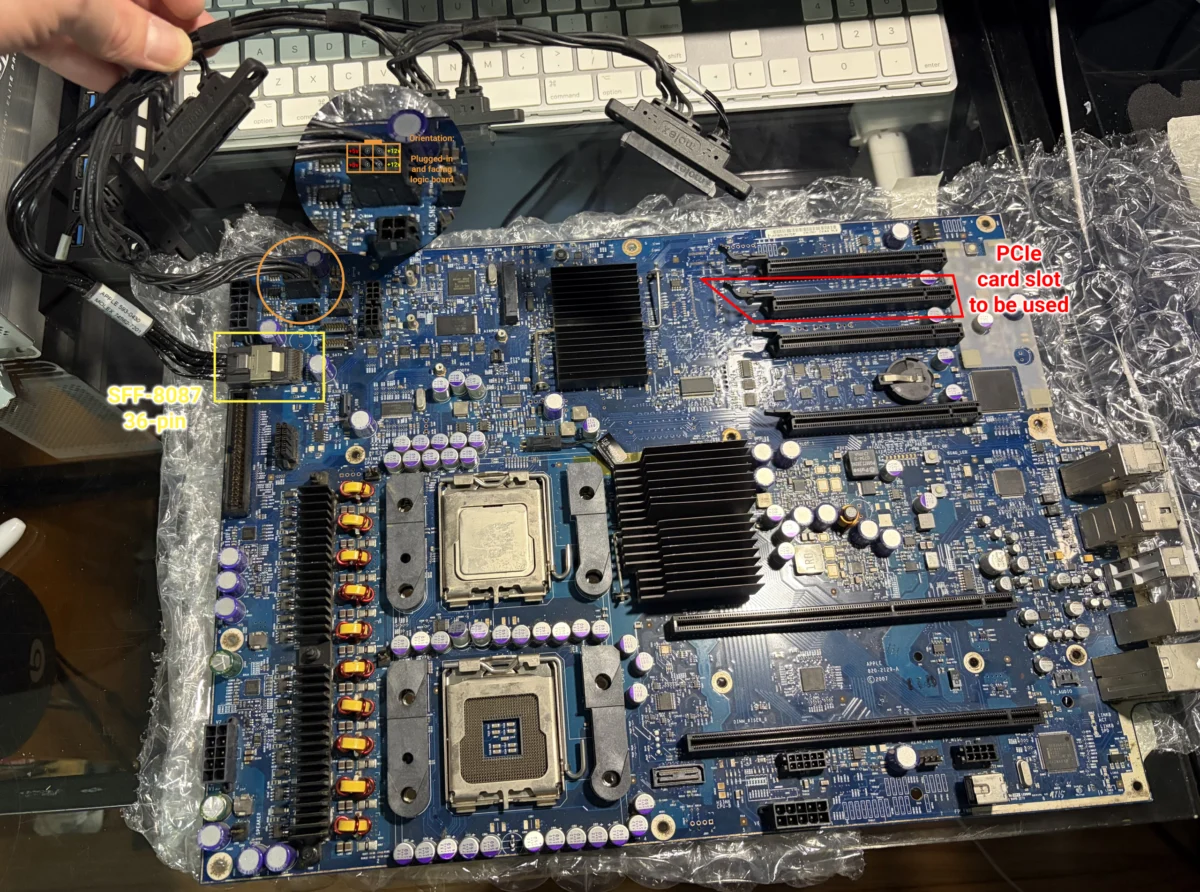
The classic Mac Pro 1,1 and 2,1, released between 2006 and 2007, remain iconic pieces of computing history, celebrated for their modularity and robust aluminum chassis. However, integrating modern storage solutions, such as high-performance PCIe RAID controllers, often presents significant hardware hurdles. A recent technical project has successfully demonstrated that users can circumvent the lack of proprietary cables by repurposing existing internal wiring harnesses to bridge the gap between legacy logic boards and modern storage interfaces like the RocketRAID 2720SGL. This development provides a viable path for enthusiasts looking to extend the utility of these aging workstations into the modern era of data-intensive tasks.
Context and Hardware Limitations
The Mac Pro 1,1 and 2,1 utilize a proprietary drive backplane and cabling system that was state-of-the-art for its time but lacks compatibility with modern SFF-8087 (Mini-SAS) interfaces commonly found on contemporary RAID cards. When attempting to install a HighPoint RocketRAID 2720SGL into the PCIe expansion slots of these machines, users face two primary obstacles: the physical reach of the Mini-SAS cables and the requirement for external power to the hard drive bays.

The standard Mac Pro drive bay wiring harness relies on a specific pinout configuration that is not natively compatible with third-party PCIe RAID controllers. Without an SFF-8087 to SATA/SAS cable, the card may be detected by the operating system, but the attached storage media will remain unpowered and inaccessible. This limitation historically forced users to purchase expensive, often proprietary adapter cables or abandon the upgrade project entirely.
Chronology of the Modification Process
The technical endeavor to bridge this gap began with a systematic evaluation of the internal chassis architecture. The project lead identified that the power connector for the drive bay backplane sits in close proximity to the logic board’s Mini-SAS interface, though the RAID controller card resides on the opposite side of the internal PCIe bus.
In the initial phase, the investigator analyzed the power connector pinout to determine how to draw stable voltage from the optical drive bay—a common source of auxiliary power in the Mac Pro tower. By utilizing a standard Molex adapter as a base, the technician performed a delicate hardware intervention. The pins were carefully extracted from the plastic housing, flattened using precision pliers, and then vertically segmented to fit into the Mac Pro’s mini 8-pin PCIe power connector.

To ensure electrical safety and system stability, the modified pins were encased within the plastic shell of an repurposed ASUS PCIe 6-to-8-pin adapter. This was necessary to prevent short circuits and ensure a snug connection within the crowded interior of the tower. The final assembly involved carefully sleeving the wires and routing them to ensure they did not interfere with the airflow or the mechanical integrity of the drive sleds.
Technical Data and Performance Metrics
The effectiveness of this modification was tested using a Corsair Force GT 240GB SSD installed in "Bay 4." Upon initialization, the system utilized a set of modified kexts (kernel extensions) to enable the RocketRAID 2720SGL within the OS X El Capitan environment.
Performance testing yielded promising results for a machine of this vintage. The system achieved read speeds of 477 MB/s and write speeds of 388 MB/s. These metrics represent a significant improvement over the performance of the native Apple RAID card and the machine’s onboard SATA II controllers, which were historically limited by the bandwidth constraints of the 2006-era architecture.

The RAID card demonstrated intelligent lane allocation, scaling its performance based on the hardware connected to it. While a single legacy hard drive might only register as utilizing a single PCIe lane, the inclusion of a high-speed SSD allowed the card to leverage eight lanes, maximizing the throughput of the PCIe 1.0/2.0 slots found on the Mac Pro 1,1/2,1 logic board.
Implications for Legacy Hardware Preservation
This project highlights a broader trend in the retro-computing community: the pursuit of "life extension" for high-end professional hardware that has been officially sunset by manufacturers. As Apple ceased software support for these machines years ago, the reliance on custom kexts and hardware modifications has become the primary method for maintaining functionality.
The ability to successfully integrate a high-bandwidth RAID controller suggests that these legacy towers can still serve as efficient file servers or media storage hubs. By repurposing existing wire harnesses rather than sourcing rare, original equipment manufacturer (OEM) cables, users can reduce electronic waste and lower the financial barrier to entry for retro-system upgrades.

However, the modification is not without risks. The use of manual wire modification—specifically the flattening and cutting of pins—requires a high degree of precision. Inadequate insulation or poor contact could lead to localized heat buildup or damage to the logic board’s power delivery circuit. Experts emphasize that while the current "clear tape" stabilization method used in this pilot project is functional, more robust, heat-resistant mounting solutions are recommended for long-term reliability.
Future Research and Development
Following the successful integration of the RAID card, the scope of the project has expanded to include questions regarding boot capabilities. A critical limitation for many legacy Mac Pro users is the ability to boot an operating system, such as OS X El Capitan, from a storage array managed by a third-party PCIe controller. The investigation is now shifting toward the viability of using open-source bootloaders, such as rEFIt or its successors, to bridge the firmware gap between the Mac Pro’s EFI and modern storage protocols.
Additionally, the project aims to address the aesthetic and structural "wire management" of the modified harnesses. Future iterations are expected to involve custom-sleeved cables and 3D-printed connectors, which would offer a more professional and reliable alternative to the temporary pin modifications used in the initial trial.

Summary of Findings
The modification of the Mac Pro 1,1/2,1 wiring harness serves as a case study in practical engineering. By understanding the underlying pinout and power requirements of the internal backplane, it is possible to achieve data throughput speeds that exceed the original specifications of the workstation.
As professional users and hobbyists continue to seek ways to maximize the value of their hardware, these DIY solutions serve as a testament to the enduring design of the early Mac Pro series. While modern cloud storage and high-speed NVMe drives have become the industry standard, there remains a dedicated cohort of users who find value in the expandability and tactile nature of these classic workstations. The success of this RAID controller implementation underscores that with enough technical ingenuity, the functional lifespan of even the most outdated equipment can be significantly extended.
This project also suggests that the limitation for these machines is not necessarily the processing power, but rather the bottlenecked storage interfaces. By upgrading the storage controller, the system’s responsiveness—even in tasks like file indexing and system booting—is vastly improved, effectively removing the "disk I/O" ceiling that plagued many early Mac Pro users during their original professional deployment. The next phase of development, focusing on native boot support, will be the final hurdle in determining whether these modified machines can function as truly autonomous, high-performance systems in a modern digital workflow.