Farhan hamdan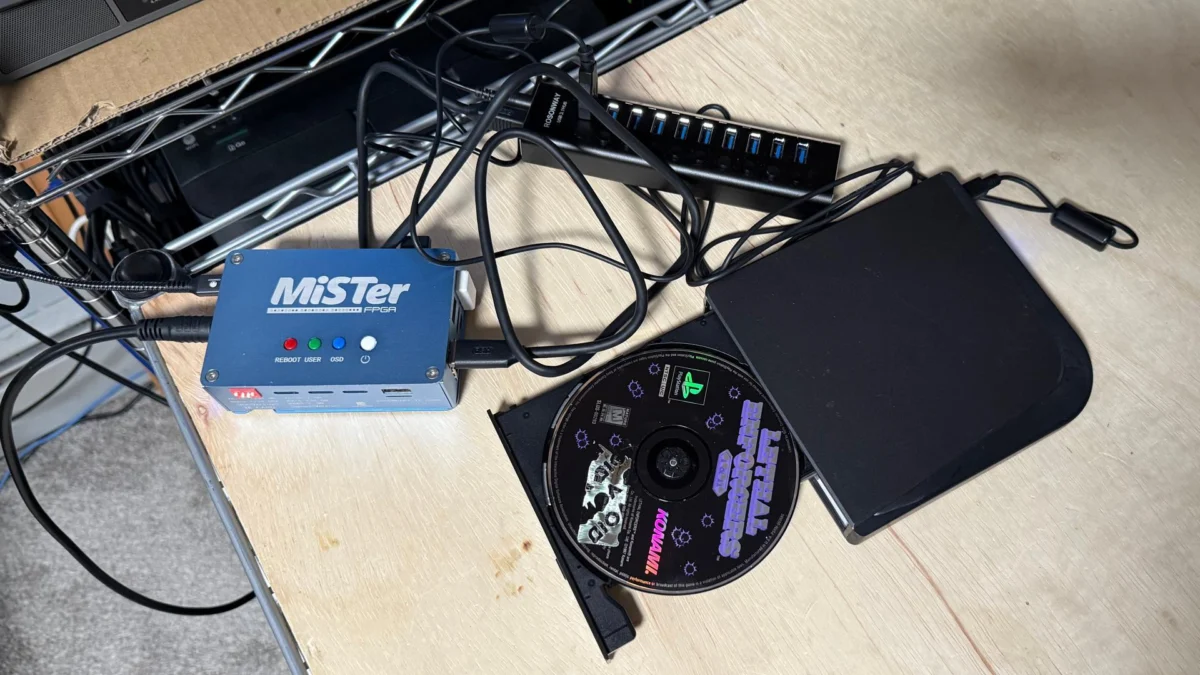
The highly acclaimed MiSTer FPGA project, a hardware-based emulation platform revered for its exceptional accuracy in replicating classic video game systems, has reached a significant new plateau with the integration of physical disc support. This groundbreaking development, spearheaded by the dedicated developer known as Anime0t4ku, now allows users to play original CD-ROM and CD-i media directly on their MiSTer devices for an expanding list of iconic consoles. The supported systems currently include the PlayStation, Sega CD, TurboGrafx-16 / PC Engine CD, Sega Saturn, and Philips CD-i cores, marking a pivotal moment for retro gaming enthusiasts seeking an authentic hardware experience combined with modern convenience.
Unveiling a New Era: The Core Achievement
The recent update fundamentally transforms the MiSTer experience, moving beyond the traditional reliance on digital ROMs and ISO files. Anime0t4ku’s work facilitates the connection of external optical drives, enabling the MiSTer to read physical game discs. This capability, long desired by a segment of the MiSTer community, means that players can now insert their original PlayStation game disc, their treasured Sega CD titles, or even the more obscure Philips CD-i software, and have them load directly through the MiSTer’s FPGA core, mimicking the behavior of the original console hardware.
Initial reports indicate that disc loading performance is robust, operating at or near full-speed, contingent upon the condition of both the optical drive and the physical media itself. This level of fidelity and functionality underscores the technical prowess involved in bridging the gap between physical optical media and the MiSTer’s FPGA architecture. The developer has made the necessary files and instructions publicly available through a GitHub repository, while also maintaining a Patreon for community support and continued development.
The MiSTer FPGA Ecosystem: A Foundation of Accuracy
To fully appreciate the significance of physical disc support, it is crucial to understand the MiSTer FPGA project itself. MiSTer stands for "MiSTer is System-on-a-chip," a reference to its origins from the MiST project. It leverages Field-Programmable Gate Array (FPGA) technology, a hardware-centric approach to recreating vintage gaming systems. Unlike software emulation, which simulates original hardware through code running on a modern CPU, FPGA reconfigures a specialized chip to become the original hardware at a transistor level. This distinction is critical for retro gaming purists.
-
Understanding FPGA Technology: FPGA chips are essentially blank slates that can be programmed to mimic the exact logic gates and circuitry of another chip, such as the CPU, GPU, and sound chips of a classic console. This "re-creation" at the hardware level results in near-perfect accuracy, eliminating the input lag, timing inconsistencies, and graphical glitches that can sometimes plague software emulation. The MiSTer FPGA aims for cycle-accurate emulation, meaning it replicates the original system’s behavior down to the precise clock cycles, offering an experience indistinguishable from the original hardware for most users.
-
MiSTer’s Ascendancy in Retro Gaming: Since its inception, the MiSTer project has steadily grown in popularity, becoming a formidable contender in the retro gaming scene. Its open-source nature, coupled with a dedicated community of developers, has led to the creation of high-quality cores for dozens of classic arcade and home console systems, ranging from the NES and SNES to the Neo Geo and Sega Genesis. Its modular design, allowing for various add-on boards (like the I/O board for original controller ports or the SDRAM module for specific core requirements), further enhances its versatility. The ability to run games with minimal latency, output at native resolutions, and apply various video filters has cemented its reputation as a premium solution for experiencing retro games.
Technical Implementation: Bridging Physical and Digital
The process of integrating physical disc support involved intricate engineering challenges. Optical drives, especially older ones, can be particular about power delivery and data transfer. Anime0t4ku’s solution is designed for broad compatibility, generally working with most external optical drives.
-
Installation and Configuration: The installation process is designed to be straightforward for existing MiSTer users. It involves downloading a compressed file from the provided GitHub link, extracting its contents to the MiSTer’s MicroSD card, and then adding a specific line of code (
[CD-*] main=MiSTer_Physical-CD) to theMiSTer.iniconfiguration file. Upon rebooting, a new directory titled "Physical Disc Cores" appears, containing the necessary files to launch the disc-enabled cores. Users can then simply insert their physical game discs either before or after launching the core, mirroring the user experience of an original console. This simplicity of integration is a testament to the thoughtful design behind the project. -
Hardware Compatibility and Performance: While the system is designed to be highly compatible, certain hardware considerations are notable. Slimline optical drives, which often draw power solely from the USB connection, may require a powered USB hub to function reliably. This is due to the potential for insufficient power delivery from the MiSTer itself, especially when combined with other peripherals. Older, less efficient drives might also exhibit minor performance issues, such as stuttering during data loading. However, using a modern, quality optical drive is expected to yield optimal performance, matching the smooth operation demonstrated by Anime0t4ku in their initial showcases. Factors such as the MiSTer I/O board and the overall power supply unit (PSU) also play a role in ensuring stable operation. The flexibility to use a powered hub provides a practical workaround for potential power-related challenges.
-
The Ingenuity of Core Integration: A particularly intelligent aspect of this implementation is its modularity. For most supported systems, Anime0t4ku has avoided forking existing MiSTer cores. Instead, the physical disc support utilizes
.mglfiles within the new "Physical Disc Cores" directory. This approach allows the system to leverage the established and continuously updated main cores for each console, rather than requiring Anime0t4ku to maintain separate, potentially divergent versions of each core. This design choice is beneficial for the entire MiSTer ecosystem, ensuring that physical disc support remains compatible with future core updates without creating additional maintenance burdens. The Philips CD-i core is a temporary exception, currently requiring its own fork, but the long-term goal is to integrate it similarly to the other cores.
A Chronology of Innovation and Anticipation
The MiSTer project has always been characterized by continuous evolution. From its humble beginnings to its current robust state, each major update has pushed the boundaries of what is possible with FPGA technology in the retro gaming context. The addition of physical disc support fits perfectly within this narrative of relentless innovation.
-
The Journey to Physical Disc Support: For years, the MiSTer community has discussed and dreamed of native physical disc support. While playing disc-based games via ISO files has been standard, the ability to use original media adds a layer of authenticity that many purists crave. The technical hurdles were significant, involving complex interactions between the MiSTer’s Linux operating system, its FPGA cores, and external USB hardware. Anime0t4ku’s dedicated efforts represent the culmination of considerable research, development, and problem-solving, bringing this long-sought feature to fruition. This development wasn’t an overnight success but the result of iterative improvements and a deep understanding of the MiSTer’s architecture.
-
The "SuperStation One" Benchmark: A notable, and somewhat humorous, aspect of this release is its timing relative to other anticipated projects. The MiSTer’s physical disc support has, in effect, "beaten" the official SuperStation One disc loading solution to market. The SuperStation One is a separate hardware project aiming to enhance the PlayStation experience, and its own disc loading capabilities have been a subject of much anticipation. Anime0t4ku’s demonstration of their solution even working seamlessly with the SuperDock, a popular MiSTer add-on, further highlighted the robustness and compatibility of their work. This competitive, yet ultimately beneficial, race to innovate underscores the dynamic nature of the retro gaming hardware scene. It suggests that collaborative efforts among open-source developers could potentially lead to even more refined and universal disc loading solutions in the future.
Community Reaction and Broader Implications
The announcement of physical disc support has been met with widespread excitement and commendation across the retro gaming community, particularly among MiSTer enthusiasts.
-
Enthusiastic Reception from the Retro Gaming Community: The immediate reaction has been overwhelmingly positive. Users have expressed delight at the prospect of dusting off their original game collections and experiencing them on the MiSTer. This feature appeals directly to collectors and purists who prioritize using original media, adding another layer of authenticity to the already highly accurate FPGA platform. Forums and social media platforms are abuzz with users sharing their experiences, troubleshooting minor issues, and praising Anime0t4ku’s contribution. The ability to bypass the often-cumbersome process of ripping discs to ISOs, or the ethical debates surrounding ROM acquisition, also resonates with a significant portion of the community.
-
Impact on Game Preservation and Authenticity: From a game preservation standpoint, this development is highly significant. While digital archives of disc images are crucial, the ability to directly interact with physical media on modern, accurate hardware offers a new dimension to preservation. It ensures that the experience of using original discs – including their unique loading times, audio tracks, and potential copy protection schemes – can be accurately replicated and studied. This adds an important layer of historical fidelity, allowing researchers and enthusiasts to interact with games as they were originally intended, rather than solely relying on digital copies that may introduce subtle alterations. It also validates the ongoing relevance of physical media in an increasingly digital world.
-
Economic and Market Considerations: The introduction of physical disc support could have several implications for the retro gaming market. It may increase the adoption rate of the MiSTer FPGA, attracting a new segment of users who previously hesitated due to the lack of physical media compatibility. This could, in turn, drive demand for MiSTer hardware and its various accessories. Furthermore, it might subtly influence the market for retro game discs, potentially increasing the desirability of complete-in-box (CIB) games, as their utility on accurate modern hardware is enhanced. The demand for external optical drives, especially reliable and high-quality models, may also see a modest uptick as users seek to optimize their physical disc experience.
The Road Ahead: Continuous Development and Collaboration
Anime0t4ku’s project is not a static release but an ongoing endeavor. The developer is committed to continuously updating the project, aiming to further refine disc loading speeds, enhance compatibility, and expand support to even more disc-based cores as they become available on the MiSTer platform.
The open-source nature of the MiSTer project, including this new physical disc support, fosters a collaborative environment. There is potential for other developers to contribute to the project, perhaps optimizing code, addressing specific drive compatibility issues, or even integrating new features. The idea that efforts could eventually be combined with other initiatives, such as the SuperStation One’s disc loading, to create a universally refined solution, is an exciting prospect for the future of retro gaming hardware. For now, Anime0t4ku’s work stands as the leading and most accessible solution for playing physical disc-based games on the MiSTer FPGA.
In conclusion, the integration of physical disc support into the MiSTer FPGA project represents a monumental achievement. It not only enhances the platform’s already impressive capabilities but also reinforces its position as a premier solution for authentic retro gaming. By bridging the gap between original physical media and cutting-edge FPGA hardware, Anime0t4ku has delivered a feature that will resonate deeply with retro gaming enthusiasts, contributing significantly to the preservation and enjoyment of classic video game history.