Johny Imanuel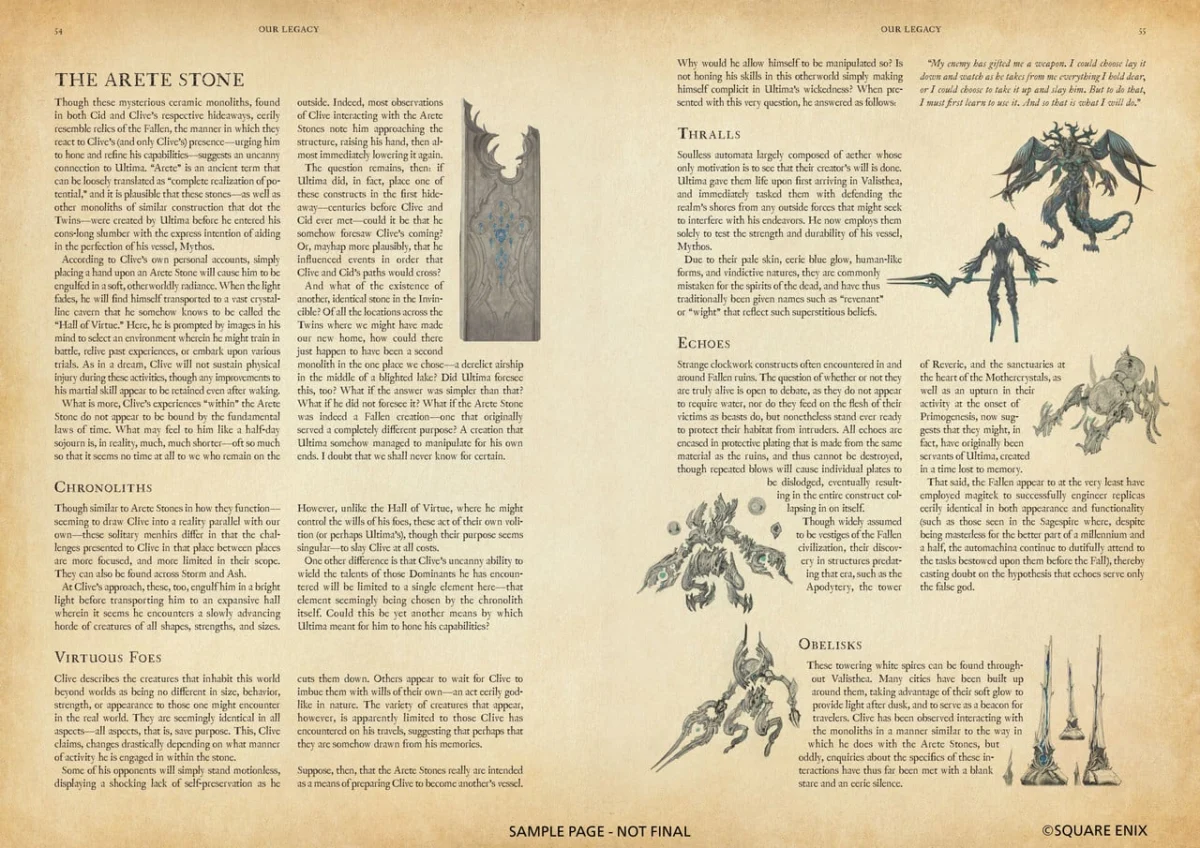
The literary expansion of the Valisthean universe has reached a significant milestone with the release of LOGOS: The World of Final Fantasy XVI, a comprehensive lore book that departs from the traditional structure of video game reference materials. Published by Square Enix, this 368-page hardcover volume represents a shift in how the developer approaches supplemental storytelling. While previous entries in the long-running franchise often utilized the "Ultimania" format—a mixture of strategy guide, art book, and technical encyclopedia—LOGOS adopts a diegetic approach, presenting its contents as an in-universe historical archive compiled by the scholar Harpocrates II Hyperboreos. This methodological shift transforms the book from a mere collection of development notes into a functional artifact of the game’s world, offering a depth of immersion that aligns with the mature, narrative-heavy themes of Final Fantasy XVI.
A Diegetic Approach to World-Building
The defining characteristic of LOGOS: The World of Final Fantasy XVI is its commitment to the perspective of Harpocrates, the keeper of "The Thousand Tomes" within the game. In the digital experience of Final Fantasy XVI, players interact with Harpocrates at the Hideaway to unlock entries regarding the people, places, and history of Valisthea. As Clive Rosfield progresses through the narrative, the scholar’s records expand, reflecting the player’s discoveries. The physical LOGOS volume acts as a tangible extension of this mechanic.
By framing the text as the work of an in-universe historian, Square Enix has moved away from the objective, third-person tone typical of Japanese gaming encyclopedias. Instead, the book utilizes a narrative voice that reflects the biases, scholarly curiosities, and cultural nuances of Valisthea itself. This choice enhances the "Active Time Lore" system—a feature lauded upon the game’s release for its ability to provide immediate context during cutscenes—by providing a "Deep Time" perspective on the continent’s centuries-old conflicts and mythologies.
Content Breakdown and New Information
One of the most striking revelations regarding LOGOS is the volume of original material it contains. According to Michael-Christopher Koji Fox, the Localization Director for Final Fantasy XVI, over 90% of the content in the book is entirely new. While the book draws upon the established canon and facts presented during Clive’s journey, it does not merely transcribe the text found in the game’s internal menus. Instead, the creative team, including Creative Director Kazutoyo Maehiro and Translator John Taylor, collaborated to expand upon the foundations of the setting.
The book is structured into several distinct thematic sections:
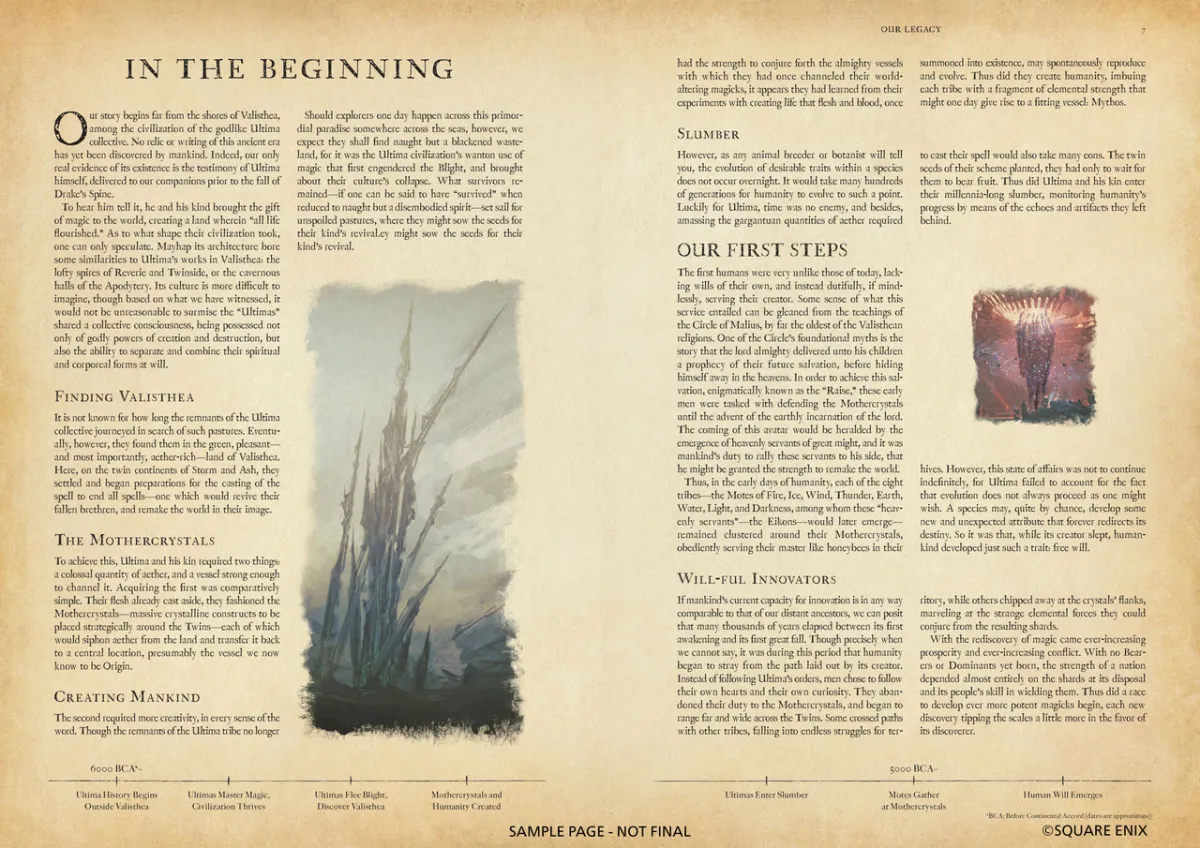
In the Beginning: Myth and Prehistory
This section serves as a factual text that doubles as a creation myth. It details the arrival of the entity known as Ultima and the subsequent establishment of the Mothercrystals—massive sources of aether that dictated the geopolitical boundaries of Valisthea. By presenting this information through the lens of a historical archive, the book clarifies the origins of the "Blight" and the cyclical nature of the world’s history in a way that the game’s main campaign often left to environmental storytelling and subtext.
The Dominants: Biographical Archives
Rather than providing standard character profiles found in promotional materials, LOGOS presents the Dominants—individuals capable of channeling the power of Eikons—through brief, formal biographies. These entries examine the political impact of figures like Cidolfus Telamon, Benedikta Harman, and Barnabas Tharmr, treating them as historical actors rather than just combatants. This section provides necessary context regarding the "Curse of the Dominants" and the varying ways different nations treated these powerful individuals, ranging from worship to enslavement.
Our Home: A Cultural and Geographical Guide
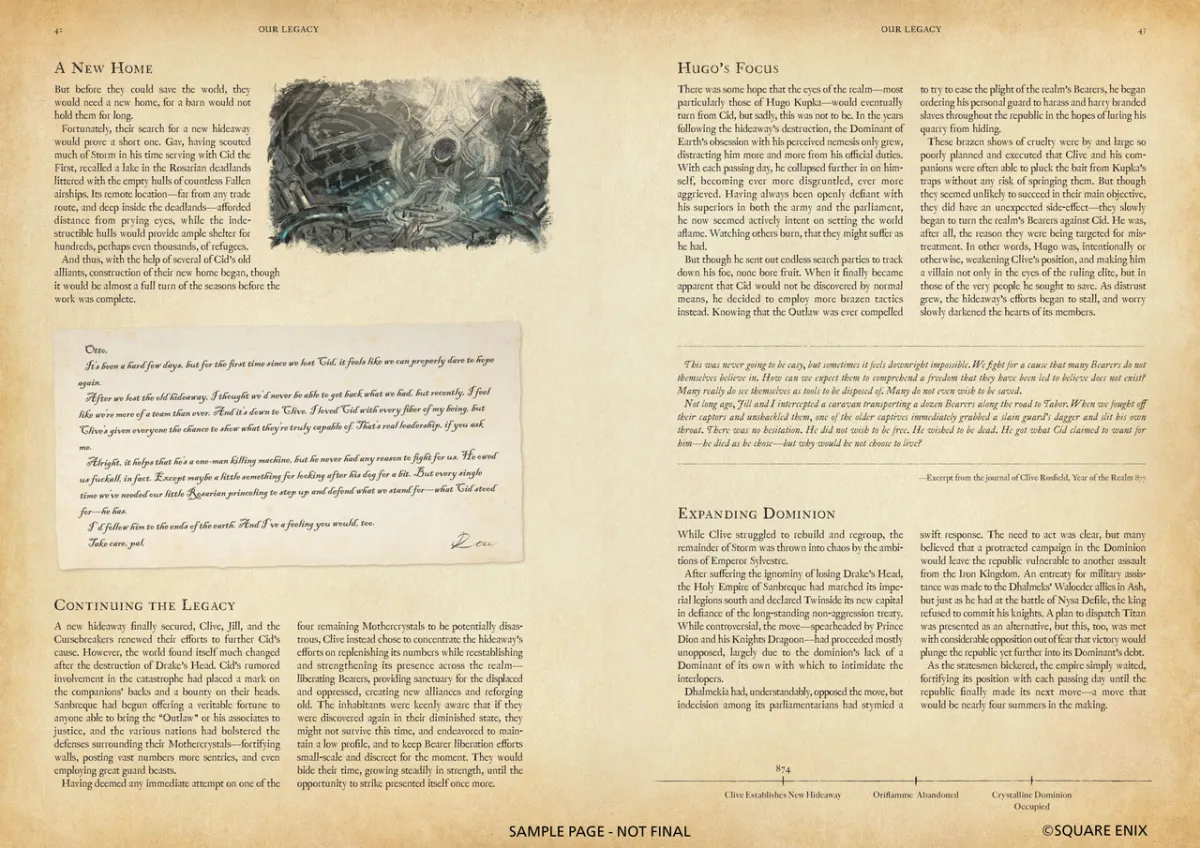
The "Our Home" portion of the book functions similarly to a high-level travel or cultural guide. It explores the Grand Duchy of Rosaria, the Holy Empire of Sanbreque, the Kingdom of Waloed, the Dhalmekian Republic, and the Iron Kingdom. These entries go beyond geographical descriptions, delving into the social hierarchies, local customs, and economies of each region. For example, the inclusion of the musical notation for the anthem of the Grand Duchy of Rosaria provides a layer of cultural texture that reinforces the "period-accurate" feel of the setting.
Production Value and Aesthetic Design
Square Enix has positioned LOGOS as a premium collector’s item, emphasizing its physical presence as much as its literary content. The 368-page volume is bound in a hardcover format designed to look antique and weathered, mimicking the appearance of a tome one might find in a medieval scriptorium or Harpocrates’ own library.
The art direction follows a "period piece" philosophy. While standard art books often feature clean digital renders and concept sketches, LOGOS utilizes character portraits, landscapes, and depictions of monsters that feel like hand-drawn illustrations from a historical manuscript. This aesthetic consistency ensures that the book serves as an extension of the game’s visual identity—a world defined by the "dirty fantasy" aesthetic and a sense of encroaching decay.
Chronology of the Final Fantasy XVI Expanded Universe
The release of LOGOS: The World of Final Fantasy XVI marks a pivotal point in the post-launch lifecycle of the title. To understand its significance, one must look at the timeline of the game’s expansion:
- June 22, 2023: Final Fantasy XVI launches on PlayStation 5, introducing the "Active Time Lore" and "The Thousand Tomes" systems.
- December 2023: The first DLC, Echoes of the Fallen, is released, expanding on the lore of the "Fallen" civilization.
- April 2024: The second DLC, The Rising Tide, launches, introducing the Eikon Leviathan and the hidden land of Mysidia.
- September 17, 2024: Final Fantasy XVI is released on PC and Xbox Series X|S, bringing the narrative to a wider audience.
- Late 2024 / Early 2025: LOGOS: The World of Final Fantasy XVI is released globally, incorporating lore from both the base game and its expansions.
This timeline suggests a coordinated effort by Creative Business Unit III to ensure that the lore book serves as the definitive final word on the Valisthean era, arriving only after all mechanical and narrative additions to the game were finalized.
Official Responses and Creative Intent
The involvement of key development staff underscores the importance Square Enix placed on this publication. Localization Director Michael-Christopher Koji Fox has been vocal about the book’s intent to reward players who sought a deeper understanding of the world’s mechanics. In promotional statements, the team emphasized that LOGOS was designed to bridge the gap between the game’s script and the vast "internal bible" created during the early stages of development.
Creative Director Kazutoyo Maehiro, known for his intricate world-building in Final Fantasy XIV and Final Fantasy Tactics, was instrumental in ensuring that the new 90% of content remained consistent with the game’s complex political landscape. The goal was to provide a "vertical slice" of Valisthean history that felt lived-in and logical, adhering to the rules of aether and magic established in the game’s engine.
Broader Impact and Implications for the Franchise
The success and reception of LOGOS: The World of Final Fantasy XVI may signal a change in how Square Enix handles its supplemental materials for future mainline entries. Historically, Western fans had to wait years for translated "Ultimania" books, or rely on fan translations that often lacked the nuance of the original Japanese text. By releasing a lore-heavy, high-quality volume like LOGOS globally and in close proximity to the game’s multi-platform launch, Square Enix is acknowledging the global appetite for deep narrative immersion.
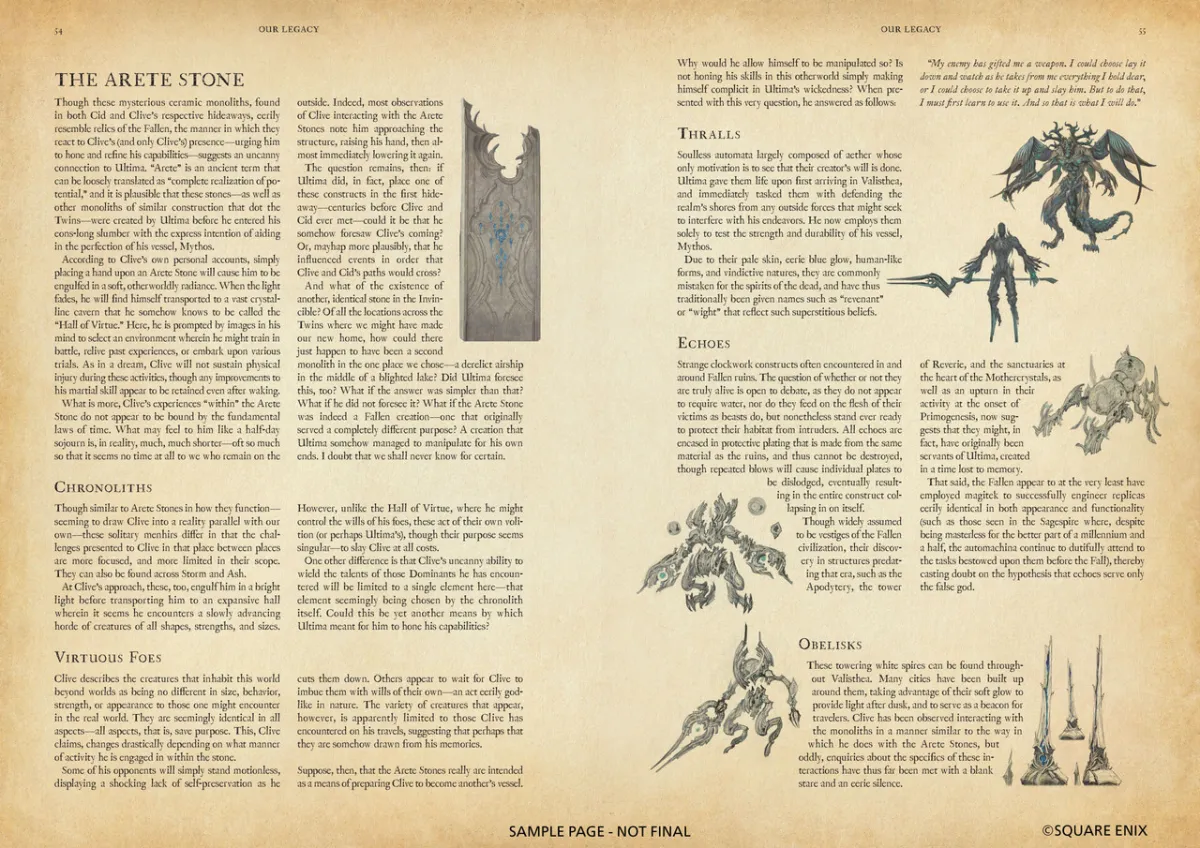
Furthermore, the "in-universe" writing style sets a new standard for the industry. While other franchises like The Elder Scrolls or The Witcher have experimented with in-world journals, the scale of LOGOS—combined with the direct involvement of the game’s core writers—elevates it to a primary source of canon. It moves the conversation away from "what happened during development" toward "what is the truth of this world," a distinction that resonates strongly with the "lore-hunting" community that has grown around modern RPGs.
Conclusion
LOGOS: The World of Final Fantasy XVI stands as more than a companion piece; it is a meticulously crafted historical document that enriches the player’s understanding of Valisthea. By leveraging the perspective of Harpocrates and committing to a vast amount of new, canon-expanding material, Square Enix has provided a blueprint for how video game lore can be preserved and presented. As the game continues to find new audiences on PC and Xbox platforms, this volume serves as an essential guide for those looking to look beyond the fires of Eikonic battle and into the heart of a world defined by its history, its struggles, and its eventual rebirth. Through its 368 pages, the book ensures that while the Mothercrystals may have faded, the legacy of Valisthea remains documented for posterity.