Jia Lissa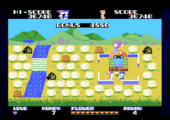
The game places players in the role of Papri, a young girl who must navigate a series of environments to collect flowers for her love interest, Minto. The narrative stakes are established through a visual timer: Minto is shown walking toward another girl, Cocco, and the player must complete their task before he reaches her. This early use of a visual, character-driven narrative device was sophisticated for the era, moving beyond the abstract countdown timers found in contemporary titles. The game’s technical execution, particularly its use of the SG-1000’s limited hardware, demonstrated a level of polish that would define Sega’s internal development standards for decades to come.
Historical Context and the Rise of Yuji Naka
To understand the significance of Girl’s Garden, one must examine the state of the Japanese video game industry in 1984. Sega had launched the SG-1000 in 1983, the same day Nintendo released the Famicom. While the Famicom eventually dominated the market, the SG-1000 served as a critical learning ground for Sega’s software engineers. Yuji Naka joined Sega in 1984 and was tasked with creating a game that could capture a "non-traditional" gaming audience.
According to archival interviews, Naka spent approximately five months developing the game alongside Hiroshi Kawaguchi, who served as a programmer before finding fame as the legendary composer for hits like Space Harrier and Out Run. The development of Girl’s Garden was essentially a training project that exceeded expectations. Sega management was reportedly so impressed by the prototype’s visual fidelity and playability that they transitioned it from a training exercise into a full commercial release. This decision validated Naka’s technical prowess, specifically his ability to extract performance from the Texas Instruments TMS9918A Video Display Processor (VDP) that powered the SG-1000.
Gameplay Mechanics and Narrative Innovation
The core gameplay of Girl’s Garden involves a strategic collection of floral bouquets. Players must gather exactly ten flowers to advance the stage and win Minto’s affection. However, the mechanic is complicated by a biological growth cycle. Each flower cycles through six distinct frames of animation; Papri can only harvest a flower when it is in full bloom. If she attempts to pick a wilted flower, she is penalized with the loss of half her current inventory.
The primary antagonists are bears that patrol the garden. These enemies introduce a layer of survival horror elements to the otherwise pastoral setting. Papri is defenseless against direct contact with the bears, but she can deploy honey pots—a limited resource—to distract them. This creates a resource management loop where the player must balance the speed of flower collection against the depletion of honey. The environmental hazards extend to water bodies and bees, the latter of which can drop either beneficial items, such as extra lives and full bouquets, or detrimental items like skulls that cause immediate death.
The game’s progression system is structured around increasing environmental complexity. As players advance, the layout of Minto’s yard becomes more treacherous, featuring more water hazards and narrower pathways that limit movement options when evading bears. This escalation of difficulty ensured that despite its "cute" aesthetic, Girl’s Garden provided a challenge comparable to the arcade-style games of the era.
Technical Milestones on the SG-1000
From a technical standpoint, Girl’s Garden is often cited as one of the most advanced titles on the SG-1000. The hardware was notoriously limited, capable of displaying only 16 colors with significant restrictions on sprite placement. The SG-1000 lacked a hardware-based scrolling feature, a common limitation of the TMS9918A chip. Despite this, Naka and his team implemented a form of parallax scrolling, a technique where background elements move at different speeds to create an illusion of depth.
This was achieved through clever manipulation of the background tiles. While the scrolling is noticeably "choppy" compared to later 8-bit systems, the presence of moving clouds, shifting mountain ranges, and varying foreground grass tufts was a revelation for SG-1000 owners. Furthermore, the game utilized the "Magnified Sprite" mode of the VDP during its "Challenging Stage." This bonus round features oversized versions of Papri and the bears, demonstrating the system’s ability to handle larger, more detailed character assets without the typical flickering associated with sprite-heavy scenes.
The visual presentation also benefited from sophisticated color layering. To bypass the single-color-per-sprite limitation, the developers overlaid multiple sprites to create multi-colored characters, such as Papri with her pink hair and dress. This technique required precise timing to avoid the horizontal sprite limit, which would cause parts of the character to disappear.
Audio Composition and Aesthetic Polish
The soundtrack of Girl’s Garden, contributed to by Tohru Nakabayashi and Katsuhiro Hayashi, provided a level of auditory variety rarely heard on the SG-1000’s SN76489 Programmable Sound Generator. The game features distinct themes for the main gameplay, the challenging stages, and various victory jingles. Notably, the game includes a digital rendition of Felix Mendelssohn’s "Wedding March" to signify the successful completion of a level.
The aesthetic polish extended to character animations. Unlike many contemporary games where a "death" resulted in a simple sprite flicker or disappearance, Girl’s Garden featured a unique animation for Papri bursting into tears upon being caught by a bear. These small touches added a layer of personality and emotional weight to the gameplay, further aligning the title with its goal of appealing to a broader, more character-focused audience.
Market Reception and Legacy
While Girl’s Garden did not achieve the massive commercial success of later Sega franchises, its impact on the company’s internal culture was profound. It established a precedent for "blue sky" game design—bright, colorful, and optimistic—that would become a hallmark of Sega’s identity throughout the 1980s and 1990s. The game also proved that the SG-1000 could produce high-quality original software, rather than just ports of existing arcade titles.
The game’s legacy is inextricably linked to the career of Yuji Naka. Many of the technical tricks used to simulate speed and depth in Girl’s Garden would be refined in his later work on Phantasy Star and Sonic the Hedgehog. In a 1998 interview, Naka reflected on the project, noting that the constraints of the SG-1000 forced him to become a more creative programmer, a mindset that directly led to the development of the "Sonic" engine on the Mega Drive/Genesis.
Modern Availability and Preservation
For modern audiences, experiencing Girl’s Garden in its original format can be challenging due to the rarity of the SG-1000 hardware and the original cartridge. However, the game has been preserved through several official re-releases. It is compatible with the Sega Mark III and the Master System, though the color palette appears slightly darker on the latter due to differences in video output hardware.
In 2016, Sega included Girl’s Garden as a hidden bonus in the Nintendo 3DS compilation, Sega 3D Reprint Archives 3: Final Stage. Unlocking the game required the player to have save data from the two previous volumes in the series, making it a "prestige" unlockable for dedicated Sega fans. This inclusion signaled Sega’s recognition of the game as a foundational piece of their corporate history.
Broader Industry Implications
Girl’s Garden serves as an early example of targeted demographic marketing in the video game industry. By consciously designing a game for girls, Sega acknowledged the potential for market expansion beyond the "hardcore" arcade audience. While the game’s premise—a girl competing for a boy’s affection—reflects the gender tropes of the 1980s, the technical sophistication of the software treated its target audience with respect, offering a deep and challenging experience rather than "shovelware."
In conclusion, Girl’s Garden remains a landmark title for the SG-1000. It pushed the boundaries of early 8-bit hardware, launched the careers of legendary developers, and helped define the creative philosophy of one of the world’s most influential gaming companies. Its blend of charming aesthetics, innovative technical solutions, and character-driven gameplay ensures its place in the annals of video game history as more than just a footnote, but as the garden where the seeds of Sega’s future greatness were first planted.