
 Jia Lissa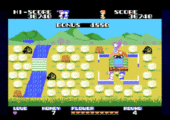
Development History and the Emergence of Yuji Naka
The genesis of Girl’s Garden is closely tied to the early career of Yuji Naka, who joined Sega in 1984. At the time, Sega’s management, recognizing the male-dominated nature of the gaming audience, tasked Naka and his small team with creating a product that would resonate with girls. This directive resulted in a game that emphasized non-violent objectives, vibrant aesthetics, and a narrative centered on romantic pursuit.
Working alongside Naka was Hiroshi Kawaguchi, who would eventually become one of Sega’s most celebrated composers, known for his work on arcade classics such as Space Harrier, Out Run, and After Burner. On Girl’s Garden, however, Kawaguchi served primarily as a programmer. The collaborative effort between Naka and Kawaguchi resulted in a product that pushed the SG-1000 hardware to its absolute limits. The development process was reportedly rigorous, as the team sought to implement visual features that were considered advanced for the system’s Texas Instruments TMS9918 video display processor. Upon completion, Sega executives were reportedly so impressed by the polish and technical sophistication of the project that they transitioned it from a training exercise into a full commercial release.
Narrative Premise and Gameplay Mechanics
The gameplay of Girl’s Garden centers on a protagonist named Papri, a young girl with pink hair and a matching dress. The player’s objective is to navigate a series of outdoor environments to collect a bouquet of exactly ten flowers. These flowers are intended as a gift for Minto, a boy for whom Papri has an unrequited affection. The central tension of the game is provided by a rival character, Cocco, who is also vying for Minto’s attention.
The game employs a visual timer in the form of a "love meter" at the top of the screen. This meter depicts Minto walking away from Papri and toward Cocco. If Minto reaches Cocco before Papri can deliver the flowers, the round is lost. This mechanic serves as a sophisticated thematic integration of traditional time-limit systems, reinforcing the game’s narrative stakes through visual storytelling.
The collection of flowers is governed by a strict set of rules. Flowers undergo a six-frame blooming cycle. Players must harvest the flowers only when they are in full bloom (the fourth frame of the cycle). If Papri picks a flower that has begun to wilt, she is penalized by losing half of her currently held bouquet. This requirement for timing and precision elevates the game from a simple "collect-athon" to a strategic action title requiring pattern recognition and patience.
Technical Innovations and Hardware Constraints
From a technical perspective, Girl’s Garden is frequently cited by historians as one of the most visually impressive titles on the SG-1000. The system was notoriously limited, capable of displaying only a single color per sprite and suffering from significant flicker when multiple sprites occupied the same horizontal scanline. To circumvent these limitations, the development team utilized clever background manipulation and sprite layering.
One of the most notable technical achievements in Girl’s Garden is the implementation of parallax scrolling. By shifting different layers of the background—the clouds, the distant mountains, and the foreground grass—at varying speeds, the game creates an illusion of depth that was rarely seen on 8-bit consoles of that era. While the scrolling is somewhat staggered due to the background-tile-based nature of the effect, it represented a significant leap over the static or single-plane scrolling found in most SG-1000 titles.
Furthermore, the game features a "Challenging Stage" every two rounds. In this mode, the system utilizes a specialized hardware setting to display sprites at four times their standard size. This stage requires Papri to jump over waves of oncoming bears, testing the player’s reflexes and understanding of the game’s hitboxes. Yuji Naka has noted in retrospective interviews that the difficulty of these stages increases significantly, eventually requiring players to utilize the edges of the screen to "wrap around" and avoid obstacles—a technique that would become a staple in many later Sega titles.
Environmental Hazards and AI Behavior
The primary antagonists in Girl’s Garden are bears that roam Minto’s property. These bears follow distinct AI patterns, chasing Papri if she enters their line of sight. The environment itself acts as both a tool and a hindrance; while Papri can be trapped by water hazards or rocks, the bears are also restricted by these background tiles.
To mitigate the bear threat, players can collect and deploy honey pots. When a honey pot is dropped, any bears on the screen will abandon their pursuit of Papri to consume the honey, providing a brief window of safety. Additionally, bees occasionally fly across the screen, dropping items that can either assist or harm the player. These items include:
- Hearts: Granting extra lives.
- Full Bouquets: Immediately completing the flower collection requirement.
- Fruit: Providing bonus points.
- Skulls: Causing immediate loss of a life if touched.
The dynamic interaction between the player, the bears, and the randomly dropped items creates a layer of emergent gameplay that was sophisticated for 1985. The penalty for "death"—whether by bear contact or falling into water—is the loss of one life and half of the collected flowers, necessitating a careful balance between speed and caution.
Audio and Aesthetic Presentation
The soundtrack of Girl’s Garden, composed by Tohru Nakabayashi and Katsuhiro Hayashi, is noted for its variety and charm. Unlike many early console games that relied on a single looping track, Girl’s Garden features distinct melodies for the main stages, the challenging stages, and various victory jingles. Upon the successful delivery of the flowers to Minto, the game plays a digitized rendition of Felix Mendelssohn’s "Wedding March," providing a definitive sense of resolution to the player’s efforts.
Visually, the game utilizes the SG-1000’s 16-color palette to create a bright, inviting world. The title screen is particularly detailed, featuring a house with smoke billowing from the chimney—the smoke itself cleverly forming the game’s title. The use of overlapping sprites to create multi-colored characters, while prone to flickering, demonstrates the developers’ commitment to high production values.
Chronology of Releases and Legacy
Following its initial release on the SG-1000, Girl’s Garden remained a relatively obscure piece of Sega history for several years, primarily due to the SG-1000’s limited success outside of Japan. However, as Yuji Naka’s profile rose following the success of the Sonic the Hedgehog franchise on the Genesis/Mega Drive, interest in his debut work surged among collectors and historians.
Key milestones in the game’s history include:
- 1984/1985: Initial release on the SG-1000.
- 1985: Compatibility with the Sega Mark III (the Japanese predecessor to the Master System), though the game’s colors appeared darker on the newer hardware due to palette differences.
- 2016: The game was included in the "Sega 3D Reprint Archives 3: Final Stage" for the Nintendo 3DS in Japan. To unlock Girl’s Garden, players were required to have save data from the previous two volumes of the archives, making it a "hidden" bonus for dedicated fans.
The game is now recognized as a precursor to the "kawaii" (cute) aesthetic that would become a staple of Japanese gaming. It also serves as an early example of Sega’s willingness to experiment with genres and target audiences. While the game was not a massive commercial blockbuster, its influence is felt in the polished, character-driven titles that would eventually define Sega’s golden age in the late 80s and early 90s.
Analysis of Implications
The release of Girl’s Garden marked a pivotal moment for Sega Enterprises. It proved that the company could develop high-quality, original IP for the home market rather than simply porting its arcade hits. By allowing a novice programmer like Yuji Naka to take the lead on a project, Sega established a culture of internal talent cultivation that would eventually produce some of the industry’s most influential designers.
Furthermore, the game’s focus on a female protagonist and a non-combative goal was ahead of its time. In an era where the "damsel in distress" trope was the industry standard, Girl’s Garden reversed the roles, placing the female character in the role of the active pursuer. This design choice, combined with the technical excellence of the parallax scrolling and sprite management, ensures that Girl’s Garden remains a significant subject of study for those interested in the evolution of game design and the history of the Sega Corporation.








