
 Jia Lissa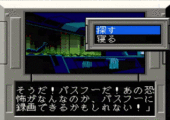
Historical Context and Development Background
The early 1990s marked a pivotal moment for the Japanese animation industry and its intersection with the burgeoning video game market. Detonator Orgun was originally conceived as an OVA project directed by Masami Ōbari, a figure renowned for his distinctively stylized mecha designs and kinetic action sequences. The OVA series was a spiritual successor to the Gall Force and Bubblegum Crisis era of science fiction, blending "mecha-knight" aesthetics with high-concept biological engineering themes.
Hot-B Co. Ltd., the publisher responsible for the Mega CD adaptation, was an established player in the 8-bit and 16-bit eras, known for diverse titles such as the shoot-’em-up Steel Empire and the RPG Inindo: Way of the Ninja. By 1992, the Sega Mega CD (known as the Sega CD in North America) was marketed as a premium peripheral capable of delivering "cinematic" experiences that the base Mega Drive hardware could not achieve. The development of Detonator Orgun was intended to capitalize on the popularity of the OVA by offering fans an interactive version of the narrative, utilizing the CD-ROM’s storage capacity for digitized animation and voice acting.
Narrative Structure and Adaptation Scope
The plot of the Detonator Orgun video game closely mirrors the events of the first two episodes of the OVA, with the final portion of the game serving primarily as a teaser for the third and concluding chapter of the animation. The story centers on Tomoru Shindo, a university student living in the futuristic "City No. 5" in the year 2292. Tomoru finds himself plagued by recurring dreams of a mechanical warrior, which eventually manifests as a telepathic connection with Orgun, a defector from the hostile Evoluder race.
The Evoluders are depicted as a race of space-faring biological machines seeking to expand their influence through conquest. Orgun, a "Solid Armor" knight, rebels against his creators and flees toward Earth, leading to a confrontation on the lunar surface. The narrative explores the symbiotic relationship between Tomoru and Orgun as they integrate to defend Earth against the impending Evoluder invasion led by the antagonist Zoa. Unlike many mecha-themed games of the era that prioritized combat, the Detonator Orgun adaptation focuses heavily on the "slow burn" mystery elements of the OVA’s first half, emphasizing character interactions and the philosophical implications of the Evoluder origin.
Gameplay Mechanics and Interface Design
As a "Digital Comic" or graphic adventure, Detonator Orgun eschews traditional action-oriented gameplay in favor of a menu-driven exploration system. This genre was highly popular on Japanese home computers like the PC-98 and consoles like the PC Engine Super CD-ROM² and Mega CD. Players navigate the story through a point-and-click interface featuring four primary commands:
- Look: Allows the player to examine the environment or specific characters to trigger descriptions or narrative progression.
- Think: Provides insight into Tomoru’s internal monologue, often serving as a hint system for the player’s next move.
- Talk: Initiates dialogue sequences with non-player characters (NPCs), essential for gathering information.
- Move: Facilitates travel between various locations within City No. 5 and the Earth Defense Force facilities.
The game is structured as a linear narrative progression where certain flags must be triggered to advance the plot. While this format ensures a faithful recreation of the anime’s storyline, it limits player agency. The lack of branching paths or significant "game over" states positions the title more as an interactive companion to the OVA than a traditional challenge-based video game. This design philosophy was common for licensed titles of the period, which prioritized "experiencing" the brand over mechanical depth.
Technical Execution and Audiovisual Analysis
The primary selling point of Detonator Orgun on the Mega CD was its inclusion of FMV sequences taken directly from the anime. However, the technical limitations of the Sega hardware in 1992 presented significant hurdles. The Mega Drive’s color palette was limited to 64 colors on-screen simultaneously from a total palette of 512. To display full-motion video, developers had to utilize dithering techniques and heavy compression.
In Detonator Orgun, the resulting video quality is characterized by significant pixelation and a reduced frame rate. While the cinematic sequences were impressive for the time—offering a level of visual fidelity impossible on a standard cartridge—the "fuzzy" appearance and small video windows are stark reminders of the hardware’s constraints. The game’s static backgrounds, however, fare better, successfully capturing the cyberpunk aesthetic and detailed mechanical designs of the source material.
The audio presentation is a point of significant contrast within the title. The soundtrack was composed by Kouji Hayama, a veteran of the industry known for his high-energy synth-rock scores (most notably the Cho Aniki series). The game features a mix of Red Book CD audio and internal YM2612 FM synthesis.
- CD Audio: Used primarily for the opening cinematic and key dramatic moments, providing high-fidelity music and voice acting.
- Internal Audio: As the game progresses, much of the background music reverts to the Mega Drive’s internal sound chip, and voice acting becomes less frequent.
This inconsistency in audio quality suggests a development cycle that may have faced budget or storage constraints. The transition from high-quality recorded dialogue to text-heavy sequences with chiptune accompaniment was a common criticism of early CD-ROM titles, as it often broke the "cinematic" immersion the format promised.
Market Reception and Cultural Impact
Upon its release in 1992, Detonator Orgun received a lukewarm reception from the Japanese gaming press. While it was praised for its faithfulness to the OVA, it was criticized for its lack of interactive depth and the technical shortcomings of its FMV implementation. For international audiences, the game remained a curiosity. Because the title is text-heavy and entirely in Japanese, it was never localized for North American or European markets. The Sega CD’s Western library tended to favor "Full Motion Video" games with real actors (like Night Trap) or localized RPGs (like Lunar: The Silver Star), leaving many Japanese "Digital Comics" stranded as imports.
The game currently holds a niche status among Sega collectors and fans of Masami Ōbari’s work. In retrospect, Detonator Orgun is viewed as a "quick-turnaround" project designed to capitalize on the OVA’s release window. Compared to contemporary graphic adventures like Hideo Kojima’s Snatcher or The Space Adventure (Cobra), Detonator Orgun lacks the mechanical polish and narrative complexity that allowed other titles in the genre to achieve lasting acclaim.
Chronology of the Detonator Orgun Franchise
To understand the game’s placement, one must look at the timeline of the franchise’s development:
- 1991 (January – June): Release of the first two OVA episodes in Japan.
- 1992 (May): Release of the final OVA episode, concluding the story.
- 1992 (July 31): Release of the Mega CD video game by Hot-B.
- 1990s Late: The Detonator Orgun characters were featured in the Super Robot Wars crossover series (specifically Super Robot Wars W), which helped maintain the franchise’s visibility long after the original media had aged.
Broader Implications for the Mega CD Library
The release of Detonator Orgun serves as a case study for the "early adopter" phase of CD-ROM gaming. It highlights the industry’s initial struggle to balance the vast storage space of optical media with the processing limitations of 16-bit consoles. The game’s reliance on the "Digital Comic" format was a safe bet for developers who wanted to showcase "multimedia" without the high costs of developing complex 2D or 3D engines.
Furthermore, the game illustrates the importance of localization in the preservation of gaming history. Because Detonator Orgun was never translated, its impact remained localized to Japan, and it did not contribute to the growth of the graphic adventure genre in the West. Today, the game is primarily analyzed through the lens of technical archaeology—an example of how developers attempted to bridge the gap between traditional animation and interactive software during the dawn of the digital age.
In conclusion, Detonator Orgun on the Mega CD is a faithful but technically flawed adaptation of its source material. While it succeeded in bringing the aesthetic of a high-budget OVA to home consoles, it failed to provide a compelling gameplay experience that could stand independently of the anime. Its legacy remains tied to the specific "multimedia" zeitgeist of 1992, serving as a reminder of the experimental and often inconsistent nature of early CD-ROM software.








