Jia Lissa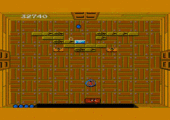
The landscape of 1980s console gaming was defined by a rapid evolution of input methodology, shifting from the binary "on-off" nature of digital directional pads to the nuanced, high-precision control offered by analog paddle controllers. While the Atari 2600 established the paddle as an industry standard—facilitating the success of titles like Super Breakout, Kaboom!, and Warlords—the subsequent console generation witnessed a notable decline in the peripheral’s ubiquity. Among the few developers to champion the paddle controller in the late 1980s was Sega, which, in 1987, released a specialized controller peripheral for its Mark III console, bundled with specific software titles to incentivize adoption.
The Evolution of the Paddle Controller Market
The paddle controller utilizes a potentiometer to regulate electrical voltage, allowing for a degree of sensitivity that digital inputs cannot replicate. In the early arcade era, this input method was the gold standard for "block-breaker" style games, which required players to move a paddle horizontally across the bottom of the screen with fluid, instantaneous precision.
Following the arcade success of Taito’s 1986 hit Arkanoid, which expanded upon the foundational mechanics of Atari’s Breakout by introducing enemies, power-ups, and varying brick structures, the demand for home ports grew significantly. However, a divergence in hardware strategy emerged. Nintendo, having opted not to bundle a paddle controller with the Famicom, forced Taito to manufacture and bundle its own proprietary peripheral. Consequently, only three Famicom titles—all published by Taito—supported this device, including the racing title Chase H.Q. In the Western market, the NES version of Arkanoid arrived without the specialized controller, marking a significant decline in the technology’s market presence compared to the 30-plus titles that supported the Atari 2600 paddle.
Sega’s 1987 Hardware Initiative
Sega’s entry into this niche market occurred in 1987 with the release of the Sega Mark III paddle controller. Unlike its competitors, Sega opted to bundle the hardware directly with software to ensure immediate utility for the consumer. Two distinct bundles were introduced: one featuring the card-based title Woody Pop: Shinjinrui no Block Kuzugi, and another featuring Alex Kidd BMX Trial, which was distributed on a 1Mb Gold Cartridge.
Despite the paddle controller’s lack of widespread support in the broader arcade catalog, Sega’s internal development teams produced seven titles compatible with the Mark III peripheral. Four of these—including Megumi Rescue and Woody Pop—were exclusive to the controller, demonstrating a concerted, albeit narrow, effort by the company to leverage the peripheral as a unique selling point for the Mark III.
Structural and Mechanical Analysis of Woody Pop
Woody Pop: Shinjinrui no Block Kuzugi, the final Sega My Card title for the Mark III, attempted to iterate on the Arkanoid formula through several key gameplay modifications. Unlike the original Arkanoid, which featured a static, vertical screen orientation, Woody Pop was designed for a 4:3 console display. This adjustment necessitated a wider playfield, significantly increasing the distance the player must travel to intercept the ball.
The game introduced several technical enhancements:
- Visual Feedback: Unlike its predecessors, bricks requiring multiple strikes display visible cracks, providing the player with immediate tactical information.
- Branching Progression: After clearing a level, players are presented with multiple paths, introducing a non-linear element intended to increase replayability.
- Power-up Integration: The game allows for the stacking of certain power-ups, such as the "glue" item (which catches the ball) and the "flame" item (which destroys bricks upon impact).
Despite these additions, the title suffered from design inefficiencies. The wider aspect ratio, combined with a rapid, non-linear increase in ball speed, often resulted in a difficulty curve that many players found prohibitive. Furthermore, the inclusion of "toy box" blocks—which endlessly spawn robotic enemies—introduced a level of environmental friction that critics argued detracted from the core experience of precision timing.
Aesthetic and Audio Design Constraints
The aesthetic presentation of Woody Pop has been cited as a primary factor in its mixed reception. The game features a character named "Woody the Wood Spirit," whose goal is to navigate a "Bizarre Mansion." The color palette relies heavily on shades of brown and orange to emulate wood paneling, a common interior design aesthetic of the era. This choice created a high-contrast issue when paired with the vibrant colors of the game’s breakable bricks, often resulting in a visually discordant experience.
The audio design further distinguished the title from its peers. Lacking a traditional musical score, the game utilizes a system of sound effects and percussion cues. Analysis of the sound design suggests an experimental approach, characterized by a series of synthesized pings and bloops that serve as the primary rhythmic accompaniment. While this approach was technically functional, it lacked the thematic cohesion typically found in contemporary Sega titles.
Implications and Market Reception
The title’s Japanese subtitle, translated as "New Generation Block Breaker," suggests that Sega intended for the game to advance the genre. However, the implementation of its novel features—such as warp points and branching rooms—often resulted in extended periods of inactivity where the player was forced to wait for the ball to return to the active playfield.
From a market perspective, Woody Pop serves as a case study in the limitations of hardware-software bundling. The game was positioned less as a marquee title and more as a functional requirement for users seeking to utilize the Mark III paddle controller. This strategy reflects a period in gaming history where hardware manufacturers often prioritized the expansion of peripheral utility over the long-term polish of individual software titles.
Historical Context and Legacy
When evaluating the legacy of Woody Pop, it is categorized as a transitional project. While it shares conceptual DNA with the subsequent block-breaker evolution seen in titles like Wizorb, its deviations from the established Arkanoid standard were, for the most part, poorly optimized. The decision to limit the paddle controller to only seven titles on the Mark III underscores the difficulty of maintaining proprietary peripherals during the late 80s.
By the time the industry shifted toward the 16-bit era, the specialized paddle controller had largely been relegated to the history of niche arcade-at-home hardware. While Woody Pop provided a necessary entry point for early adopters of the Sega paddle, it is largely remembered today as an artifact of a specific, experimental phase in console development. The title stands as a reminder of the challenges inherent in adapting arcade-centric mechanics to the constraints of the home console, particularly when hardware limitations and design goals fail to align. Despite its historical curiosity, the game remains a secondary component in the broader narrative of Sega’s 1980s hardware portfolio, serving as a footnote to the more successful implementations of analog control in subsequent generations.