 Vera Clarissa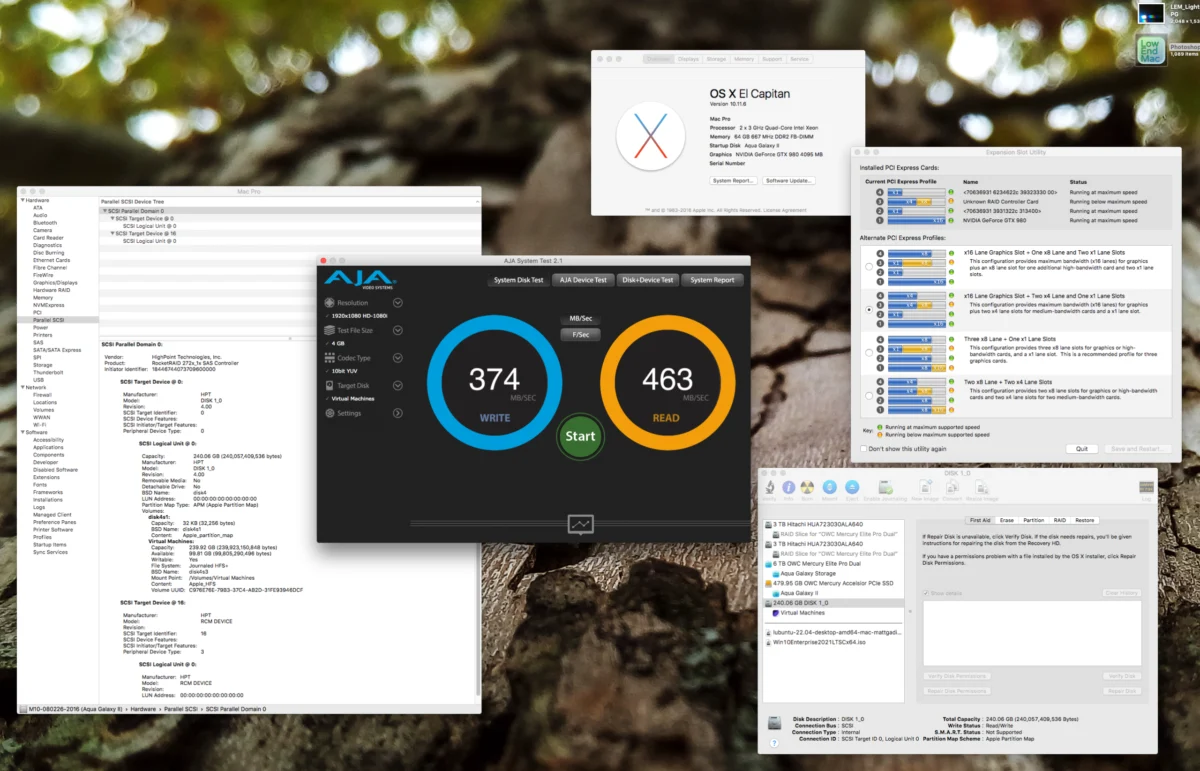
The classic Mac Pro 1,1 and 2,1 models, released between 2006 and 2008, remain revered among computing enthusiasts for their highly modular architecture and robust build quality. Despite their longevity, these machines are fundamentally limited by aging hardware interfaces, most notably the onboard SATA II controllers, which cap data transfer rates at 3.0 Gb/s. A recent technical breakthrough has demonstrated that it is possible to bypass these legacy constraints by integrating a HighPoint RocketRAID 2720SGL PCIe controller, effectively bringing SATA III 6.0 Gb/s performance to these nearly two-decade-old workstations. This integration, while requiring sophisticated manual intervention, offers a significant boost in throughput, enabling modern SSDs to operate at speeds far exceeding the original design specifications of the hardware.

Context and Technical Limitations
When Apple introduced the Mac Pro 1,1, the platform was designed around a bus architecture that prioritized stability and ECC memory support over raw storage bandwidth. The integrated storage controllers were sufficient for the mechanical hard drives of the mid-2000s, but they have become a significant bottleneck for users attempting to utilize modern solid-state drives (SSDs). While the Mac Pro’s PCIe 1.0 slots offer sufficient lanes for expansion, the lack of native driver support for modern high-performance RAID cards in older versions of OS X creates a challenging barrier for users attempting to upgrade their storage subsystems.

The RocketRAID 2720SGL, a hardware-based SAS/SATA RAID controller, emerged as a potential solution due to its support for high-speed connectivity and its legacy in server-grade environments. However, the card was never intended for consumer-grade legacy Mac environments, leading to significant hurdles in driver compatibility, particularly when running OS X El Capitan (10.11), which introduced stricter kernel security protocols, including System Integrity Protection (SIP).

Chronology of the Integration Process
The path to successfully implementing the RocketRAID 2720SGL involves a multi-stage process of hardware installation, driver extraction, and manual configuration of the kernel environment.

Initially, the hardware must be seated into a high-bandwidth PCIe slot—typically slot 1 or 4—to ensure optimal communication with the Mac Pro’s logic board. Once the hardware is physically present, the OS X kernel must be instructed to recognize the controller. In many cases, the standard installer packages provided by the manufacturer fail to bind correctly to the card because the specific PCI hardware IDs are missing from the configuration files.

The troubleshooting phase begins with an analysis of the PCIe device tree. Using the Terminal utility and the ioreg command, administrators can verify that the system identifies the vendor (HighPoint, ID 1103) and the device (RocketRAID 2720, ID 2720). If the system detects the card but fails to load a corresponding kernel extension (kext), the issue is confirmed as a driver-binding failure.

The resolution involves extracting the required kexts from legacy installer packages—specifically those designed for older OS X versions like Lion or Mountain Lion—and manually modifying the Info.plist file to include the device ID 0x27201103. This process requires disabling System Integrity Protection, as the modified drivers are not digitally signed by a contemporary Apple-approved developer, a requirement enforced by the OS X 10.11 environment. Once the kext is manually copied to the /Library/Extensions directory, the system’s cache must be rebuilt using kextcache to ensure the driver loads during the boot sequence.

Performance Metrics and Data Throughput
The impact of this upgrade is substantial. Standard internal storage on a Mac Pro 1,1 is typically limited to a ceiling of approximately 200–250 MB/s, depending on the specific hard drive or early-generation SSD utilized. Initial testing of the RocketRAID 2720SGL configuration has yielded read speeds of approximately 477 MB/s and write speeds of 388 MB/s for a single SATA III SSD.

These figures represent a near-doubling of the maximum theoretical throughput allowed by the native SATA II interface. By utilizing the PCIe bus, the user effectively removes the storage bottleneck, allowing for faster boot times, quicker application launching, and significantly improved responsiveness during file-heavy tasks. Furthermore, the controller supports multi-drive RAID arrays, suggesting that the total potential bandwidth could reach even higher thresholds if multiple SSDs are striped in a RAID 0 configuration.

Challenges and Hardware Constraints
While the performance gains are clear, the integration is not without complications. A primary concern is the physical connectivity of the storage devices. The Mac Pro 1,1 backplane is designed for direct drive connections, and the RocketRAID card requires SFF-8087 cables. Users must either source specific adapter cables or, as has been demonstrated in enthusiast circles, construct custom wiring harnesses to bridge the card’s internal SAS ports to the drive bays.

Additionally, the issue of bootability remains a technical frontier. While the card functions as an add-on storage controller within the OS, making it a bootable device—allowing the Mac to start directly from a drive connected to the card—requires the installation of an EFI ROM onto the card’s firmware. This process is notoriously difficult, with limited documentation and a high risk of rendering the card inoperable if the flashing process is interrupted or if the firmware is incompatible with the Mac Pro’s older EFI architecture.

Broader Implications for Legacy Hardware
The successful deployment of modern RAID controllers in decade-old hardware highlights a broader trend in the computing community: the "retro-productivity" movement. This initiative aims to extend the useful life of high-end, legacy workstations that, while capable of handling modern workloads, are hampered by outdated I/O standards.

From an environmental and economic perspective, the ability to upgrade these machines provides a sustainable alternative to the planned obsolescence cycles of modern consumer electronics. A Mac Pro 1,1, when equipped with modern storage and sufficient RAM, remains more than capable of handling tasks such as media consumption, document processing, and even light computational work. By documenting these complex workarounds, the community creates a knowledge base that allows these machines to remain functional in modern networks.

Conclusion and Future Outlook
The integration of the RocketRAID 2720SGL into the Mac Pro 1,1/2,1 architecture serves as a case study in how targeted hardware upgrades can bypass legacy limitations. While the process is not for the faint of heart—requiring a deep familiarity with the Unix-based command line and the intricacies of OS X kernel management—the results provide a tangible increase in system performance.

As these machines continue to age, the primary challenges will shift from simple speed improvements to broader compatibility issues, such as the lack of support for modern file systems (like APFS) or the increasing difficulty of running current web browsers on legacy OS versions. However, for those dedicated to preserving these "classic" machines, the ability to achieve SATA III speeds is a major milestone, transforming a museum piece into a viable, high-performance tool for contemporary workflows. The next logical steps for researchers in this field will be to further refine the bootloader configurations, potentially using custom EFI environments like rEFIt or OpenCore to simplify the boot process and enhance system stability across all volumes.