Jia Lissa
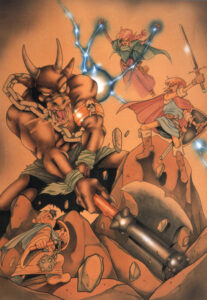
In the burgeoning landscape of the early 1990s video game industry, the role-playing game (RPG) genre was largely defined by two titans: Nintendo’s The Legend of Zelda and Enix’s Dragon Quest. For Sega, establishing a comparable foothold required a departure from traditional 8-bit constraints and a move toward the sophisticated 16-bit architecture of the Mega Drive, known in North America as the Genesis. This transition was catalyzed by the formation of Climax Entertainment and the release of Shining in the Darkness in 1991, a title that would not only launch a decades-long franchise but also redefine the technical and aesthetic possibilities of first-person dungeon crawlers.
The Foundation: From Dragon Quest to Independence
The DNA of the Shining series originates within the development cycles of Dragon Quest III and IV. Hiroyuki Takahashi and Hiroshi (Kan) Naitō, the architects of Climax Entertainment, met at Chunsoft, a studio then synonymous with Enix’s success on Nintendo hardware. Despite their professional success, both men harbored a desire for creative autonomy and a belief that Japanese game development was becoming too derivative, often settling for "usable copies" of Western concepts or repetitive sequels.
Takahashi, who transitioned from television production and various corporate roles to game development at age 28, brought a unique perspective to the industry. His meticulous approach—exemplified by his creation of a comprehensive flow-chart notebook of every dialogue line in Dragon Quest III—caught the attention of Enix producers. Naitō, conversely, was a programming prodigy whose obsession with 3D imagery and wireframe graphics began in high school. Together, they sought to create software that could earn global respect for its innovation rather than its adherence to local trends.

In April 1990, Takahashi and Naitō officially departed Chunsoft to form Climax Entertainment. Their exit was a calculated risk intended to signal a shift in the industry power dynamic. They were joined by key staff members, including Shinya Nishigaki, while other veterans like Manabu Yamana remained to continue the Dragon Quest lineage. This separation marked the beginning of a new era for Sega, which was desperate for high-quality third-party RPG content to compete with the Super Famicom.
Strategic Shift to the Mega Drive
While Climax’s founders were deeply familiar with Nintendo’s Famicom, they chose to develop their first project for Sega’s 16-bit Mega Drive. This decision was driven by technical necessity. The 8-bit Famicom was incapable of rendering the spatial awareness and fluid movement required for a truly immersive 3D dungeon. While the Super Famicom offered "Mode 7" scaling and rotation, Takahashi was wary of the growing pains associated with a brand-new system. The Mega Drive, powered by the well-documented Motorola 68000 CPU, offered a stable yet powerful platform for their ambitions.

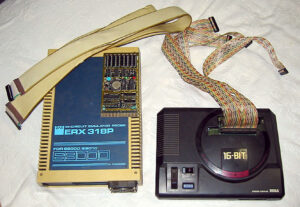
Sega’s leadership, including President Hayao Nakayama, recognized the potential of the Climax team. To facilitate development, Sega provided Climax with high-performance Hewlett-Packard workstations and direct access to R&D engineers. However, the partnership was not without friction. Naitō famously criticized Sega’s early in-circuit emulators (ICE) for their inability to display graphics accurately, leading Climax to develop their own proprietary graphics tools. This independent spirit allowed the team to push the Mega Drive’s hardware further than many of Sega’s in-house teams had managed at that stage.
Aesthetic Innovation and the Disney Influence
A defining characteristic of Shining in the Darkness was its departure from the manga-inspired art styles prevalent in Japanese RPGs. Takahashi and Naitō aimed for a "universal" aesthetic, drawing inspiration from Disney’s golden age of animation, including Sleeping Beauty and Alice in Wonderland. They sought to replicate the heart-pounding excitement of films like Gremlins, blending classic fantasy tropes with high-quality character designs.
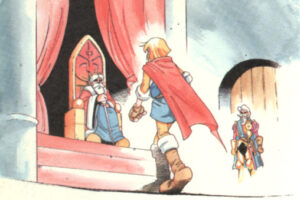
To achieve this, they recruited Yoshitaka Tamaki, a young freelance artist who shared their affinity for Western animation. Tamaki’s character designs for the protagonist Max (Hiro in Japan) and his companions, Milo and Pyra, utilized a "caricature" look that provided depth and personality within the cramped confines of a first-person perspective. This visual identity became the hallmark of the Shining brand, distinguishing it from the more traditional sword-and-sorcery visuals of its contemporaries.
Technical Mastery: Panorama 3D and Icon-Based Menus
The development of Shining in the Darkness was a masterclass in working within hardware constraints. The team’s primary goal was to create a "Panorama 3D" experience—a fluid, immersive environment that felt alive despite the Mega Drive’s lack of dedicated 3D hardware.
The Pseudo-3D Engine
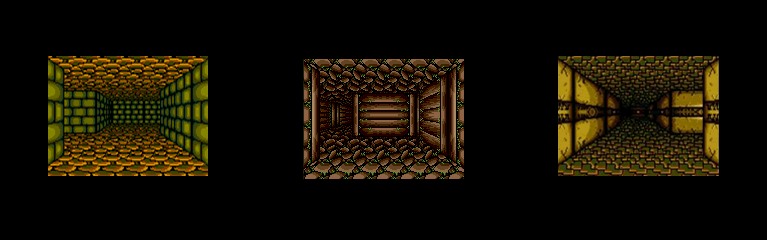
Programmer Yasuhiro Taguchi was tasked with creating a smooth-scrolling engine for the game’s central labyrinth. Unlike Phantasy Star, which used larger windows but often suffered from clunky transitions, Shining in the Darkness utilized a smaller, more detailed viewport. This allowed the game to render complex wall textures and animated enemies without sacrificing performance. The engine relied on tile-based tricks, rearranging pre-drawn wall segments and utilizing palette swaps to simulate lighting and depth.
The Command System
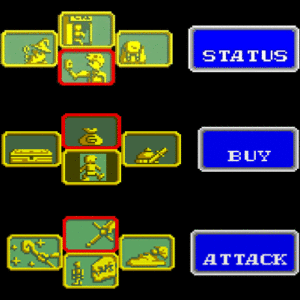
Climax also revolutionized the RPG user interface. Traditional PC RPGs of the era relied on text-heavy, obstructive menus. Climax implemented an intuitive, icon-based command system where each option—Magic, Item, Attack, or Retreat—was represented by a small, animated icon mapped to the directional pad. This system was designed to be navigable with one hand, reducing the burden on the player and keeping the focus on the action. This icon-driven approach would later be adopted and refined by numerous other franchises, including Square’s Secret of Mana.

Gameplay Philosophy: The Labyrinth and the Town
Set in the Kingdom of Thornwood, the game follows a simple yet effective structure: one town, one castle, and one massive, multi-floored labyrinth. The story involves the rescue of Princess Jessa and the knight Mortred from the clutches of the evil Dark Sol.
While many RPGs of the era were beginning to implement auto-mapping, Climax deliberately omitted this feature. Naitō believed that auto-maps encouraged players to ignore their surroundings. Instead, the labyrinth was designed with visual landmarks—puddles, torches, and specific wall decorations—that forced players to learn the environment through trial and error. For those truly lost, the game provided "Wisdom Seeds" and the "View" spell, but these were intended as secondary aids rather than primary navigation tools.

The town served as a theatrical stage, influenced by Takahashi’s background in theater. Characters within the town reacted dynamically to the party’s status. For instance, an innkeeper might refuse service until a fallen party member was revived, or a priest might comment on a specific curse. This "event-based" interaction gave the Kingdom of Thornwood a sense of life that exceeded its limited geographical scope.
Auditory Atmosphere and Soundtrack
The game’s atmosphere was further enhanced by the score of Masahiko Yoshimura. A graduate of the Shōbi-Gakuen Junior College School of Music Business, Yoshimura brought a sophisticated orchestral sensibility to the Mega Drive’s YM2612 sound chip. He worked closely with artist Yoshitaka Tamaki to ensure the music matched the visual tone of each scenario, often engaging in lengthy debates over the identity of specific themes.
The soundtrack was characterized by its strong contrasts: the regal, brassy tones of the castle provided a safe haven from the claustrophobic, eerie melodies of the labyrinth. Despite Yoshimura’s personal frustrations with the Mega Drive’s hardware limitations, the score became a benchmark for the series and was eventually released as a standalone "Sound Story" CD in Japan.
Market Reception and Global Impact
Shining in the Darkness was released in Japan on March 29, 1991, and became an immediate commercial success. It sold approximately 300,000 units, representing an impressive 16% capture rate of the Mega Drive’s Japanese install base at the time.

| Region | Release Date | Estimated Sales |
|---|---|---|
| Japan | March 29, 1991 | 300,000+ |
| North America | August 1991 | Consistent "Long Tail" |
| Europe | October 1991 | Moderate |
In North America, the game was released with minimal marketing compared to flagship titles like Sonic the Hedgehog. Sega of America’s marketing head, Al Nilsen, noted that while RPGs were a niche genre on the Genesis, Shining in the Darkness maintained a loyal and dedicated audience. Its success was largely driven by positive word-of-mouth among fans of Western dungeon crawlers like Wizardry, many of whom were shocked to learn the game was developed by a Japanese team.
Broader Implications and Corporate Shift
The success of Shining in the Darkness established Climax Entertainment as a premier developer, but it also highlighted the growing pains of Sega’s corporate expansion. Takahashi noted that as Sega grew into a global powerhouse, the management style shifted. The intimate, collaborative relationship Climax enjoyed during the development of their first title began to erode, replaced by a more profit-driven corporate structure that viewed independent studios with increasing skepticism.
Despite these tensions, the legacy of Shining in the Darkness is undeniable. It proved that the Mega Drive could serve as a viable home for deep, technically impressive RPGs. The game’s chronological placement—sixth in the series timeline—laid the groundwork for the lore explored in Shining Force and Shining Force II. It demonstrated that a focused, well-executed design could overcome a modest budget and hardware limitations, creating a blueprint for the "immersive RPG" that would influence the genre for years to come.
As Climax transitioned into the development of Shining Force, they carried with them the lessons learned in the labyrinth of Thornwood: the importance of a streamlined interface, the power of a unique aesthetic, and the necessity of technical independence. Shining in the Darkness remains a landmark achievement in the 16-bit era, a testament to the vision of its creators and the enduring appeal of a well-crafted adventure.