Jia Lissa
The 1991 release of Shining in the Darkness marked a pivotal moment in the evolution of the role-playing game (RPG) genre on home consoles, establishing a franchise that would eventually stand alongside Phantasy Star as a pillar of Sega’s software library. While Nintendo fans of the early 1990s looked toward The Legend of Zelda and Final Fantasy as the benchmarks of the genre, Sega Genesis owners found a unique alternative in the Shining series. Spanning nearly two dozen entries across multiple hardware generations, the series began with a high-stakes gamble by a small, independent studio called Climax Entertainment. This studio, founded by veterans of the Dragon Quest series, sought to redefine the dungeon-crawling experience by blending Western-inspired aesthetics with cutting-edge 16-bit programming.
The Foundations of Climax Entertainment
The DNA of the Shining series is ironically rooted in the very franchise most associated with Nintendo: Dragon Quest. Climax Entertainment was the brainchild of Hiroyuki Takahashi and Hiroshi "Kan" Naitō, two developers who met at Chunsoft while working on the seminal Dragon Quest III and IV for Enix. Takahashi’s path to game development was unconventional; a former TV production assistant and ski instructor, he entered the industry later than most, fueled by a fascination with the design philosophies of Shigeru Miyamoto. His meticulous nature was evidenced during his tenure at Enix, where he created a comprehensive notebook documenting every line of dialogue and quest flow in Dragon Quest III to improve narrative consistency.
Naitō, by contrast, was a self-taught programming prodigy who began his career as a high school student. His obsession with 3D imagery was sparked by early wireframe games like 3D Maze on the NEC PC-6001. By the time he joined Chunsoft, he was a seasoned assembly language programmer. Despite their success with Dragon Quest, both men felt constrained by the rigid structures of large development teams. They desired creative autonomy and a platform to elevate the status of game creators in Japan to the level of professional athletes or film directors. In April 1990, Takahashi and Naitō departed Chunsoft to form Climax Entertainment, taking with them several key staff members, including Shinya Nishigaki.

Strategic Shift: Choosing the Sega Mega Drive
When Climax began conceptualizing its first project, the choice of hardware was a critical strategic decision. While the Famicom (NES) was the dominant platform in Japan, its 8-bit architecture was insufficient for the "immersive" 3D experience Takahashi envisioned. The Super Famicom (SNES) was the logical successor, but its new architecture presented a steep learning curve. The Sega Mega Drive (Genesis), however, offered the Motorola 68000 CPU—a powerful and well-documented microprocessor that Naitō believed could handle the complex calculations required for fluid first-person movement.
Sega, desperate to build a third-party library to compete with Nintendo’s ironclad grip on the market, welcomed Climax with open arms. Sega President Hayao Nakayama personally oversaw the recruitment of the studio, providing them with high-performance Hewlett-Packard workstations to accelerate development. This partnership allowed Climax to bypass the technical limitations of 8-bit hardware and focus on creating a visual presentation that would distinguish them from the "manga-style" RPGs then dominating the Japanese market.
Design Philosophy: Disney Influence and Panorama 3D
Takahashi and Naitō were determined to create a game with global appeal. Takahashi believed that Japanese developers were often viewed by Western audiences as mere "copyists" of foreign technology. To combat this perception, Climax eschewed traditional anime aesthetics in favor of a style inspired by early Disney animation and classic Western fantasy like J.R.R. Tolkien’s The Lord of the Rings.
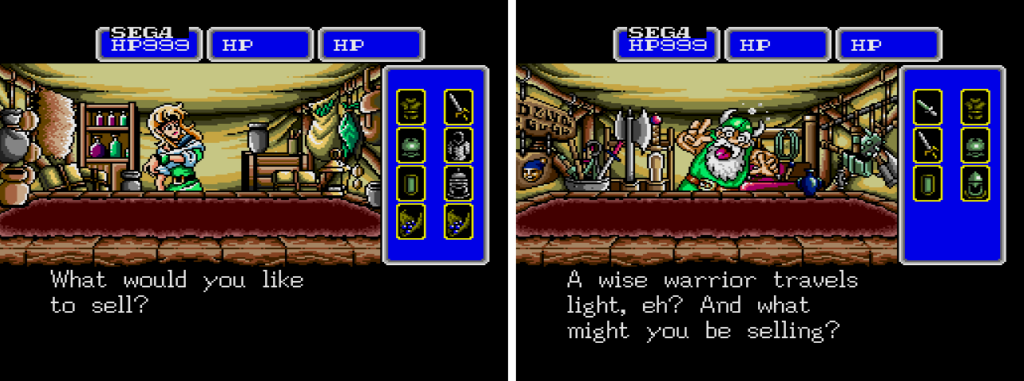
The studio recruited Yoshitaka Tamaki, a freelance artist who shared this affinity for Disney’s "caricature" style. Tamaki’s character designs for the protagonist Max (Hiro), the priest Milo, and the mage Pyra featured expressive, exaggerated features that felt more like a Saturday morning cartoon than a traditional JRPG. This aesthetic extended to the game’s "Panorama 3D" system. Climax wanted the town and castle locations to feel like a theater stage, where characters would change size and perspective as they moved, creating a sense of depth that was rare on 16-bit consoles.
Technical Innovation in a 16-bit Environment
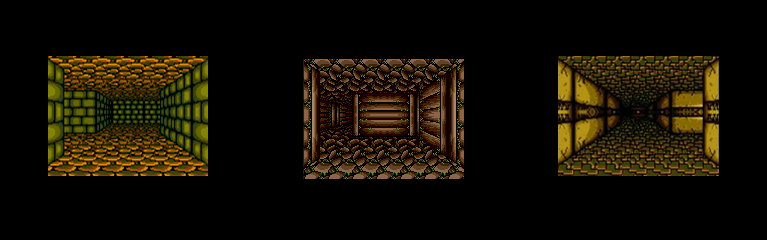
Programming the 3D dungeons of Shining in the Darkness was the project’s greatest technical hurdle. Because the Mega Drive lacked hardware-accelerated scaling and rotation—features like the SNES’s "Mode 7"—Naitō and special effects programmer Yasuhiro Taguchi had to simulate 3D movement through software-based tile manipulation.
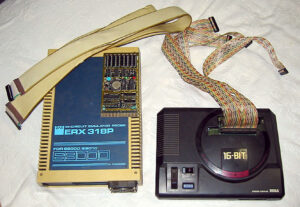
The engine was built on a strict single-point perspective. To maintain a fluid frame rate, Climax reduced the active gameplay window, surrounding it with a static UI. This allowed the 68000 CPU to focus its resources on updating the dungeon tiles and animating the large, detailed enemy sprites. Unlike previous dungeon crawlers like Phantasy Star, which used abrupt screen transitions, Shining in the Darkness aimed for smooth, continuous motion. This required the development of custom graphics tools, as the standard development kits provided by Sega were deemed insufficient by the Climax team.
The Controversy of the Missing Map
One of the most enduring debates surrounding Shining in the Darkness is the deliberate omission of an auto-mapping system. In an era where competing titles like Might and Magic provided players with navigational aids, Climax forced players to rely on memory and physical graph paper.
Naitō defended this decision as a core component of the game’s realism. He argued that auto-mapping made dungeons feel like a chore to be completed rather than a space to be explored. By forcing players to recognize landmarks—such as specific puddles, torches, or wall textures—Climax aimed to create a more rewarding "trial and error" experience. For players who struggled, the developers included the "Wisdom Seed" item and the "View" spell as limited resources to check coordinates, but these were intended as last resorts rather than primary navigational tools.

Audio Identity: The Work of Masahiko Yoshimura
The atmosphere of the Kingdom of Thornwood was further defined by the score of Masahiko Yoshimura. A graduate of the Shōbi-Gakuen Junior College School of Music Business, Yoshimura sought to create a soundtrack that emphasized the contrast between the regal safety of the castle and the claustrophobic tension of the labyrinth.
Despite his technical frustrations with the Mega Drive’s YM2612 sound chip, which he felt lacked the richness of his original compositions, Yoshimura’s work became a benchmark for the series. His collaboration with Tamaki ensured that the music matched the "Disney-esque" tone of the visuals. The soundtrack was later released as an arranged CD in Japan, titled Sound Story of Shining & the Darkness, which allowed Yoshimura to present the themes as he had originally envisioned them without hardware constraints.
Release, Reception, and Market Impact
Shining in the Darkness launched in Japan on March 29, 1991. It was a significant commercial success, selling approximately 300,000 copies. This represented a 16 percent attach rate for the Mega Drive’s installed base at the time, a remarkable feat for a new IP from a fledgling studio.
In North America, the game faced different challenges. Sega of America focused the bulk of its marketing budget on the upcoming launch of Sonic the Hedgehog, leaving Shining in the Darkness with minimal promotion. Despite this, the game found a dedicated audience among Western RPG fans, many of whom were veterans of the Wizardry series. Al Nilsen, former head of marketing for Sega of America, noted that the game performed well for its genre, maintaining a loyal following despite its high price point—a result of the expensive 8-megabit cartridge and battery backup required for save files.
Chronology and Franchise Legacy
While Shining in the Darkness was the first game released in the franchise, it occupies a specific place in a complex, non-linear timeline. Chronologically, it is often cited as the sixth entry in the series, following the events of Shining Force, the Game Gear titles, and Shining Force II.
The success of the first game led to a shift in direction for the sequel. Rather than a direct dungeon-crawling follow-up, Climax developed Shining Force, a tactical RPG that would become even more popular than its predecessor. Takahashi and Naitō eventually returned to the first-person dungeon format with Shining the Holy Ark on the Sega Saturn in 1996, which served as a spiritual successor to the mechanics established in the 1991 original.

Broader Implications for Sega
The development of Shining in the Darkness proved that the Sega Mega Drive could serve as a viable home for deep, narrative-driven RPGs, a genre previously dominated by Nintendo. However, the relationship between Climax and Sega would eventually sour. Takahashi later alleged that as Sega grew into a global corporate entity, it lost its "software-oriented" focus, treating second-party developers like Climax as "unruly subsidiaries" rather than creative partners. This tension eventually led to the splintering of the team, with members forming Camelot Software Planning, which would continue the Shining legacy before eventually moving to Nintendo to create the Golden Sun series.
Ultimately, Shining in the Darkness remains a landmark title of the 16-bit era. It demonstrated that technical constraints could be overcome through creative programming and a clear artistic vision. By blending Western aesthetics with Japanese design discipline, Climax Entertainment created a foundational text for the RPG genre that continues to be studied and celebrated by retro gaming enthusiasts today.