Jia Lissa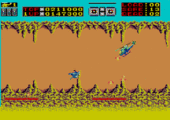
The 1986 release of Choplifter on the Sega Master System represented a pivotal moment for Sega Enterprises as it sought to establish its 8-bit hardware as a superior alternative to contemporary home computing and rival console platforms. Originally conceived by Dan Gorlin and published by Brøderbund for the Apple II in 1982, the title underwent a significant transformation when Sega’s arcade division, Sega Enterprises USA, acquired the license to produce a coin-operated version. This arcade iteration, which debuted in October 1985 as a conversion kit alongside the seminal racing title Hang-On, served as the primary blueprint for the Master System port. Programmed by Rikiya Nakagawa—a figure who would later gain renown for his work on Alien Syndrome and Thunderblade—the Sega version of Choplifter introduced a layer of arcade-style polish and mechanical refinement that distinguished it from Gorlin’s original strategic simulation.
Historical Chronology and the Evolution of a Franchise
The lineage of Choplifter is a case study in the cross-pollination of Western software design and Japanese arcade sensibilities. The original 1982 Apple II version was celebrated for its physics-based gameplay and its subversion of the typical "destroy everything" ethos of the era. Instead of focusing solely on combat, players were tasked with the delicate retrieval of hostages. Following its success on home computers, Sega recognized the potential for a high-fidelity arcade adaptation.
In 1985, Nakagawa and his team at Sega reimagined the title for the Sega System 1 arcade hardware. This version introduced more vibrant colors, parallax scrolling, and a structured level progression that replaced the singular, looping field of the Apple II version. The arcade version also adjusted the hostage count; while the original required the player to manage 16 hostages per trip, the arcade version reduced this to eight, a decision intended to increase the frequency of high-tension return trips to the home base.
When the Master System (known as the SG-1000 Mark III in Japan) launched, Choplifter was positioned as a flagship title to demonstrate the console’s ability to replicate arcade experiences at home. Released in 1986, the port was not merely a translation of the Apple II original but a faithful recreation of the 1985 arcade hit, complete with the additional environments and refined mechanics introduced by Nakagawa.
Technical Specifications and Master System Architecture
The Master System version of Choplifter was designed to leverage the console’s Zilog Z80 CPU and its Video Display Processor (VDP), which offered a significant palette advantage over the Nintendo Entertainment System (NES). While the NES could display 13 colors simultaneously from a palette of 52, the Master System could display 31 colors from a palette of 64. This technical edge is visible in the game’s lush desert sunsets, the deep blues of the oceanic stage, and the atmospheric lighting of the cave environment.
One of the most notable technical achievements in the Master System port is the implementation of parallax scrolling. By moving background layers at different speeds relative to the foreground, the developers created a sense of depth that was rare for 8-bit home consoles in the mid-1980s. This visual fidelity was paired with a sophisticated sprite-handling system that allowed for multiple enemy jets, tanks, and hostages to appear on screen with minimal flicker, a common hardware limitation of the era.
Gameplay Mechanics: The Burden of Rescue
At its core, Choplifter is a side-scrolling action game that utilizes a multi-phase gameplay loop. The player controls a rescue helicopter with the primary objective of liberating hostages held in enemy barracks. The mechanical complexity arises from the helicopter’s flight physics. Unlike many "shmups" of the period, the player’s craft has momentum and requires careful orientation to fire at ground targets or aerial threats.
The rescue process is divided into four distinct stages:
- Infiltration: Navigating through anti-aircraft fire and enemy interceptors to reach the barracks.
- Extraction: Landing the helicopter with precision. If the player lands directly on a hostage, the hostage is killed. Once landed, the barracks must be breached with gunfire to allow hostages to flee toward the craft.
- Loading: The helicopter can hold a maximum of eight hostages at a time. During this phase, the player is vulnerable to ground-based tanks and air-to-surface missiles.
- Return: Navigating the laden, and often damaged, craft back to the safety of the "Poste de Commandement."
The game requires the rescue of 40 hostages to clear a stage. Given that the helicopter can only carry eight at a time, a minimum of five successful sorties is required per level. This structure creates a "push-your-luck" dynamic where players must decide whether to risk a damaged chopper for one last hostage or return to base early to repair and save progress.
Environmental Design and Level Progression
The Master System version features three distinct environments, which loop twice for a total of six stages. Each environment introduces unique hazards and requires different tactical approaches:
- The Desert (Stages 1 and 4): This stage serves as the introduction to the game’s mechanics. It features open skies and predictable enemy patterns. In the second loop (Stage 4), the environment transitions to a night setting, increasing the difficulty and changing the visual aesthetic.
- The Ocean (Stages 2 and 5): This environment replaces solid ground with a naval fleet and a submarine. Hostages must swim from the submarine to the helicopter, adding a timing element to the rescue as the player must hover or land on a narrow platform while contending with naval artillery.
- The Cave (Stages 3 and 6): Widely considered the most difficult portion of the game, the cave environment introduces "natural" hazards in the form of stalactites and narrow passageways. The cramped quarters limit the helicopter’s maneuverability, making it an easy target for ground forces and requiring precise altitude control.
The Nakagawa Refinements and Arcade Philosophy
Rikiya Nakagawa’s influence on the Master System port is evident in the increased pace and the inclusion of "Easter eggs." If a player manages to destroy 16 enemy rockets in specific sequences, iconic characters such as Superman or E.T. the Extra-Terrestrial appear on screen. These additions were characteristic of Sega’s arcade culture in the 1980s, which prioritized secret rewards and high-score chasing.
However, the game also inherited the "quarter-muncher" difficulty curve of the arcade. The lack of traditional boss encounters is compensated for by a relentless increase in enemy density. By Stage 3, the screen is often filled with homing missiles and airships that require pixel-perfect movement to evade. This difficulty was a deliberate design choice, common in an era where game length was often extended through high challenge rather than a high volume of unique assets.
Market Impact and Critical Reception
Upon its release, Choplifter was a critical success for the Master System. Reviewers in 1986 and 1987 frequently cited the game as a "must-buy," praising its graphical fidelity and the tension inherent in the rescue mechanic. While the game could be completed in approximately 15 to 20 minutes by a skilled player, the high skill ceiling ensured significant replay value.
In the broader context of the "Console Wars" of the 1980s, Choplifter served as a vital piece of software for Sega. It demonstrated that the Master System was the premier destination for arcade-to-home conversions, a narrative Sega pushed heavily against the Nintendo Entertainment System. While the NES received a version of Choplifter published by Jaleco, the Master System version was widely regarded as the superior port due to its closer adherence to the Sega arcade original’s graphics and fluid gameplay.
Legacy and Conclusion
The success of Choplifter on the Master System paved the way for future entries in the series, including Choplifter II and Choplifter III on various platforms, and eventually a modern reimagining, Choplifter HD, in 2012. The game remains a definitive example of the "rescue shmup" subgenre, influencing titles like Desert Strike and its sequels.
The Master System port of Choplifter stands as a testament to an era when technical constraints forced developers to focus on tight, evocative gameplay loops. Despite its brevity and punishing difficulty—particularly within the cave levels—it remains a highlight of the 8-bit era. Its blend of rescue-based objectives and intense arcade action provided a blueprint for how home consoles could move beyond simple "shoot-’em-ups" toward more nuanced, mission-based experiences. For historians of the medium and fans of the Sega Master System, Choplifter is not merely a nostalgic artifact but a masterclass in 8-bit porting and game design.