
 Jia Lissa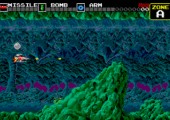
The 2021 physical cartridge release of Darius Extra Version for the Sega Mega Drive represents a significant milestone in the history of retro game preservation and software engineering, effectively completing a "timeline correction" that began with the 2019 Mega Drive Mini. Developed by the emulation and porting specialists at M2 and published through a collaboration between Taito, Columbus Circle, and Strictly Limited Games, this release serves as an expansive refinement of the original 1986 arcade masterpiece. Unlike previous home conversions that often struggled to replicate the three-screen spectacle of the arcade original, this iteration leverages modern programming techniques and deep historical research to deliver an experience that many enthusiasts consider superior to the source material. By addressing long-standing balance issues, enhancing audio fidelity through specialized FM synthesis, and incorporating multiple arcade revisions, M2 has transformed a 35-year-old title into a flagship showcase for 16-bit hardware capabilities.
Historical Context and the Path to the Mega Drive
To understand the significance of the 2021 Darius Extra Version, one must examine the atypical history of the franchise on Sega hardware. In 1986, Taito’s Darius was a marvel of arcade engineering, utilizing three CRT monitors aligned horizontally to create an ultra-wide cinematic experience. This unique aspect ratio made home ports notoriously difficult during the late 1980s and early 1990s. While the PC Engine received several high-quality ports such as Super Darius, the Sega Mega Drive—despite its popularity in Japan and the West—never received a native version of the first game during its primary commercial lifecycle.
The narrative shifted in 2019 when SEGA announced the inclusion of a brand-new Darius port for the Mega Drive Mini. This version, developed primarily by the programmer known as Hidecade and polished by M2, was a technical revelation, proving that the Motorola 68000-based console could indeed handle the complex sprite work and multi-layered backgrounds of the arcade original. However, the Mini version was limited by the constraints of its digital-only distribution and a singular focus on the "OLD" and "NEW" arcade revisions. The 2021 cartridge release expands this foundation significantly, incorporating the "EXTRA" version of the game—a revision that was historically polarizing among arcade players—and applying a level of technical polish that fixes edge-case bugs and graphical anomalies present in the 2019 code.
The Three Arcade Revisions: A Comparative Breakdown
The Darius Extra Version cartridge is notable for including three distinct iterations of the arcade game, each representing a different philosophy in game design and difficulty scaling.
The OLD and NEW Versions
The "OLD" version represents the original launch state of the game in 1986, characterized by high difficulty and specific "safe spots" during boss encounters. The "NEW" version, released shortly thereafter, attempted to balance the experience by adjusting enemy placement and power-up distribution. In the 2021 Mega Drive release, these modes serve as the baseline experience, offering a pure recreation of the classic arcade challenge without the "power-down on death" penalty in certain configurations.
The EXTRA Version Controversy and Correction
The "EXTRA" version was Taito’s final arcade revision, designed to increase revenue by raising the difficulty ceiling and preventing "marathon" sessions by skilled players. Historically, this version was criticized for its aggressive enemy patterns and the introduction of "red roe" enemies that tracked the player with lethal precision. Certain stages, such as Zone L, were famously dubbed "punishment zones" by Japanese arcade veterans due to their overwhelming bullet density and lack of defensive resources.
M2’s approach to the EXTRA version on the Mega Drive is one of "curated restoration." Working with "superplayer" KZS—a renowned expert from the Takadanobaba Mikado Arcade Center—M2 re-balanced the EXTRA mode to ensure it remained challenging but fair. For example, in Zone M (the central asteroid field), the number of airborne enemy formations was slightly reduced to prevent unavoidable deaths caused by the overlapping geometry of asteroids and enemies. Similarly, underwater routes that previously featured continuous walls of turret fire were adjusted to allow for "weaving" patterns, rewarding player skill over brute-force shielding.
Technical Innovations in Audio and Visuals
The 2021 release is more than a simple ROM dump; it is a ground-up optimization of the Mega Drive’s internal architecture.
FM Synthesis and Sound Reconstruction
One of the most praised aspects of the Darius Extra Version is its audio. M2 commissioned sound artist WING☆, known for his work on the Mega Drive Mini 2’s Space Harrier ports, to rebuild the game’s FM (Frequency Modulation) mix. The original arcade game utilized the Yamaha YM2151 chip, whereas the Mega Drive uses the YM2612. WING☆ meticulously translated Hisayoshi Ogura’s iconic avant-garde soundtrack to the Mega Drive’s hardware, restoring the low-end bass frequencies and stereo separation that were muffled in the 2019 Mini version.
Furthermore, the cartridge replaces low-quality PCM (Pulse Code Modulation) samples for sound effects with high-fidelity recreations on the YM2612 and DCSG (Digital Complex Sound Generator). This includes the restoration of the "BOOM, BOOM, BOOM" rolling explosion sequence when a boss is defeated—a signature Darius element that requires precise timing and multi-channel audio management to replicate effectively on home hardware.
Visual Polish and VDP Management
Visually, the game pushes the Mega Drive’s Video Display Processor (VDP) to its limits. M2 addressed several graphical glitches and "CRAM dots" (color RAM artifacts) that occurred on real hardware in the 2019 version. The EXTRA mode, which features higher sprite counts than the OLD or NEW versions, required dynamic VRAM management to prevent sprite flicker and slowdown. The result is a smooth 60-frames-per-second experience where massive mechanical bosses, such as the coelacanth-inspired "Green Coronatus," undulate with a fluidity that mimics the original arcade’s multi-screen presentation.
Gameplay Mechanics and Expanded Content
To maximize replay value, M2 and Taito introduced several features that go beyond the scope of a traditional arcade port.
The 26-Boss Mode
In the original arcade release, ROM size constraints forced Taito to reuse 11 boss designs across the game’s 28 zones. The 2021 cartridge offers a "26 Bosses" mode, which assigns a unique boss encounter to every route. This includes revised patterns for bosses originally exclusive to the PC Engine’s Super Darius, such as "Steel Spine" in Zone J. This mode transforms the branching map from a choice of difficulty into a choice of unique content, significantly extending the game’s longevity.
Scoring and Rank Systems
The scoring system in the EXTRA version introduces the "Remained Player Bonus," awarding one million points per ship in stock upon completing the game. This encourages "no-miss" runs and aligns the original Darius more closely with its acclaimed successor, Darius Gaiden. M2 also implemented independent high-score tables for each arcade revision and boss mode, alongside a hidden "Arcade Mode" accessible via a button code. This mode enforces a strict ruleset: no pausing, no soft resets, and a 10 Hz limit on rapid-fire, providing a "tournament-standard" environment for competitive players.
Input and Control Refinement
On original hardware, the Darius Extra Version eliminates the input latency often associated with software emulation on the Mega Drive Mini. The cartridge supports a wide range of auto-fire settings, from 10 Hz to 30 Hz, configurable per button row. High-frequency auto-fire (20-30 Hz) alters the game’s rhythm, allowing players to maintain constant forward pressure and creating a gameplay flow that feels more aggressive and modern.
Industry Impact and Preservation Analysis
The release of Darius Extra Version serves as a case study in how "retro-modern" development can benefit the gaming industry. By securing official licensing from Taito and employing the industry’s leading porting specialists, the publishers have created a product that satisfies both collectors and competitive players.
Data and Performance Metrics
Technical analysis of the cartridge indicates a highly efficient use of the Mega Drive’s 4MB ROM limit. The inclusion of three full arcade revisions, a Boss Rush mode, and a sound test with looping functions demonstrates a level of optimization rarely seen in the 16-bit era. Furthermore, the collaboration with arcade "superplayers" ensures that the software serves as a definitive historical record of how Darius was intended to be played, corrected for the limitations of single-screen home displays.
Broader Implications
This project underscores a growing trend in the industry where "lost" or "unreleased" historical versions of games are given a second life through high-quality physical releases. It bridges the gap between emulation and original hardware, providing a "reference quality" version of a classic title that is no longer tethered to aging arcade cabinets. For Taito, it reinforces the enduring legacy of the Darius brand, which continues to see new entries like Darius Cozmic Collection and Dariusburst.
Conclusion
Darius Extra Version for the Sega Mega Drive is an exhaustive tribute to one of the most influential shoot-’em-ups in arcade history. Through the technical expertise of M2 and the historical insights of the shmup community, the 2021 release transcends the status of a mere port. It is a comprehensive package that offers superior audio fidelity, refined gameplay balance, and an unprecedented amount of content for the platform. For the Sega Mega Drive, a console that missed out on the initial Darius wave in the early 90s, this release provides a definitive conclusion to its library, proving that with enough care and technical skill, the "silver hawk" can fly as high on home consoles as it ever did in the arcades.








