Jia Lissa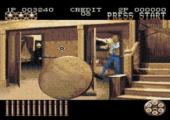
Following the commercial success and cultural notoriety of its predecessor, Konami’s release of Lethal Enforcers II: Gun Fighters in 1994 marked a significant pivot for the franchise. While the original 1992 arcade hit and its subsequent 1993 home ports focused on gritty, modern-day urban policing, the sequel transported players back to the American frontier of 1873. Released for the Sega CD, Sega Genesis, and arcade platforms, the title sought to refine the "light gun" genre during a period of intense scrutiny regarding video game violence.
The Sega CD version, in particular, represented a unique intersection of 16-bit graphical limitations and high-fidelity audio capabilities. By utilizing the CD-ROM format, Konami was able to provide an experience that closely mimicked the arcade’s auditory environment, even as the visual presentation remained tethered to the constraints of the Sega Genesis hardware. This technical dichotomy, combined with a shift in setting and a revised approach to difficulty, defined the game’s legacy within the fourth generation of video game consoles.
Historical Context and Regulatory Climate
The release of Lethal Enforcers II: Gun Fighters occurred during a transformative era for the video game industry. In late 1993 and early 1994, the United States Senate, led by Senators Joe Lieberman and Herb Kohl, held a series of hearings regarding the impact of violent video games on children. The original Lethal Enforcers, which featured digitized images of real people as targets and a realistic "Justifier" light gun peripheral, was a primary focus of these discussions.
Consequently, the industry moved toward a formal rating system. While the first game had been rated MA-17 by Sega’s internal Video Rating Council (VRC), Lethal Enforcers II: Gun Fighters received an MA-13 rating. Analysts suggest this change was likely due to the historical, "Western" setting, which moved the violence away from contemporary law enforcement scenarios into a more stylized, cinematic context reminiscent of Hollywood oaters. Despite the lower rating, the game maintained the franchise’s signature digitized sprites, providing a level of realism that was still considered advanced for the mid-1990s.
Hardware Specifications and Peripheral Integration
A defining characteristic of the Lethal Enforcers series is its reliance on specialized hardware. On the Sega CD, the game supports the standard three-button or six-button controller, but it was designed primarily for use with the Konami Justifier. The Justifier was a revolver-style light gun that connected directly to the console’s controller port.
From a technical standpoint, the Justifier operates by detecting the light emitted from a Cathode Ray Tube (CRT) television. When the trigger is pulled, the screen flashes white for a fraction of a second, allowing the gun’s photodiode to sense the timing of the electron beam and calculate the exact coordinates of the aim. Because modern liquid crystal displays (LCD) and plasma screens do not utilize this scanning method and often introduce input lag, Lethal Enforcers II remains unplayable with original hardware on modern televisions.
The Sega CD version supported a two-player cooperative mode, though this required a specific hardware configuration. The primary Justifier (typically blue) would be plugged into the console, while a second, "daisy-chained" Justifier (typically pink) would connect to the bottom of the first gun. This hardware requirement remains a point of interest for retro-gaming collectors and historians documenting the evolution of console peripherals.
Technical Analysis: Graphics vs. Audio
The Sega CD version of Lethal Enforcers II: Gun Fighters presents a fascinating case study in the trade-offs of 1990s multimedia hardware. Because the Sega CD was an add-on for the Genesis, it shared the base console’s color palette. The Genesis was notoriously limited to 64 colors on-screen simultaneously from a palette of 512. In contrast, the arcade original used a much wider array of colors, leading to a home port that appears somewhat "dithered" or grainy.
However, the Sega CD utilized its "Red Book" audio capabilities to surpass the standard cartridge version. The soundtrack features high-quality arrangements of Western-themed music, and the voice samples—crucial for providing cues like "Reload!" or "Don’t shoot!"—are significantly clearer than the muffled audio found on the Genesis cartridge. This audio fidelity was a major selling point for the Sega CD, as it allowed for an atmospheric experience that compensated for the graphical shortcomings.
Operational Mechanics and Stage Progression
The gameplay of Lethal Enforcers II: Gun Fighters is built upon a "shoot or be shot" reflex system. Players must eliminate outlaws while avoiding "innocents," such as bankers, stagecoach passengers, and saloon girls. Shooting an innocent results in the loss of a life, as does being hit by an enemy’s projectile.
The game is structured into five distinct stages, each culminating in a boss encounter:
Stage 1: The Bank Robbery
Set in a frontier town, the opening stage involves a high-stakes shootout within a local bank. The boss encounter features a criminal positioned behind a covered wagon equipped with three cannons. This encounter introduces a "multitasking" mechanic where the player must intercept incoming cannonballs while simultaneously finding windows of opportunity to damage the boss.
Stage 2: The Stagecoach Pursuit
This stage emphasizes kinetic movement, as players defend a stagecoach from mounted bandits. The transition to moving targets increases the difficulty significantly. The boss utilizes environmental hazards, throwing barrels at the player. Following this stage, the game introduces the first bonus round—a saloon-based target practice session designed to test speed and accuracy without the risk of losing lives.
Stage 3: The Saloon Shootout
A staple of the Western genre, the saloon stage requires players to navigate a crowded interior filled with both hostiles and civilians. The stage concludes with a "Quick Draw" duel, a departure from the standard gameplay. Players must face three black-clad gunfighters in a sequence that demands high-precision timing.
Stage 4: The Train Robbery
This stage takes place on a moving locomotive, moving from the caboose to the engine. The boss is a demolition expert who hurls sticks of dynamite. Players are required to shoot the dynamite out of the air before it detonates, a mechanic that requires faster reticle movement than previous stages.
Stage 5: The OK Mine Company
The final stage takes the player into a gold mine. In a surprising shift from the historical realism of the previous stages, the final boss utilizes supernatural elements, summoning skeletal warriors. These enemies throw knives and even their own heads at the player. While the skeletons serve as distractions, the player must focus fire on the main antagonist to complete the game.
Scoring, Ranking, and Difficulty Adjustments
Konami implemented several changes to the difficulty balance in Lethal Enforcers II. In the original game, players were required to maintain a minimum accuracy percentage to progress to the next level. In the sequel, this "gatekeeping" mechanic was removed, allowing players to see the entire game regardless of their shooting prowess, provided they had enough continues.
To compensate for this, the enemies in Gun Fighters are notably more aggressive. Reaction windows are shorter, and several enemies require multiple hits to be neutralized. The ranking system remains the primary metric for player performance, calculated based on accuracy and the avoidance of civilian casualties. The ranks are categorized as follows:
- 90% and above: U.S. Marshal
- 80-89%: Deputy Marshal
- 70-79%: Sheriff
- 60-69%: Deputy
- 59% and under: Posse
The Sega CD version provided players with nine continues, an increase from the five offered in the original home port, acknowledging the higher difficulty curve of the Western setting.
Broader Impact and Industry Legacy
Lethal Enforcers II: Gun Fighters represents the twilight of the digitized sprite era. Shortly after its release, the industry began a rapid transition toward fully 3D rendered environments with titles like Sega’s Virtua Cop and Namco’s Time Crisis. These newer games utilized polygonal graphics to allow for dynamic camera angles and more complex hit detection, making the static, pre-rendered screens of Lethal Enforcers appear dated.
Furthermore, the game serves as a historical marker for the Sega CD. As one of the platform’s more competent arcade ports, it demonstrated the value of CD audio in enhancing gameplay immersion. However, it also highlighted the limitations of the Sega CD as a mere "add-on," as the hardware was unable to bridge the graphical gap between the home and the arcade in the way the upcoming 32-bit consoles (Sega Saturn and PlayStation) eventually would.
Today, Lethal Enforcers II: Gun Fighters is remembered by enthusiasts as a high-water mark for 2D light gun shooters. Its transition to the Old West provided a fresh aesthetic for a genre that had become saturated with police procedurals. For collectors, it remains a "must-have" title for the Sega CD, provided they have the necessary CRT television and Justifier hardware to experience the game as Konami intended in 1994. The game stands as a testament to a specific moment in time when video games were transitioning from 16-bit cartridges to the expansive possibilities of optical media.