Jia Lissa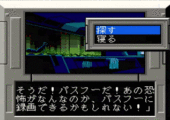
Detonator Orgun, a graphic adventure title developed by Darts and published by Hot-B, arrived on the Japanese Sega Mega CD on July 31, 1992, serving as a digital adaptation of the popular 1991 three-part Original Video Animation (OVA) series. At the time of its release, the Mega CD was a nascent platform, marketed heavily on its ability to deliver "multimedia" experiences that were impossible on standard cartridge-based hardware. This specific title represented a burgeoning genre in the Japanese market: the digital comic or visual novel, which sought to bridge the gap between passive anime consumption and interactive electronic entertainment. While the game remained a Japanese exclusive, its production reflects the technical ambitions and limitations of early 1990s optical media gaming.
Historical Context and the OVA Boom
To understand the development of Detonator Orgun for the Mega CD, one must look at the landscape of the Japanese animation industry in the late 1980s and early 1990s. This era was defined by the "OVA Boom," a period where high-budget animation was produced specifically for the home video market rather than television or theatrical release. Detonator Orgun was a flagship production of this movement, directed by Masami Ōbari, a figure renowned for his distinct mechanical designs and kinetic action choreography in series such as Bubblegum Crisis and Fatal Fury.
The OVA told the story of Tomoru Shindo, a university student living in the futuristic City No. 5. His life is irrevocably changed when he begins receiving telepathic distress signals from Orgun, a "mechanized knight" from the hostile Evoluder race. Orgun, labeled a traitor by his own kind for refusing to participate in the destruction of Earth, seeks a compatible human host to help defend the planet. This narrative served as a modern reimagining of the classic "Tekkaman" tropes, blending hard science fiction with psychological drama.
When Hot-B Co. Ltd. secured the rights to produce a video game adaptation, the choice of the Mega CD platform was strategic. The storage capacity of a CD-ROM (approximately 600MB) allowed for the inclusion of Full Motion Video (FMV) and high-fidelity audio, which were essential for capturing the essence of an Ōbari production.
Narrative Structure and Gameplay Mechanics
Unlike many contemporary mecha-themed games that focused on side-scrolling action or tactical simulation, Detonator Orgun was designed as a "command-select" graphic adventure. This genre, popularized by titles like Hideo Kojima’s Snatcher and The Space Adventure: Cobra, prioritized narrative immersion over twitch-based gameplay.
The game’s plot closely follows the events of the first two episodes of the OVA, with a concluding segment that provides a preview of the third episode. Players interact with the world through a static menu interface featuring several primary commands:
- Look: Allows the player to examine the environment, often triggering descriptive text or revealing hidden items.
- Think: Provides internal monologue from the protagonist, Tomoru, offering hints or context for the current situation.
- Talk: Initiates dialogue with non-player characters (NPCs), essential for advancing the plot.
- Move: Facilitates travel between different locations within the game’s futuristic setting.
The pacing of the game mirrors the "slow burn" approach of the anime. It emphasizes the psychological toll on Tomoru and the political machinations of Earth’s Defense Force. While this approach was praised for its faithfulness to the source material, it created a high barrier to entry for international players. Because the game relies almost entirely on Japanese text and voice acting to convey its objectives, the lack of an English localization meant that non-Japanese speakers were largely unable to navigate the branching dialogue paths or logic-based puzzles.
Technical Implementation and Visual Fidelity
The Mega CD hardware, while revolutionary, possessed significant limitations that are evident in the presentation of Detonator Orgun. The console’s primary challenge was its color palette; while the Mega Drive could display only 64 colors on screen simultaneously from a palette of 512, the Mega CD added some scaling and rotation capabilities but did not fundamentally increase the base color depth of the video output.
In Detonator Orgun, the FMV sequences are pulled directly from the anime production cells. However, to fit within the bandwidth constraints of the single-speed CD-ROM drive, these videos were heavily compressed. This resulted in a "dithered" appearance, where the limited color palette was used to simulate gradients through patterns of dots. While the cinematic flair of Ōbari’s direction remains visible, the visual clarity is noticeably reduced compared to the VHS or LaserDisc versions of the anime.
Despite these constraints, the game succeeded in capturing the cyberpunk aesthetic of the early 90s. The static backgrounds are detailed, portraying a world of neon-lit skyscrapers, advanced laboratory facilities, and the cold vacuum of space. The interface is clean, designed to frame the artwork without obscuring the central action.
The Audio Paradox: Redbook vs. Synth
One of the most discussed aspects of Detonator Orgun’s technical profile is its inconsistent use of audio hardware. The game features a score by Kouji Hayama, a composer noted for his high-energy, synth-heavy soundtracks (most famously for the Cho Aniki series).
During the game’s introduction and key cinematic moments, the audio utilizes the "Redbook" CD audio format. This allowed for studio-quality music and clear voice acting, featuring the original cast from the OVA. However, as the player progresses into the standard gameplay loops, the audio frequently shifts from the CD track to the Mega Drive’s internal YM2612 FM synthesis chip.
This transition is jarring for several reasons:
- Aural Consistency: The shift from rich, orchestral-style CD tracks to 6-channel FM chiptunes breaks the cinematic immersion.
- Resource Management: In 1992, developers often used internal synth music during dialogue-heavy scenes to save space on the disc or to allow the laser assembly to focus on reading data rather than streaming audio.
- Voice Quality: While the game is praised for having a significant amount of voiced dialogue, the quality of the voice samples used during gameplay (stored as PCM data) is often scratchy and muffled compared to the crystal-clear audio of the opening cinematic.
This technical compromise suggests a rushed production cycle or budget constraints, common issues for licensed titles aiming to capitalize on a specific window of an anime’s popularity.
Market Reception and Historical Significance
Upon its release, Detonator Orgun received a lukewarm reception from the Japanese gaming press. Critics noted that while it was a faithful recreation of the anime, it offered very little in terms of "gameplay" for those who were not already fans of the visual novel genre. The lack of interactive combat sequences was a particular point of contention, as the source material was famous for its high-octane mecha battles.
In the broader context of Sega’s history, Detonator Orgun stands as a testament to the "multimedia" era of the Mega CD. It belongs to a library of games that attempted to prove that video games could be more than just toys—they could be interactive movies. This trend eventually led to the development of the Saturn and PlayStation, consoles built from the ground up to handle the demands of FMV and high-fidelity 3D graphics.
The game also highlights the difficulties of the early localization market. During the early 90s, Sega of America and other Western publishers were hesitant to bring text-heavy graphic adventures to the United States. The high cost of translating thousands of lines of dialogue, combined with the expense of re-recording voice acting in English, made titles like Detonator Orgun a financial risk. Consequently, Western audiences were deprived of a significant portion of the Mega CD’s library, which was heavily weighted toward these narrative-driven experiences.
Legacy and Modern Availability
Today, Detonator Orgun is primarily remembered by collectors of "import" software and fans of retro mecha anime. It remains a curiosity of the 16-bit era, representing the moment when the industry first began to experiment with the fusion of traditional animation and interactive software.
For modern enthusiasts, the game is difficult to experience in its intended form. The original hardware is prone to laser failure, and the game has never been re-released on modern digital storefronts or included in "mini" console collections. Furthermore, because there is no comprehensive fan translation, the game remains inaccessible to a global audience, unlike other Mega CD classics like Snatcher or Lunar: Eternal Blue, which have seen extensive fan-led localization efforts.
Ultimately, Detonator Orgun serves as a historical marker. It illustrates the transition from the cartridge era to the optical media era, capturing both the excitement of new possibilities and the technical hurdles that defined the early 1990s. While it may not be remembered as a masterpiece of game design, its dedication to the aesthetic and narrative of its source material ensures its place in the history of anime-to-game adaptations. For those interested in the evolution of the visual novel or the specific "Ōbari" style of mecha design, it remains a fascinating, if flawed, artifact of gaming history.