
 Jia Lissa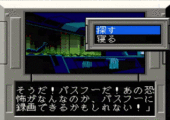
The release of Detonator Orgun on the Sega Mega CD on July 31, 1992, marked a significant moment in the evolution of the "digital comic" genre, a precursor to the modern visual novel. Developed by Darts and published by Hot-B Co. Ltd., the title served as a direct interactive adaptation of the three-part original video animation (OVA) series produced by Anime International Company (AIC) and Artmic between 1991 and 1992. At a time when the CD-ROM medium was still in its infancy, the project represented an ambitious attempt to bridge the gap between high-fidelity animation and home console entertainment. However, the game’s reliance on narrative depth over interactive action, combined with the technical constraints of the Sega Mega Drive hardware, resulted in a product that remains a polarizing example of early 1990s multimedia software.
Historical Context and Development Background
The early 1990s was a period of rapid transition for the Japanese video game industry. With the introduction of the Sega Mega CD (known as the Sega CD in North America), developers were granted access to approximately 500 megabytes of storage space—a staggering leap from the 1 to 2 megabytes typically found on standard ROM cartridges. This technological shift allowed for the inclusion of Red Book CD audio and Full-Motion Video (FMV), features that were heavily marketed as the "future of gaming."
Detonator Orgun was conceived during this "FMV boom." The source material, directed by Masami Ōbari—a figure renowned for his distinctively fluid animation style and "mecha" designs—was a high-profile sci-fi property. The OVA series was noted for its complex narrative, which blended elements of sentient technology, cosmic horror, and existential dread. Hot-B, a publisher primarily known for niche titles such as the steampunk shooter Steel Empire (Koutetsu Teikoku), sought to capitalize on the OVA’s popularity by offering fans an interactive way to experience the story of Tomoru Shindo and the mysterious mechanized warrior, Orgun.
Narrative Structure and Plot Chronology
The game’s narrative is set in the 23rd century, specifically in the sprawling metropolis known as City No. 5. The plot centers on Tomoru Shindo, a university student who experiences recurring dreams of a mechanical knight. The chronology of the game closely mirrors the first two episodes of the OVA series, with the following key plot points serving as the backbone of the gameplay experience:
- The Lunar Contact: The story initiates with a violent conflict on the Moon involving Orgun, a defector from the Evoluder race—a species of space-faring warriors who have traded their biological bodies for mechanical armor.
- The Telepathic Link: During his escape, Orgun establishes a telepathic connection with Tomoru Shindo on Earth. This link is central to the game’s progression, as it drives the protagonist’s motivation to uncover the truth behind the Earth Defense Force (EDF) and the impending Evoluder invasion.
- The Arrival of the Evoluders: As the EDF attempts to reverse-engineer alien technology, the first wave of Evoluder scouts arrives on Earth. The game depicts the struggle of the human military to combat a threat that is technologically superior in every measurable metric.
- Integration and Transformation: The climax of the interactive narrative involves Tomoru’s physical and mental integration with the Orgun armor, a sequence that explores the themes of identity and the cost of power.
The game concludes with a narrative bridge—essentially a preview of the third OVA episode—leaving the final resolution of the conflict to the original animated medium.
Gameplay Mechanics and User Interface
Unlike contemporary mecha titles such as Assault Suits Leynos or Mobile Suit Gundam adaptations, Detonator Orgun eschews traditional action-oriented gameplay. It is categorized as a graphic adventure or visual novel, utilizing a point-and-click interface that was popular on Japanese PC platforms like the PC-9801.
The player interacts with the world through a series of static and semi-animated menus. The primary commands include:
- Look (Miru): Allows the player to examine the environment or specific characters to gain clues.
- Think (Kangaeru): Provides internal monologue from Tomoru, often serving as a hint system for the player’s next move.
- Talk (Hanasu): Initiates dialogue with NPCs, which is the primary method of advancing the plot.
- Move (Idou): Transfers the player to different locations within City No. 5 or EDF headquarters.
The gameplay loop is designed to be methodical. Success is determined not by reflexes, but by the player’s ability to navigate dialogue trees and trigger specific flags within the game’s logic. This design choice was intended to preserve the cinematic pacing of the anime, though it arguably limited the game’s appeal to those seeking a more traditional "gaming" experience.
Technical Analysis of Audio-Visual Components
The technical execution of Detonator Orgun on the Mega CD is a study in the limitations of 16-bit hardware. While the CD-ROM provided ample storage, the Mega Drive’s VDP (Video Display Processor) was limited to a total of 64 colors on screen at any given time from a palette of 512.
Visual Presentation
The FMV sequences in the game are direct ports from the OVA. To fit within the bandwidth constraints of the Mega CD’s single-speed drive (150 KB/s transfer rate), the video was heavily compressed. This resulted in significant "macroblocking" and a reduced frame rate. To compensate for the limited color palette, the developers utilized extensive dithering—a technique where alternating colors are placed in a checkerboard pattern to simulate a wider range of shades. While effective for the time, this gave the game a characteristically "grainy" aesthetic.
Audio Discrepancies
Perhaps the most notable technical aspect of Detonator Orgun is its inconsistent audio quality. The game features a score by Kouji Hayama, a celebrated composer known for his work on the Cho Aniki series. The opening cinematic utilizes high-quality Red Book audio, delivering a powerful synth-driven orchestral experience.
However, as the player progresses into the core gameplay, the audio frequently shifts from the CD-DA tracks to the Mega Drive’s internal YM2612 FM synthesis chip. This transition is jarring for many users, as the chiptune renditions lack the depth and fidelity of the CD tracks. Furthermore, while the game features extensive voice acting from the original anime cast, the quality of the voice samples varies. Early scenes are crisp, but later dialogue segments suffer from audible compression hiss, likely a result of the developers attempting to save disc space for the video files.
Market Reception and Regional Availability
Upon its 1992 release, Detonator Orgun was positioned as a premium product for anime enthusiasts. In Japan, the "Digital Comic" genre was highly successful, catering to a demographic that valued narrative immersion. However, the game was never localized for Western markets.
The lack of a North American or European release can be attributed to several factors:
- The Language Barrier: The game is extremely text-heavy. Translating the script would have required significant investment, and the "Talk/Think" mechanics would have been incomprehensible to non-Japanese speakers without a full localization.
- Niche Appeal: While Robotech and Voltron had established a Western audience for mecha, Detonator Orgun was a relatively obscure OVA in the United States in the early 90s.
- Genre Preferences: Western Sega CD owners generally favored action, platforming, and "Full Motion Video" games with real actors (such as Night Trap), rather than the slow-paced menu-driven adventures popular in Japan.
Broader Impact and Implications for the Genre
Detonator Orgun serves as a historical marker for the "Multimedia Age" of gaming. It demonstrated that while CD-ROMs offered the potential for cinematic storytelling, the underlying hardware still dictated the quality of the experience. The game’s 6/10 critical standing in retrospective circles often reflects its status as a "faithful but flawed" adaptation.
The implications of such titles were significant for the industry. The mixed reception of FMV-heavy graphic adventures eventually led to the development of more sophisticated engines that could blend 2D sprites with high-quality video backgrounds, a technique perfected in later Saturn and PlayStation titles.
Furthermore, the game highlights the challenges of "quick-turnaround" anime licensing. By focusing on only two of the three OVA episodes, the game felt incomplete to some consumers, suggesting a development cycle that may have been rushed to coincide with the peak of the anime’s marketing window. Despite these criticisms, the title remains a sought-after collector’s item for Sega enthusiasts, representing a specific era where the boundaries between television animation and interactive software began to blur.
In the final analysis, Detonator Orgun is a testament to the ambition of early 90s developers. While it struggled with technical inconsistencies and a lack of traditional gameplay, it successfully delivered a cyberpunk atmosphere that was true to its source material. For historians of the Sega CD, it remains a primary example of how the industry navigated the transition from the "bit-wars" of the 1980s to the "multimedia revolution" of the 1990s.








