Farhan hamdan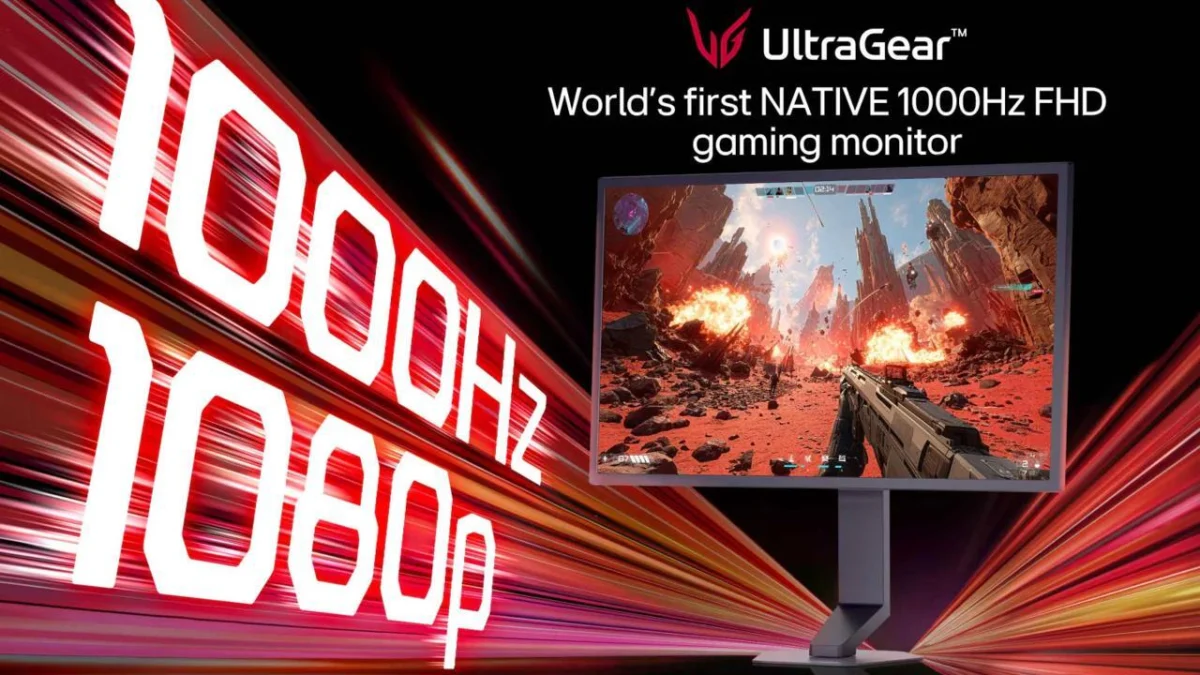
LG Electronics has officially announced the UltraGear 25G590B, a groundbreaking 24.5-inch native 1080p IPS display capable of achieving an astonishing 1000Hz refresh rate. This monitor is slated for release by the end of this year and is poised to introduce a new benchmark in gaming visual performance. Beyond its unprecedented refresh rate, the monitor integrates LG’s proprietary "Motion Blur Reduction Pro" technology, a sophisticated implementation of Black Frame Insertion (BFI), which promises to significantly enhance motion clarity. This development has sparked considerable discussion among display technologists and the gaming community regarding its potential to redefine the gaming experience across a broad spectrum of hardware configurations, from high-end PCs to current-generation consoles.
The Pursuit of Perfect Motion Clarity: A Historical Context
The evolution of display technology for gaming has been a relentless pursuit of speed and clarity. For decades, Cathode Ray Tube (CRT) monitors were the gold standard for competitive gaming, primarily due to their "impulse-type" display mechanism. Unlike modern "sample-and-hold" displays such as Liquid Crystal Displays (LCDs) and Organic Light-Emitting Diode (OLED) panels, CRTs rapidly scanned a beam of electrons across the screen, illuminating pixels for only a brief moment before they faded, resulting in virtually zero perceptible motion blur. When LCDs began to replace CRTs, gamers quickly noticed a significant drawback: motion blur. This phenomenon, inherent to sample-and-hold displays, occurs because each frame is held static on the screen until the next frame is ready, causing moving objects to smear across the retina.
Early LCDs operated at 60Hz, a frequency that exacerbated motion blur. Over the years, manufacturers steadily increased refresh rates to 120Hz, 144Hz, 240Hz, 360Hz, and more recently, 500Hz. While higher refresh rates reduce the time each frame is held, thereby decreasing motion blur, they do not eliminate it entirely. Even at 360Hz, discernible blur can persist, particularly during rapid camera movements in fast-paced games. This is where technologies like Black Frame Insertion (BFI) come into play. BFI works by inserting a black frame between each displayed image frame, effectively shortening the "on" time of each pixel and mimicking the impulse-like behavior of CRTs. This technique, while effective in reducing blur, often comes with trade-offs such as reduced brightness and noticeable flicker, especially at lower refresh rates.
LG’s announcement of a native 1000Hz panel with an integrated BFI solution marks a significant leap in this ongoing quest for motion clarity. The company, a prominent innovator in display technology, particularly with its advancements in OLED panels and high-refresh-rate gaming monitors, is now pushing the boundaries of traditional IPS technology to unprecedented levels of speed.
Technical Deep Dive: 1000Hz and Motion Blur Reduction Pro
The LG UltraGear 25G590B’s headline feature is its native 1000Hz refresh rate. This means the display is capable of drawing up to 1000 frames per second natively, a feat of engineering that requires extremely fast pixel response times and sophisticated panel control. While achieving 1000 frames per second (FPS) in demanding games at 1080p will necessitate cutting-edge graphics hardware, the monitor’s true innovation might lie in how this extreme refresh rate synergizes with its "Motion Blur Reduction Pro" technology.
Motion Blur Reduction Pro is LG’s brand for BFI. The critical advantage of having BFI implemented directly into the display’s circuitry, especially on a panel capable of 1000Hz, is multifaceted. Firstly, hardware-level BFI ensures optimal timing and synchronization, avoiding potential issues that arise from external software solutions. Secondly, and more importantly, the extreme refresh rate dramatically mitigates the traditional drawbacks of BFI. At lower refresh rates (e.g., 60Hz or 120Hz), inserting black frames causes a noticeable reduction in perceived brightness and a prominent flicker, making the feature undesirable for many users. However, as the refresh rate increases, the duration of each black frame becomes infinitesimally short, and the frequency of flicker moves beyond the threshold of human perception for most individuals.
This principle was observed with technologies like NVIDIA’s G-SYNC Pulsar, which demonstrated that BFI becomes significantly more palatable at refresh rates of 120Hz and above, due to reduced flicker. At 1000Hz, the flicker associated with BFI is expected to be virtually imperceptible, allowing users to experience the full benefits of enhanced motion clarity without the traditional compromises.
Furthermore, the 1000Hz refresh rate opens the door for advanced BFI techniques that could fundamentally change how motion blur is addressed. Concepts like Blur Busters’ CRT Beam Emulation, which aims to replicate the precise scanning behavior of CRTs, become far more feasible and effective on such a high-speed panel. This technique involves breaking down a single source frame into multiple sub-frames, each displayed for a minuscule duration, effectively simulating the "beam" of a CRT. For instance, a 60Hz input signal could theoretically be processed into 16 distinct sub-frames on a 1000Hz panel (1000Hz / 60Hz ≈ 16.6), significantly reducing the pixel’s "on" time and thus motion blur, while maintaining reasonable brightness. In contrast, a 240Hz monitor could only split a 60Hz signal into four parts, offering a notable but less dramatic improvement. The potential for such granular control over pixel illumination could bring motion clarity levels very close to the zero-blur experience of CRTs.
The 24.5-inch screen size and 1080p resolution are strategic choices. While higher resolutions like 1440p or 4K are increasingly popular, driving games at 1000 FPS at these resolutions would be an insurmountable task for current and near-future consumer hardware. The 1080p resolution focuses the monitor’s capabilities squarely on achieving maximum refresh rate and motion clarity, making it ideal for competitive esports where every millisecond and pixel of clarity counts. The IPS panel technology ensures excellent color reproduction and wide viewing angles, maintaining a high standard of image quality even at extreme speeds. While OLED panels inherently offer faster pixel response and true blacks, the combination of 1000Hz and advanced BFI on an IPS panel could potentially narrow the gap in perceived motion clarity, making the panel type less critical for this specific performance metric.
Implications for Gamers and the Gaming Ecosystem

The introduction of the LG UltraGear 25G590B carries profound implications for various segments of the gaming community and the broader display industry.
Competitive Gaming and Esports: For professional esports players, where fractions of a second can determine victory, the potential for near-zero motion blur at extreme refresh rates represents a significant competitive advantage. Faster target acquisition, improved tracking of rapidly moving objects, and reduced eye strain over extended play sessions are direct benefits. This monitor could become a staple in professional gaming setups, setting a new standard for competitive visual fidelity.
Beyond 1000 FPS: Critically, the benefits of this monitor extend far beyond gamers who can actually achieve 1000 FPS in their games. Current-generation consoles and many PC games often target 120Hz. Even at these lower frame rates, the 1000Hz panel with advanced BFI can provide substantial improvements. If the monitor’s "Motion Blur Reduction Pro" is sophisticated enough to intelligently process lower-frequency signals, a 120Hz game could be displayed with significantly enhanced clarity by leveraging the panel’s ability to refresh at multiples of 120Hz (e.g., 8x at 960Hz). This means even console gamers could experience unprecedented motion clarity, making fast-paced action games feel dramatically smoother and more responsive.
Consider a scenario where a 60Hz game is upscaled to 120Hz by an external scaler or the display’s internal processing. This 120Hz signal could then be fed into the 1000Hz monitor, which, utilizing its advanced BFI, could display it at 960Hz (a multiple of 120Hz). This process, while introducing a slight buffering delay from the scaler, could result in a motion clarity profile that far surpasses traditional 120Hz displays, with significantly less flicker than BFI at 60Hz or even 120Hz. The psychological effect of reduced motion blur can also influence perceived latency; a display with consistent, clear motion can make input feel "snappier" even if the raw input lag numbers are similar to a blurrier display. This phenomenon has been observed when comparing high-definition CRTs with LCDs, where CRTs often feel more responsive despite potentially having similar or even slightly higher raw latency.
Hardware Requirements and Accessibility: While the monitor’s potential is immense, it also highlights the increasing demands on PC hardware. To consistently hit 1000 FPS in modern AAA titles at 1080p would require the absolute top-tier graphics cards, processors, and memory. This positions the monitor initially as a premium product for enthusiasts and professionals. However, as previously noted, its utility extends to lower frame rates, making it a valuable upgrade for a wider audience seeking superior motion clarity, even if they aren’t pushing the absolute limits of their hardware.
Broader Market Impact and Future Outlook
The LG UltraGear 25G590B’s arrival is likely to catalyze a new phase in the display technology arms race. Competitors will undoubtedly evaluate LG’s strategy and performance, potentially leading to similar high-refresh-rate offerings from other manufacturers. This could accelerate the development of even faster panels and more sophisticated motion clarity technologies. The market may also see a renewed focus on optimizing display processing to take full advantage of these extreme refresh rates, moving beyond just raw Hertz numbers to emphasize effective motion blur reduction.
Standardization in measuring and marketing motion clarity may also evolve. Currently, response time (GtG or MPRT) and refresh rate are primary metrics. However, with advanced BFI and techniques like CRT Beam Emulation becoming more prevalent, new, more comprehensive metrics might emerge to quantify the subjective experience of motion clarity more accurately.
Consumer adoption will depend on several factors, including pricing, the perceived benefits by the average gamer, and the continued improvement of gaming hardware. While 1000Hz monitors might initially occupy a niche segment, the underlying technology, particularly advanced BFI, could trickle down to more mainstream displays, offering improved motion clarity across the board. The monitor’s launch could also influence the development of display interfaces (e.g., DisplayPort, HDMI) to support the immense bandwidth required for such high refresh rates.
Looking ahead, this monitor represents a significant step towards achieving display performance that closely mimics the ideal, blur-free vision of the human eye. As display technology continues to advance, the focus will likely shift towards combining these extreme refresh rates with higher resolutions, potentially through innovative upscaling and rendering techniques that dynamically balance resolution and frame rate to deliver the best possible visual experience.
Conclusion
The LG UltraGear 25G590B stands as a testament to the relentless innovation in display technology. Its native 1000Hz refresh rate, combined with the promising "Motion Blur Reduction Pro" technology, has the potential to fundamentally alter the gaming landscape by delivering unparalleled motion clarity. While the full impact of this monitor will hinge on the efficacy of LG’s BFI implementation and its ability to enhance visual fidelity across a range of input frame rates, it undeniably sets a new technical benchmark. Industry analysts are expected to closely monitor its market reception and performance, as real-world testing will be crucial in validating its transformative potential. Should it deliver on its promise, the UltraGear 25G590B could well be remembered as a pivotal product in the ongoing quest for the ultimate immersive and responsive gaming experience.