Jia Lissa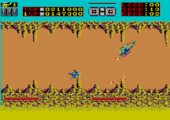
The release of Choplifter for the Sega Master System in 1986 marked a pivotal moment in the evolution of the shoot-’em-up genre, transitioning a beloved home computer classic into a high-fidelity arcade experience for the domestic market. Originally conceptualized and developed by Dan Gorlin for the Apple II in 1982 and published by Brøderbund, Choplifter fundamentally altered the trajectory of action games by introducing a humanitarian objective—rescue—into a genre previously dominated by the singular goal of destruction. While the original version was a landmark in software design, it was Sega’s internal development teams that refined the concept for the coin-op market in 1985, subsequently porting that enhanced version to their 8-bit home console, the Sega Master System (SMS), a year later.
The Genesis of a Rescue Simulation: From Apple II to Sega Arcade
Before the Sega Master System version could exist, the title underwent a significant transformation through Sega’s arcade division. In October 1985, Sega Enterprises USA debuted the arcade iteration of Choplifter as a conversion kit alongside the motorcycle racing pioneer Hang-On. This version was programmed by Rikiya Nakagawa, a developer whose pedigree would later include seminal titles such as Alien Syndrome and Thunderblade. Nakagawa’s influence was profound; he transitioned the game from a relatively minimalist computer simulation into a vibrant, multi-environment spectacle.
Nakagawa’s team implemented several critical changes to the gameplay loop. The hostage count per building was reduced from the original 16 down to eight, a move designed to increase the frequency of landings and take-offs, thereby heightening the tension and vulnerability of the player’s craft. Furthermore, the arcade version introduced diverse environments beyond the desert, adding naval fleets and subterranean caverns. These additions provided the blueprint for the 1986 Master System port, which sought to replicate the arcade’s visual fidelity and mechanical complexity on home hardware.
Technical Specifications and the 8-Bit Architecture
The 1986 Master System port of Choplifter arrived during a period of intense competition between Sega and the Nintendo Entertainment System (NES). Technically, the Master System held a distinct advantage in color palette and graphical throughput, which Choplifter utilized to great effect. The game utilized the Master System’s Video Display Processor (VDP) to render a 64-color palette (32 on-screen), allowing for rich gradients in the sky and detailed sprites for the hostages and enemy vehicles.
A standout technical achievement for the time was the implementation of parallax scrolling. As the player piloted the helicopter, the background layers moved at different speeds, creating a sense of depth that was often absent in contemporary NES titles. The game’s ROM size—typically 32KB or 128KB depending on the region and cartridge type—was optimized to ensure that the fluid animation of the helicopter’s rotation and the frantic movement of the hostages remained consistent even during intense combat sequences.
Gameplay Mechanics: The Burden of Command
In Choplifter, the player assumes the role of a combat pilot operating a maneuverable rescue helicopter. The primary objective is to penetrate enemy lines, destroy barracks to release hostages, and transport them back to the safety of the "Post Office" or home base. Unlike traditional "shmups" where the player is a moving turret, Choplifter requires delicate physics management. The helicopter can tilt to gain speed, hover to fire precisely, and must land gently to avoid crushing the very civilians it is sent to save.
The rescue process is a multi-stage logistical challenge:
- Extraction: The player must blast open the barracks where hostages are held.
- Landing: The craft must touch down on level ground. If the player lands directly on a hostage, that hostage is killed instantly, a mechanic that introduced a level of consequence rarely seen in 1980s gaming.
- Loading: Up to 16 hostages can be carried at once. While the helicopter is grounded, it is a stationary target for enemy tanks and jet fighters.
- Transit: The return trip to base is often the most dangerous, as the enemy presence scales based on the player’s progress.
To advance to subsequent levels, the player must successfully rescue 40 out of a possible 64 hostages. This margin for error—allowing for 24 casualties—initially seems generous but quickly becomes a tight constraint as the difficulty spikes in the later environments.
Environmental Analysis and Chronology of Stages
The Master System version features three distinct environments, which loop twice with increased difficulty and time-of-day changes for a total of six stages.
The Desert (Stages 1 and 4)
The opening stage serves as a tribute to the original Apple II version but with enhanced Sega aesthetics. Players face traditional tanks and jet fighters. In the second loop (Stage 4), the environment shifts to a night-time setting, demonstrating the Master System’s superior color handling. The darkness is not merely cosmetic; it obscures enemy projectiles, forcing players to rely on muzzle flashes to anticipate incoming fire.
The Sea (Stages 2 and 5)
Moving the action to the ocean, this stage introduces naval combat. Hostages are held on a series of transport ships and a massive battleship. A unique mechanic in this stage involves hostages swimming from a sinking submarine to the player’s helicopter. The lack of solid ground—requiring the player to land on moving decks—increases the mechanical demand on the player’s "hover" control.
The Cave (Stages 3 and 6)
Widely regarded as the most difficult segment of the game, the cave environment shifts the gameplay into a claustrophobic, horizontal gauntlet. Natural hazards such as stalactites and narrow passageways limit the helicopter’s movement. This stage introduces "airships"—hovering enemies that track the player’s movement with high precision. The Cave stage is often cited by historians as a prime example of "arcade difficulty," designed to challenge the limits of a player’s memorization and reflexes.
Development Philosophy and Cultural Impact
The programming of the Master System port was handled with a focus on "arcade-perfect" reproduction. During the mid-1980s, the marketing strategy for Sega was "The Challenge is Real," positioning the Master System as the more mature, technically capable alternative to Nintendo. Choplifter was a cornerstone of this campaign. It wasn’t just a game about shooting; it was a game about precision and moral stakes.
The inclusion of "Easter eggs" or hidden bonuses also spoke to the era’s development culture. If a player managed to destroy 16 enemy rockets in specific sequences, they could trigger cameos from pop-culture icons like Superman or E.T. the Extra-Terrestrial. These inclusions, while whimsical, provided a reprieve from the game’s otherwise punishing difficulty and encouraged players to experiment with the game’s systems beyond the basic rescue loop.
Comparative Reception and Legacy
Upon its release, Choplifter was lauded by contemporary publications. Computer and Video Games (CVG) and Electronic Gaming Monthly (EGM) frequently cited the Master System version as the definitive home port, surpassing the 7800 and NES versions in terms of both graphical fidelity and control responsiveness. The game’s brevity—a skilled player can complete all stages in approximately 15 to 20 minutes—was a common point of critique, yet this was balanced by the sheer difficulty of the "pro" loops.
The legacy of Choplifter on the Sega Master System is visible in several subsequent titles and genres:
- The "Strike" Series: Electronic Arts’ Desert Strike and its sequels clearly inherited the rescue-and-return mechanics pioneered by Gorlin and refined by Sega.
- Modern Indie Games: Titles like Resogun and Helldivers often utilize the "save the survivors" mechanic as a primary scoring multiplier, a direct lineage from the 1986 classic.
- Sega’s Identity: The success of Choplifter helped establish Sega as a company that could successfully bridge the gap between the arcade and the living room, a reputation that would eventually lead to the massive success of the Sega Genesis.
Conclusion: A Timeless Exercise in Tension
The 1986 release of Choplifter for the Sega Master System remains a high-water mark for 8-bit action games. By successfully porting the refinements of the arcade version—specifically the work of Rikiya Nakagawa—Sega provided home users with a game that was visually stunning, mechanically deep, and emotionally resonant. While its steep difficulty curve and short length may reflect the arcade sensibilities of its time, its core gameplay loop remains as engaging today as it was nearly four decades ago. It stands not only as a testament to the power of the Master System hardware but also as a reminder that in the world of video games, the act of saving a life can be just as thrilling as the act of taking one. For collectors and enthusiasts of the 8-bit era, Choplifter is an essential piece of history that continues to define the potential of the rescue-sim genre.