Farhan hamdan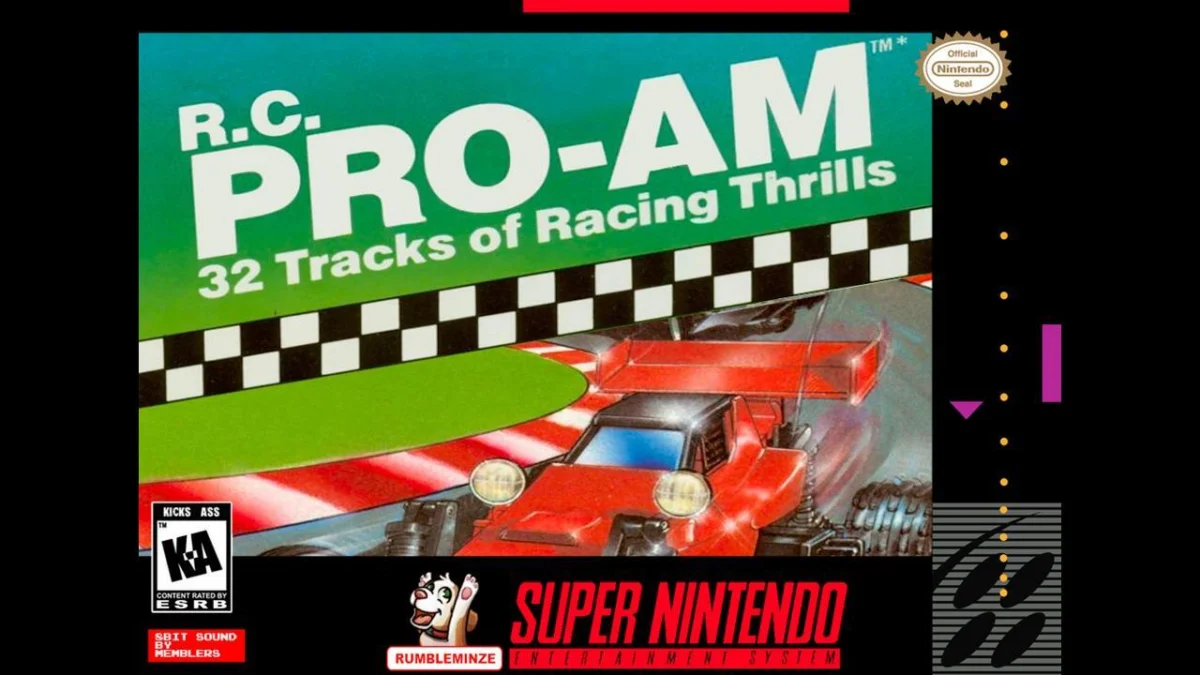
In a significant development for the retro gaming community, independent developer Rumbleminze has unveiled their latest technical achievement: a meticulously crafted conversion of the iconic 1988 NES title, R.C. Pro-Am, for the Super Nintendo Entertainment System (SNES). This conversion leverages advanced SNES hardware capabilities, specifically FastROM/HiROM architecture and the console’s superior sprite handling, to deliver a dramatically improved gameplay experience, largely mitigating the performance limitations inherent to the original 8-bit platform. The release marks another milestone in fan-driven efforts to preserve and enhance classic titles, building upon Rumbleminze’s established track record of successful NES-to-SNES conversions.
The Genesis of a Classic: R.C. Pro-Am’s Enduring Legacy
R.C. Pro-Am, developed by Rare and published by Nintendo, first captivated players on the Nintendo Entertainment System in 1988. It quickly distinguished itself within the nascent racing genre with its unique isometric perspective, engaging combat mechanics, and a compelling blend of skill-based driving and strategic power-up usage. Players controlled miniature remote-controlled cars through a series of increasingly complex tracks, collecting power-ups like missiles, bombs, and turbo boosts to outmaneuver and eliminate opponents. The game’s innovative design, particularly its emphasis on competitive interaction beyond mere speed, earned it critical acclaim and a dedicated following.
The NES, while revolutionary for its time, possessed inherent hardware constraints that often impacted gameplay, especially in visually dynamic titles. R.C. Pro-Am was no exception. Players frequently encountered instances of "sprite flicker" – where sprites would disappear and reappear rapidly – and noticeable slowdown during intense moments of action, particularly when multiple cars, projectiles, and environmental elements were simultaneously rendered on screen. These limitations, a direct consequence of the NES Picture Processing Unit (PPU) being capable of displaying only eight sprites per scanline and a total of 64 sprites on screen, were common across many sophisticated NES titles and, while accepted at the time, often detracted from the fluidity of the experience. Despite these technical hurdles, R.C. Pro-Am sold over 2.3 million copies worldwide, cementing its place as a quintessential NES title and a precursor to later isometric racers and combat-racing hybrids. Its success even spawned a sequel, R.C. Pro-Am II, in 1992, and a spiritual successor, Cobra Triangle.
Rumbleminze’s Vision: Elevating Retro Experiences
Rumbleminze has emerged as a prominent figure within the retro gaming modification and preservation community, known for their meticulous and technically sophisticated conversions. Their work focuses on porting NES games to the more powerful SNES architecture, not merely as emulated experiences, but as native conversions that leverage the SNES’s superior hardware. Previous projects, documented on platforms like RetroRGB, have demonstrated a consistent commitment to enhancing classic gameplay by addressing the very limitations that characterized the 8-bit era. This latest R.C. Pro-Am conversion is a direct continuation of this philosophy, aiming to present the beloved racer in a form that fully realizes its original potential, unburdened by archaic hardware constraints. The motivation behind such projects is multi-faceted: a deep appreciation for classic games, a desire to push the boundaries of retro hardware, and a commitment to game preservation by offering new ways to experience historical titles.
Technical Deep Dive: Bridging the 8-bit and 16-bit Divide
The core of Rumbleminze’s R.C. Pro-Am conversion lies in its intelligent utilization of the SNES’s advanced architecture, specifically FastROM/HiROM and its significantly expanded sprite capabilities.
FastROM/HiROM Implementation for Enhanced Data Transfer:
The SNES, a 16-bit console, operates with a more sophisticated memory mapping and access scheme compared to the 8-bit NES. FastROM (also known as HiROM or LoROM depending on memory mapping) on the SNES refers to a mode where the console’s CPU can access ROM data at its full clock speed (typically 3.58 MHz), rather than being limited by slower memory access cycles. For this R.C. Pro-Am conversion, Rumbleminze has implemented FastROM/HiROM to significantly speed up the data transfer from the converted NES game’s ROM image. In essence, the SNES can read the game’s program code and assets much more rapidly than the original NES hardware could, leading to faster processing and more responsive game logic. This is critical for translating the original game’s mechanics smoothly onto the SNES, as it allows the SNES CPU (the Ricoh 5A22) to efficiently execute the adapted NES game code without artificial bottlenecks. The original NES CPU (a MOS 6502 derivative) operated at a slower 1.79 MHz, and its memory access speeds were also comparatively constrained, contributing to the slowdown observed in complex scenes. By leveraging FastROM, the SNES can process game states, AI routines, and input much faster, directly contributing to a more fluid experience.
Overcoming Sprite Limitations: A Flicker-Free Experience:
Perhaps the most visually impactful improvement in this conversion addresses the notorious sprite flicker and slowdown issues of the original NES version. The NES PPU’s fundamental limitation of displaying only eight sprites per scanline and a maximum of 64 sprites total on screen forced developers to employ various tricks, such as sprite multiplexing (rapidly cycling sprites in and out of visibility) or simply accepting visual flicker, when more objects needed to be rendered simultaneously. This was particularly evident in R.C. Pro-Am during multi-car pile-ups, projectile barrages, or when numerous power-ups and explosions filled the screen.
The SNES, by contrast, boasts a vastly superior PPU. It can display up to 128 sprites on screen simultaneously, with a maximum of 32 sprites per scanline. Furthermore, SNES sprites can be significantly larger (up to 64×64 pixels compared to NES’s 8×16 or 8×8 tiles) and support 256 colors per sprite (from a palette of 32,768) compared to the NES’s limited three-color palettes per sprite. Rumbleminze’s conversion fully capitalizes on this architectural advantage. By porting the game to the SNES, the code can now instruct the SNES PPU to render all on-screen elements simultaneously without exceeding its much higher limits. The result is a dramatic reduction, if not complete elimination, of sprite flicker and slowdown, allowing for a consistently smooth and visually stable presentation of the racing action. This technical enhancement directly translates to a more immersive and less frustrating gameplay experience, allowing players to focus on strategy and racing prowess rather than being distracted by visual anomalies.
Authentic Audio via Memblers 2A03 Emulator:
For audio, the conversion employs the Memblers 2A03 Emulator. The 2A03 is the sound chip integrated into the NES’s CPU (Ricoh 2A03), responsible for its distinctive 5-channel sound (two pulse waves, one triangle wave, one noise channel, and one DPCM channel). Emulating this chip on the SNES ensures that the game’s original sound effects – the distinct engine noises, the satisfying "thwack" of a missile hitting an opponent, the chime of collecting a letter – are faithfully reproduced. This commitment to authentic sound design is crucial for maintaining the nostalgic feel of the original game while benefiting from modern performance. It is important to note that, as stated by Rumbleminze, there is no MSU-1 version planned for this conversion. MSU-1 (Media Streaming Unit-1) is a Super Nintendo enhancement chip that allows for CD-quality audio and full-motion video playback, often used in fan translations and hacks to upgrade game soundtracks. However, R.C. Pro-Am famously lacked in-race music in its original NES iteration, focusing instead on sound effects to convey the intensity of the race. Therefore, an MSU-1 audio upgrade would not align with the original game’s design philosophy and would be largely superfluous.

The Transformed Player Experience
The confluence of these technical improvements fundamentally transforms the player’s experience. What was once a beloved but often visually compromised game on the NES becomes a remarkably fluid and visually coherent racer on the SNES. The enhanced speed means inputs are registered with greater precision, and the game world updates without lag. The absence of sprite flicker allows for clearer visual identification of opponents, power-ups, and track hazards, improving both tactical awareness and overall enjoyment. The original article’s author fondly recalled R.C. Pro-Am‘s responsive controls and the fun of "shooting" other cars. With this SNES conversion, these core gameplay strengths are amplified, allowing players to fully appreciate Rare’s original design intentions without the technical frustrations of the past. The conversion essentially provides a "definitive" way to experience the classic, making it more accessible and enjoyable for both veterans and newcomers to retro gaming.
Distribution and Community Engagement
Rumbleminze has made the R.C. Pro-Am SNES conversion readily available to the community through popular online repositories. The game ROM can be downloaded from Archive.org (https://archive.org/details/r.-c.-pro-am) and Mega (https://mega.nz/folder/ApJnHYja#GGcaUurJtSiRqKgD5G1ltw). These platforms are standard for distributing fan-made projects and ROM hacks within the retro gaming scene, ensuring broad access for enthusiasts equipped with SNES flash carts (like the FXPak Pro or Super EverDrive) or SNES emulators.
Further demonstrating commitment to community engagement, the developer and related platforms like RetroRGB have actively promoted the conversion through multimedia content. A livestream, as referenced in the original announcement, showcased the R.C. Pro-Am conversion alongside the original NES version and even a recently discovered Sega Genesis version (which was itself a port developed by Rare), offering a comparative analysis of the various iterations. This kind of direct comparison is invaluable for highlighting the tangible improvements brought about by the SNES conversion and fostering discussion within the retro gaming community about the merits of such projects. These livestreams and videos serve as a crucial educational tool, demonstrating the technical feats achieved and the impact on gameplay, thereby engaging a wider audience of retro enthusiasts.
Broader Impact and Implications for Game Preservation
Rumbleminze’s R.C. Pro-Am conversion is more than just a technical curiosity; it represents a significant contribution to the broader efforts of game preservation and the ongoing evolution of the retro gaming scene.
Enhancing Accessibility and Longevity: By porting an NES classic to the SNES, the conversion effectively future-proofs the game in new ways. While emulators ensure the original NES version remains playable, a native SNES conversion offers an experience closer to what an "official" enhanced re-release might offer, but driven entirely by community passion. It introduces the game to a new generation of players who might be more familiar or comfortable with the SNES hardware and its capabilities. It also ensures that the essence of R.C. Pro-Am‘s gameplay can be appreciated without the visual compromises that characterized its original release, thus enhancing its longevity and appeal.
The Role of Fan-Driven Development: This project underscores the vital role that independent developers and the modding community play in game preservation. Often, official publishers do not revisit older titles with the level of technical dedication seen in projects like Rumbleminze’s. Fan-driven initiatives fill this gap, driven by a deep love for the source material and a sophisticated understanding of retro hardware. These projects not only preserve games but actively improve them, offering "definitive editions" that might never otherwise exist. This collaborative, open-source spirit is a hallmark of the retro community, fostering innovation and pushing the boundaries of what is possible with vintage hardware.
Precedent for Future Conversions: Rumbleminze’s consistent success with NES-to-SNES conversions, including R.C. Pro-Am, sets a strong precedent for similar projects. It demonstrates the technical feasibility and the significant player demand for such enhancements. As the tools and knowledge within the retro development community continue to advance, it is plausible to expect more classic 8-bit titles to receive the "SNES enhancement" treatment, unlocking their full potential on a more capable 16-bit platform. This trend reflects a broader desire within the community to experience beloved games in their "best possible" form, blurring the lines between emulation, porting, and original development.
Ethical Considerations and Community Standards: While these conversions are generally celebrated, they also touch upon ethical considerations surrounding intellectual property. These projects typically rely on existing game ROMs, which are copyrighted. However, the retro community largely operates under an unwritten understanding that such fan-driven, non-commercial enhancements contribute to cultural preservation and often increase interest in the original works, rather than detracting from them. The distribution through community archives and non-profit channels further reinforces their nature as passion projects rather than commercial ventures.
Conclusion
Rumbleminze’s NES to SNES conversion of R.C. Pro-Am stands as a testament to the enduring appeal of classic video games and the ingenuity of the retro gaming community. By meticulously porting the iconic racer and leveraging the SNES’s superior hardware, Rumbleminze has effectively eliminated the sprite flicker and slowdown that plagued the original NES version, delivering a significantly smoother and more visually coherent experience. The careful implementation of FastROM/HiROM for data transfer and the authentic 2A03 audio emulation ensure that the game retains its classic feel while shedding its technical limitations. This project not only breathes new life into a beloved title but also reinforces the vital role of fan-driven development in game preservation, setting a high standard for how classic games can be enhanced for future generations of players. As the retro gaming landscape continues to evolve, projects like these solidify the community’s commitment to honoring the past while simultaneously pushing the boundaries of what is possible within the realm of vintage hardware.