
 Jia Lissa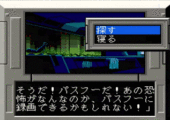
Narrative Foundation and Source Material
The game is a direct adaptation of the three-part Detonator Orgun OVA series, which debuted in Japan between 1991 and 1992. Directed by the renowned Masami Ōbari, the anime was a seminal work in the "mecha" genre, blending elements of sentient armor, existential sci-fi, and cosmic horror. The story is set in the mid-21st century and centers on Tomoru Shindo, a university student residing in the futuristic "City No. 5." Tomoru’s mundane life is disrupted by recurring dreams of a mechanized knight named Orgun.
Orgun is a member of the Evoluder, a militant extraterrestrial race of cyborgs who were once human but have since abandoned their organic origins to survive the rigors of deep space. Having rebelled against his warlike kin, Orgun flees toward Earth, eventually making telepathic contact with Tomoru. This connection allows Tomoru to pilot the Orgun armor, transforming him into Earth’s primary defense against the impending Evoluder invasion. The game specifically adapts the narrative beats of the first two episodes of the OVA, focusing on the slow-burn mystery of Tomoru’s transformation and the initial skirmishes with the Evoluder scouts.
Gameplay Mechanics and Interface Design
Departing from the high-octane action typically associated with mecha-themed media, Detonator Orgun on the Mega CD is a dedicated graphic adventure. It utilizes a menu-driven interface common to the "visual novel" genre, which gained immense popularity in Japan during the late 80s and early 90s. Players navigate the story through a series of static and semi-animated screens, interacting with the environment via a command window.
The primary interaction modes include:
- Look: Allows the player to examine specific background elements or characters to gather clues.
- Think: Provides internal monologue from Tomoru, often serving as a hint system to guide the player toward the next objective.
- Talk: Facilitates dialogue with NPCs, such as the scientist Michi Kanzaki or members of the Earth Defense Force.
- Move: Enables travel between various locations within City No. 5 and military installations.
Unlike contemporary titles like Snatcher or The Space Adventure, which featured light-gun shooting segments or complex puzzles, Detonator Orgun remains strictly focused on narrative progression. The "gameplay" is found in selecting the correct sequence of commands to trigger the next story beat. This design choice has been a point of contention among retro gaming historians; while it ensures a faithful recreation of the anime’s pacing, it offers little in the way of traditional mechanical challenge.
Technical Execution and Multimedia Integration
At the time of its release, the Mega CD was marketed on its ability to play Full Motion Video (FMV) and high-fidelity Redbook audio. Detonator Orgun utilizes these features to varying degrees of success. The game incorporates several cinematic sequences taken directly from the OVA. However, due to the Mega Drive’s hardware limitations—specifically its 64-color on-screen palette and the limited bandwidth of the single-speed CD-ROM drive—these scenes are heavily compressed. The result is a grainy, "dithered" aesthetic that, while impressive in 1992, struggled to capture the fluid animation and vibrant colors of Ōbari’s original work.
The audio presentation is similarly bifurcated. The game’s soundtrack was composed by Kouji Hayama, a veteran of the industry known for his energetic work on the Cho Aniki series. The opening cinematic features high-quality digital audio and full voice acting, providing an immersive experience that cartridge-based games of the era could not replicate. However, as the game progresses, the reliance on CD-DA (Compact Disc Digital Audio) diminishes. Significant portions of the game utilize the Mega Drive’s internal YM2612 FM synthesis chip for background music, and voice acting becomes increasingly sparse. This inconsistency suggests a development cycle hampered by storage constraints or budget limitations, as the "premium" feel of the CD format is not maintained throughout the entire experience.
Chronology of Development and Release
To understand the positioning of Detonator Orgun in the market, one must look at the timeline of the Mega CD’s lifecycle in Japan:
- December 1991: The Mega CD launches in Japan, promising a new era of multimedia gaming.
- Early 1992: The Detonator Orgun OVA concludes its three-episode run, reaching the height of its popularity among "otaku" audiences.
- July 31, 1992: HOT-B releases the game adaptation. It is positioned as a "bridge" between the anime and the gaming world, intended to capitalize on the OVA’s recent conclusion.
- 1993: The Mega CD (as the Sega CD) launches in North America and Europe. However, Detonator Orgun is not selected for localization, likely due to the high volume of Japanese text and the niche status of the anime outside of East Asia.
The lack of an international release meant that for decades, the game was only accessible to those with a Japanese Mega CD system and a high level of linguistic proficiency. The heavy reliance on kanji-dense menus made it nearly unplayable for non-speakers, further relegating it to the status of a rare collector’s item.
Critical Analysis and Market Impact
Upon its release, Detonator Orgun received a lukewarm reception from the Japanese gaming press. While praised for its faithful adherence to the source material, critics noted that the game suffered from a lack of interactivity. In an era where the Mega CD was competing against the PC Engine Super CD-ROM², which featured more robust "digital comics," Detonator Orgun felt somewhat technically underwhelming.
The game’s failure to incorporate the third and final episode of the OVA in a playable format—relegating it to a brief preview—was also a point of criticism. This decision made the game feel like an incomplete experience, serving more as a promotional tool for the home video release of the anime than a standalone piece of software.
From a broader industry perspective, Detonator Orgun represents the "quick-turnaround" licensing model of the 90s. Publishers would often secure the rights to a popular OVA, develop a visual novel with minimal gameplay, and release it while the property was still fresh in the public consciousness. This led to a saturated market of "interactive movies" that prioritized brand recognition over mechanical depth.
Legacy and Modern Relevance
Today, Detonator Orgun for the Mega CD is viewed primarily through the lens of preservation and niche fandom. The game is a testament to the early 90s cyberpunk aesthetic, capturing the neon-soaked, high-tech/low-life atmosphere that defined the era. For fans of Masami Ōbari, the game provides a unique, albeit flawed, way to engage with the Orgun universe.
The title also serves as a reminder of the challenges faced by early CD-ROM developers. The transition from the limited storage of cartridges to the 600MB capacity of a CD was a monumental shift, and many developers struggled to fill that space with meaningful content. The "audio regression" seen in Detonator Orgun—moving from CD audio back to chiptunes—highlights the logistical hurdles of managing data on first-generation CD hardware.
While Detonator Orgun may not be remembered as a masterpiece of the graphic adventure genre, its existence highlights a pivotal moment in gaming history where the lines between cinema and software began to blur. For modern collectors, it remains a fascinating artifact of a time when the "Sega CD" was the frontier of home entertainment, and the dream of "playing an anime" was just beginning to become a reality. Those seeking a more polished experience on the platform are often directed toward Urusei Yatsura: My Dear Friends or Lunar: The Silver Star, yet Detonator Orgun remains an essential study for those interested in the evolution of the Japanese visual novel and the early multimedia experiments of the 16-bit era.








