
 Jia Lissa
The release of Shining in the Darkness in 1991 marked a pivotal moment for Sega’s 16-bit hardware, establishing a franchise that would eventually rival the genre dominance of Nintendo’s flagship RPG properties. While Nintendo fans frequently cited The Legend of Zelda or Final Fantasy as the premier role-playing experiences of the era, Sega’s Shining series emerged as a versatile and enduring alternative. Over the subsequent decades, the series expanded to nearly two dozen entries across various platforms, yet its origins lie in the technical and creative ambitions of a small, independent studio named Climax Entertainment. Founded by industry veterans Hiroyuki Takahashi and Hiroshi "Kan" Naitō, Climax sought to move away from the established tropes of Japanese RPGs to create a more immersive, internationally accessible experience.
The Chunsoft Pedigree and the Formation of Climax
The architectural DNA of the Shining series is rooted in the development of the Dragon Quest franchise at Chunsoft, a developer closely associated with Enix and Nintendo. Both Takahashi and Naitō were instrumental in the production of Dragon Quest III and IV. Takahashi, whose background was in theater and television production rather than computer science, joined Enix after a brief stint as a ski instructor. His entry into the industry was fueled by an analytical obsession with game design; he famously compiled a comprehensive notebook of every line of dialogue in Dragon Quest III to map out narrative flow and quest logic. This attention to detail earned him an assistant producer role on the sequel.
Naitō, by contrast, was a self-taught programming prodigy who had been obsessed with 3D imagery since seeing wireframe graphics in the late 1970s. Having learned BASIC and Assembly language during high school, Naitō worked at Ample Software and Zap Corporation before joining Chunsoft. Despite the massive commercial success of the Dragon Quest series, both men felt constrained by the industry’s tendency toward imitation. Takahashi was particularly frustrated by what he perceived as a lack of respect for Japanese software in Western markets. During focus testing for Dragon Quest III in Seattle, he noted that American gamers often viewed Japanese titles as derivative of Western computer games. This observation motivated him to create a product that emphasized originality and a visual style that transcended the traditional manga aesthetic.

In April 1990, Takahashi and Naitō left Chunsoft to establish Climax Entertainment. They were joined by several colleagues, including Shinya Nishigaki, while other veterans like Manabu Yamana remained behind. The goal for Climax was to develop a "real-time haunted house fantasy," a concept that eventually evolved into the first-person dungeon crawler that became Shining in the Darkness.
Technical Evolution: From 8-Bit Limitations to 16-Bit Power
The decision to develop for the Sega Mega Drive (Genesis) rather than the Famicom or the newly released Super Famicom was a strategic choice based on hardware architecture. While Climax had deep ties to Nintendo, they found the 8-bit Famicom technologically insufficient for the 3D spatial awareness they wanted to achieve. Conversely, the Super Famicom’s architecture was still unfamiliar and presented a steep learning curve. The Mega Drive, powered by the Motorola 68000 CPU, offered a robust and well-documented environment that Naitō believed could handle the complex graphical calculations required for smooth pseudo-3D scrolling.

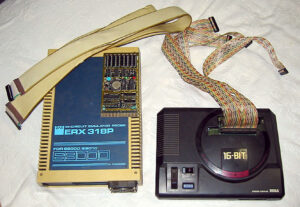
However, the transition was not without difficulty. Sega’s initial development tools were rudimentary, lacking the ability to provide accurate previews of graphical output. Naitō reportedly expressed his frustration directly to Sega R&D head Hisashi Suzuki, arguing that the company could not compete with Nintendo using such inefficient systems. To rectify this, Climax developed its own internal graphics tools and acquired a high-performance Hewlett-Packard workstation. This equipment provided the necessary speed to iterate on the game’s "Panorama 3D" engine, which aimed to simulate depth and perspective without the dedicated hardware scaling found in Nintendo’s Mode 7.
Design Philosophy and the Disney Influence
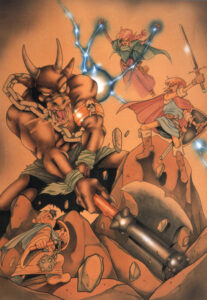
A defining characteristic of Shining in the Darkness was its departure from traditional Japanese art styles. Takahashi and Naitō were admirers of classic Disney animation, particularly the early black-and-white shorts and features like Alice in Wonderland. They recruited 18-year-old freelance artist Yoshitaka Tamaki to craft a visual identity that felt like an interactive cartoon. Tamaki utilized a "caricature" style for the characters and monsters, which allowed the game to maintain a consistent aesthetic despite the hardware’s sprite limitations.

The game’s setting, the Kingdom of Thornwood, was designed as a "stage" where characters could perform. Takahashi’s theater background influenced the game’s event-based interactions. Unlike contemporary RPGs where NPCs often provided static, repetitive dialogue, Shining in the Darkness utilized an auto-check system. Shopkeepers and townspeople would react to the party’s specific condition—such as if a member was poisoned or deceased—creating a sense of a living, reactive world.
Gameplay Innovation and the Icon-Based Command System
One of the most enduring legacies of Shining in the Darkness is its streamlined user interface. At a time when PC and console RPGs were defined by cumbersome text-heavy menus, Climax introduced an icon-based command system. This "whooshing" menu corresponded to the directional keys on the controller, allowing for rapid, intuitive navigation. While some critics suggested the system was inspired by Phantasy Star III, the Climax team maintained that their goal was to reduce the "burden" on the player, ensuring the manual was unnecessary for basic gameplay.
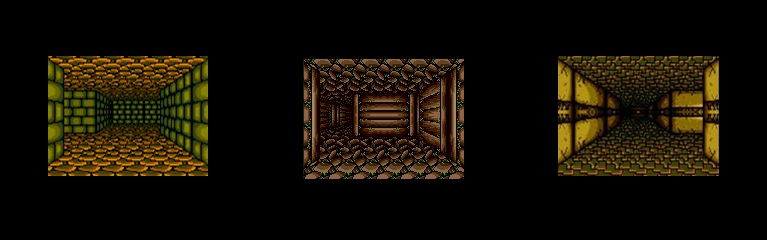
The dungeon exploration itself was a technical feat. To achieve smooth movement in the labyrinth, Special Effects Programmer Yasuhiro Taguchi used tile-based tricks and palette swapping to simulate depth. Because the Mega Drive lacked hardware scaling, every wall segment had to be meticulously placed to create a convincing illusion of movement. To preserve memory for these effects and high-quality monster animations, the developers made the conscious choice to shrink the playable window, surrounding it with a decorative border.
A controversial design choice was the omission of an auto-mapping system. Despite the complexity of the multi-floored labyrinth, Naitō believed that players should rely on landmarks—such as puddles, torches, and specific wall textures—to navigate. He argued that "spoon-feeding" the player with a map would diminish the satisfaction of mastery. Players were instead provided with limited tools, such as the "Wisdom Seed" item or the "View" spell, to orient themselves in emergencies.

Market Reception and Financial Realities
Shining in the Darkness launched in Japan on March 29, 1991, to immediate commercial success. It sold approximately 300,000 units, representing a roughly 16% attach rate for the Mega Drive’s Japanese install base at the time. Despite the lack of a significant marketing push from Sega of America, the game also found a dedicated audience in the West. Takahashi noted that the game received high praise from fans of Western dungeon crawlers like Wizardry, many of whom were surprised to learn the title was developed by a Japanese team.
Data and Performance Overview:

- Release Date: March 1991 (Japan), August 1991 (North America).
- Sales: ~300,000 units in Japan.
- Cartridge Size: 8-Megabit (one of the largest for its time).
- Soundtrack: Composed by Masahiko Yoshimura, featuring 18 major themes.
Despite the success, the relationship between Climax and Sega became strained during the development of the follow-up, Shining Force. Takahashi alleged that as Sega’s management became more profit-driven and corporate, they began to view Climax as an "unruly subsidiary." This shift in corporate culture eventually led Climax to seek more independence, though they continued to develop for Sega hardware through the Saturn era.
Broader Impact and Implications for the Genre
The legacy of Shining in the Darkness is twofold. First, it demonstrated that the Sega Genesis could serve as a viable home for high-quality RPGs, helping to diversify a library that was largely dominated by arcade ports and action games. Second, it established the "Shining" brand as a versatile entity. The game’s success allowed Climax to experiment with different sub-genres, leading to the creation of the tactical RPG Shining Force and the action-RPG Landstalker.
The game also influenced the industry’s approach to accessibility. The icon-based menu system pioneered by Climax became a standard for the genre, later refined by developers like Square in Secret of Mana. By prioritizing "interaction" over "menu management," Climax helped bridge the gap between hardcore PC-style dungeon crawling and the more approachable console RPG market.
In conclusion, Shining in the Darkness was more than a technical showcase for 16-bit hardware; it was a manifesto for a new kind of game design. By blending Western fantasy tropes with Japanese technical precision and Disney-inspired art, Hiroyuki Takahashi and Hiroshi Naitō created a landmark title that remains a cornerstone of the Sega library. The game’s success proved that a small team with a clear vision could disrupt the status quo, even in an industry dominated by corporate giants.








