 Indra Gunadi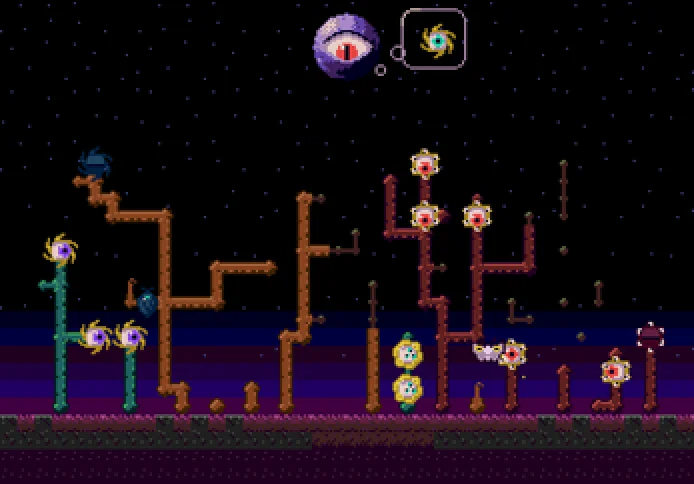
The release of Flowers Of Azathoth, a new title developed by Mike Daw for the Sega Megadrive, marks a significant entry in the contemporary homebrew scene for legacy gaming hardware. Debuting in late 2026, the game distinguishes itself through its atmospheric, meditative gameplay loop, departing from the high-octane action typically associated with the 16-bit era. By leveraging modern development tools, including AI-assisted coding, Daw has produced an experience that pushes the technical boundaries of the 1988 console while adhering to the hardware constraints that define the retro aesthetic.
Concept and Gameplay Mechanics
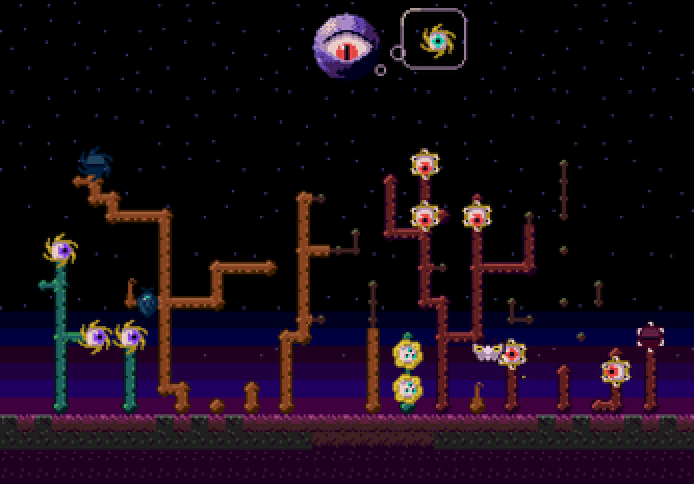
At its core, Flowers Of Azathoth presents players with a surreal, cosmic environment. The narrative and visual framing place the player within a vast terrarium, situated beneath the gaze of a colossal, dreaming eye. Unlike traditional platformers or shooters that populated the Megadrive library, this title focuses on a methodical, discovery-driven experience. Players assume the role of a moth, tasked with the pollination of exotic, otherworldly blooms.
The objective is to populate an 81-flower herbarium. This process is not merely a collection task but involves a deeper layer of emergent gameplay. Players must interact with the environment to uncover genetic traits, which are subsequently cataloged in an in-game notebook. This mechanic introduces a light simulation element, requiring players to observe and understand the relationships between different floral types. The pacing is intentionally slow, favoring a meditative quality that contrasts sharply with the rapid-fire twitch-reflex gameplay that characterized the late 1980s and early 1990s market.
The Evolution of the Sega Megadrive Homebrew Scene
The Sega Megadrive, known as the Sega Genesis in North America, remains one of the most prolific platforms for independent developers nearly four decades after its inception. The "homebrew" movement—the creation of new software for discontinued hardware—has seen a professionalization in recent years. Developers are no longer restricted to simple assembly language hacks; they are now utilizing sophisticated compilers and, increasingly, AI-assisted development tools to bridge the gap between modern programming efficiencies and archaic hardware limitations.
The development of Flowers Of Azathoth is emblematic of this transition. By utilizing AI-assisted code generation, Daw has managed to optimize the game’s performance to run on original hardware while maintaining a visual fidelity that feels both nostalgic and fresh. The Sega Megadrive’s Motorola 68000 processor, running at 7.67 MHz, imposes strict limits on memory and sprite handling. Managing these constraints while rendering the complex, surreal visuals of a cosmic terrarium represents a significant technical undertaking.
Chronology of Development and Release
The path to the release of Flowers Of Azathoth reflects the standard pipeline for modern retro titles. The project began in early 2025, with a focus on establishing the unique visual identity of the "cosmic terrarium." By mid-2025, the core loop of moth movement and pollination physics was established.
Throughout the first half of 2026, the project entered a refinement phase. Developers in the homebrew community frequently utilize community-driven forums and platforms like PDROMs to share build updates. During this period, the focus shifted from mechanical functionality to the expansion of the herbarium catalog, ensuring that the 81 unique flowers offered enough variety to sustain the player’s interest. The final build was finalized in October 2026, ensuring compatibility with both original PAL/NTSC consoles and various modern FPGA-based hardware clones.
Technical Analysis and AI Integration
The mention of AI-assisted code in the development of Flowers Of Azathoth raises pertinent questions regarding the future of retro game production. AI tools are increasingly being used to handle the tedious aspects of assembly optimization, such as memory allocation and register management, which are notoriously difficult for human developers working on 16-bit hardware.
By automating portions of the background processes, developers like Daw can dedicate more time to artistic direction and game design. This represents a paradigm shift. Historically, the "coding" phase of a Megadrive game was the most time-consuming and often the primary barrier to entry for solo developers. With the reduction of this barrier, the quality and complexity of indie releases are expected to rise. The use of AI in this context does not diminish the human role in design; rather, it functions as a force multiplier, allowing a single creator to achieve results that previously would have required a small team.
Broader Impact on Retro Gaming Markets
The release of Flowers Of Azathoth contributes to the growing ecosystem of physical releases for legacy systems. As the market for digital-only games expands, there is a counter-trend toward physical collecting, particularly in the retro community. The production of cartridges, manuals, and boxes for games released in 2026 demonstrates that the Sega Megadrive is no longer a "dead" platform in the eyes of enthusiasts.
Market analysts note that titles like Flowers Of Azathoth satisfy a niche demand for "slow gaming." In an era dominated by live-service games and competitive multiplayer, a meditative, single-player experience offers a reprieve for older gamers and curiosity for younger players seeking to understand the limitations and charms of early console design.
Official Perspectives and Community Response
While Mike Daw has not released a formal manifesto regarding his design philosophy, the community response within the homebrew scene has been largely positive. The "cosmic horror" aesthetic, albeit presented in a non-violent and contemplative way, has resonated with fans of the genre.
Industry experts who monitor the independent gaming landscape suggest that the success of projects like this serves as a benchmark for what is possible on original hardware. "The fact that a developer can take a 35-year-old console and produce a game that feels completely different from anything released in its original retail lifecycle is a testament to the longevity of the platform," says an industry observer familiar with the retro development scene.
Implications for Future Hardware Preservation
The continued release of new software for the Sega Megadrive has indirect benefits for the preservation of original hardware. As more games are released, there is an increased incentive to maintain and repair original consoles. Furthermore, the development of modern flash carts and FPGA clones—which are necessary to run homebrew software like Flowers Of Azathoth—drives innovation in hardware emulation.
By integrating modern techniques into the software layer, developers ensure that the Sega Megadrive remains a relevant platform for creative expression. Flowers Of Azathoth is not merely a nostalgic exercise; it is an active contribution to the living history of the medium. It proves that the "limits" of 16-bit hardware are, in fact, a canvas that continues to yield new and surprising results when approached with the right combination of technical skill and creative vision.
Conclusion: A New Chapter for 16-Bit Gaming
Flowers Of Azathoth stands as a significant milestone in the 2026 gaming calendar. It encapsulates the convergence of past and future, where the limitations of 1980s engineering are reconciled with the advancements of modern artificial intelligence. For the Sega Megadrive, the game represents an expansion of the console’s identity—from a battleground of high-speed platforming to a vessel for meditative, artistic exploration.
As players continue to uncover the secrets hidden within the moth’s herbarium, the legacy of the Megadrive continues to evolve. Whether viewed as an artistic experiment or a technical triumph, Flowers Of Azathoth provides a compelling reason to revisit the 16-bit era, confirming that even decades later, there is still much to discover beneath the gaze of the dreaming eye.