 Vera Clarissa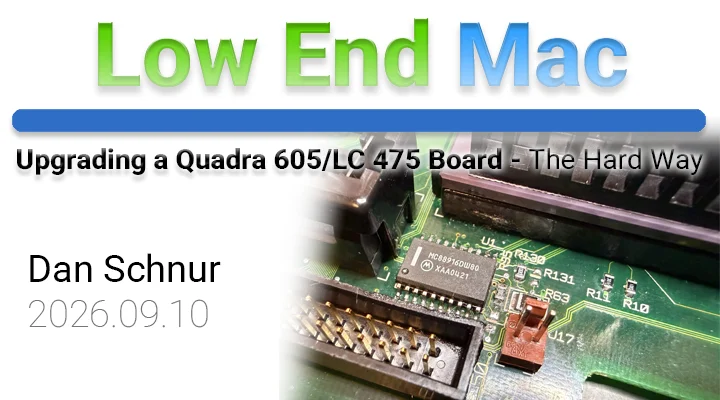
The restoration and modification of legacy hardware represent a unique intersection of electrical engineering, historical preservation, and technical ingenuity. A recent project involving the Macintosh Quadra 605, a cornerstone of Apple’s early 1990s desktop lineup, demonstrates how meticulous hardware-level modifications can extend the operational capacity of vintage computing equipment. By migrating from a stock MC68LC040 processor to a full-featured MC68040RC33, an enthusiast successfully transformed a modest 25 MHz machine into a 33 MHz system equipped with a dedicated floating-point unit (FPU), mirroring the performance characteristics of higher-tier contemporary models.
Historical Context and Technical Specifications
Released in late 1993, the Macintosh Quadra 605 was marketed as a budget-friendly entry into the powerful 68040-based series. To maintain a lower price point, Apple utilized the MC68LC040—a "low cost" version of the Motorola 68040 that lacked an FPU. While this decision saved manufacturing costs, it severely hindered the machine’s utility for scientific calculations, complex graphics rendering, and certain specialized software suites of the era.

The Quadra 605, also known as the LC 475 in certain markets, utilized a highly integrated logic board designed to be adaptable. As archival schematics reveal, Apple’s engineers anticipated potential hardware revisions or tiered product releases by designing the board with modular clock configuration pathways. These pathways allowed for multiple processor speeds, provided that the appropriate passive components and clock-management integrated circuits were correctly installed.
Chronology of the Restoration
The restoration process began with a faulty logic board, specifically one suffering from a non-functional MC68LC040 processor. The initial assessment confirmed that a direct swap with a spare MC68040RC33—a 33 MHz chip featuring a fully functional FPU—was theoretically possible. However, simply replacing the processor proved insufficient for stable operation.
The technical workflow for the upgrade followed a rigorous four-phase approach:

- Clock Configuration Resistors: The logic board contains a matrix of resistor positions (R21, R22, R24, and R25) that dictate the system’s timing. By reconfiguring these resistors from the factory-standard 25 MHz setup to the 33 MHz specification, the board was forced to synchronize with the faster processor clock. This involved physically desoldering and moving resistors R25 and R21 to the R22 and R24 positions, respectively.
- Precision Impedance Matching: The R13 resistor, situated directly beneath the processor, functions as a critical component in voltage and clock signal stability. The upgrade required a transition from the 212-Ohm standard to a 140-Ohm value. Due to the scarcity of 140-Ohm surface-mount devices, the restoration utilized a series configuration of 120-Ohm and 20-Ohm resistors, ensuring precise adherence to the required 1% tolerance.
- Resistor Bank Adjustment: The adjustment of R95 and R96 served as the final passive component modification. These resistors act as a selector switch for the clock frequency, and moving the component from R95 to R96 signaled the logic board to operate at the higher 33 MHz frequency.
- Active Component Replacement: The final and most difficult phase involved replacing the U1 clock-generator chip. The original MC88920 was deemed incompatible with the 33 MHz timing requirements. Substituting this with the obsolete MC88916 required specialized hot-air desoldering techniques, careful protection of adjacent components with heat-resistant Kapton tape, and precise manual soldering.
Supporting Data and Component Requirements
The technical specifications for the Quadra 605 upgrade highlight the importance of component selection in vintage hardware modification. Below is the configuration table derived from original engineering schematics, which dictates the necessary hardware state for specific performance tiers:
| System Clock Speed | Resistor Configuration | R13 Value (1% Tolerance) |
|---|---|---|
| 20 MHz | R22 and R25 | 121 Ohm |
| 25 MHz | R21 and R25 | 212 Ohm |
| 33 MHz | R22 and R24 | 140 Ohm |
| 40 MHz | R21 and R24 | 110 Ohm |
The shift from the MC88920 to the MC88916 chip is essential for maintaining signal integrity at higher frequencies. As these components have long been discontinued, the project highlights the necessity of relying on "new old stock" (NOS) sources. The success of the boot sequence—signified by the iconic Macintosh startup chime—confirmed that the electrical modifications were within the tolerance limits of the original printed circuit board (PCB) traces.
Analytical Perspectives on Hardware Longevity
The implications of such modifications extend beyond mere hobbyist satisfaction. This project serves as a case study in "design for repairability" and "design for upgradeability." Apple’s decision to include these configuration options in the mid-1990s demonstrates a commitment to hardware flexibility that is rarely seen in modern, highly integrated, and proprietary hardware architectures.

From an engineering standpoint, the fact that a 33 MHz upgrade functions reliably on a board originally designed for 25 MHz suggests that Apple’s design margins were substantial. This over-engineering is precisely what allows vintage systems to remain functional decades after their original support lifecycle ended.
Broader Impact and Industry Implications
While software-based overclocking utilities—such as the well-regarded Soft 475—offer a safer and less invasive alternative for users, the physical modification of the logic board provides a more permanent and "factory-correct" solution. It aligns the hardware’s electrical state with the performance requirements of the processor, potentially reducing the thermal and electrical stress that software-based overrides might otherwise introduce.
The broader impact of this restoration is the preservation of technical knowledge. As original schematics and component specifications become harder to locate, the documentation of these processes ensures that future generations of engineers and enthusiasts can maintain and iterate upon these platforms. The Quadra 605, once a entry-level device, now stands as a testament to the longevity of 68k-series architecture.

In conclusion, the successful upgrade of the Quadra 605 logic board is more than a simple speed increase; it is an act of technical reclamation. By navigating the complex requirements of timing, impedance, and component sourcing, the restoration process has successfully bridged the gap between the budget constraints of the 1990s and the performance potential of the era’s higher-end hardware. Such projects reinforce the viability of legacy systems in the modern era, proving that with enough technical documentation and careful execution, even the most constrained hardware can be brought into the next phase of its functional life.