 Farhan hamdan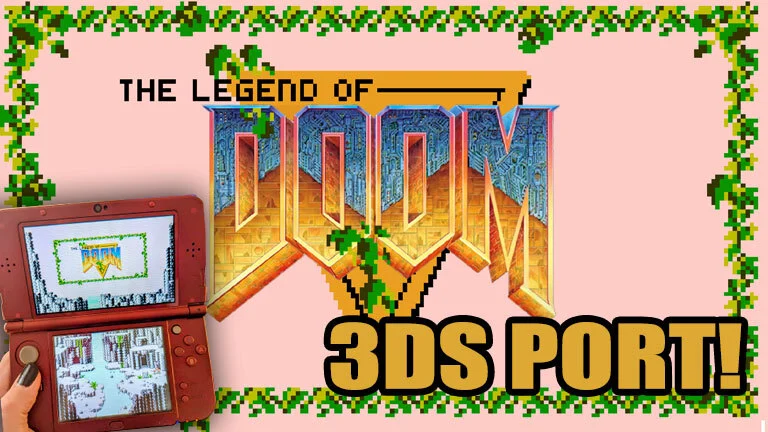
The fusion of classic retro gaming concepts has reached a new milestone as developer EstebanPdN successfully ports the acclaimed total conversion mod Legend of Doom to Nintendo’s venerable handheld console, the 3DS. Originally conceptualized and developed by DeTwelve Games on the independent creator platform itch.io, Legend of Doom reimagines the seminal 1986 Nintendo Entertainment System classic, The Legend of Zelda, through the lens of id Software’s genre-defining 1993 first-person shooter, Doom. Version 1.0 of this homebrew adaptation bridges the gap between mid-1990s PC engine architecture and dual-screen portable hardware, offering players a novel perspective on Hyrule’s foundational topography.
The release arrives as homebrew development for the Nintendo 3DS continues to sustain an active community lifecycle long after the official commercial discontinuation of the hardware and the closure of the Nintendo eShop. By utilizing the GZDoom engine framework, the 3DS port operates independently, requiring neither a proprietary NES ROM nor a commercial Doom WAD file to function. This standalone operational capacity significantly lowers the technical barrier to entry for end-users interested in experiencing the total conversion on physical portable hardware.
Technical Implementation and Handheld Optimizations
Adapting a PC-centric ray-casting total conversion for portable console hardware demands careful consideration of control schemes and interface design. EstebanPdN’s 1.0 release addresses these ergonomic challenges by incorporating specific features tailored to the physical layout of the Nintendo 3DS family of systems.
Most notably, the port includes native support for the secondary analog control input found on the "New" revision of the 3DS hardware line, enabling contemporary twin-stick first-person shooter mechanics. For players utilizing legacy hardware iterations without the built-in C-stick or Circle Pad Pro peripheral, alternative control layouts remain necessary, highlighting the hardware-dependent nature of modern handheld homebrew adaptations.
Furthermore, the dual-screen configuration of the 3DS is leveraged to improve spatial awareness and inventory management. The lower resistive touch screen hosts a persistent overhead map derived from the original NES release, paired with a responsive tap-to-toggle inventory system. This design choice removes the necessity of pausing gameplay or opening obstructive full-screen menus, streamlining the core loop of exploration and combat characteristic of the early Zelda template.
Despite these hardware-specific integration successes, certain technical limitations persist within the current build. Unlike select other software ports available on the platform—such as the Prboom-plus implementation for 3DS—Legend of Doom does not currently feature support for the system’s autostereoscopic 3D display effect. Consequently, the visual presentation remains strictly two-dimensional, requiring players to rely entirely on environmental audio cues and visual sprite scaling to judge combat distances within the retro-styled first-person perspective.
Chronology of Development and Distribution
The trajectory from an independent PC-based experiment to a functional handheld console port reflects the collaborative nature of modern video game modification communities. The foundational project, created by DeTwelve Games, initially circulated within online PC retro-gaming spaces via itch.io, demonstrating the persistent flexibility of the GZDoom source port ecosystem for total conversions that deviate entirely from traditional military or sci-fi shooter aesthetics.
Following the PC release, developer EstebanPdN undertook the optimization and compilation process required to transfer the resource-heavy engine framework to the ARM-based architecture of the 3DS. Version 1.0 of the port was officially deployed to public repositories in mid-September 2026.
Distribution of the software is handled primarily through open-source platforms to ensure accessibility for modded console owners. Users operating custom firmware environments can install the application directly via QR code utilizing the FBI Remote Install utility, while traditional manual installation files remain hosted on GitHub alongside the original DeTwelve Games project page.
Community Response and Retro-Gaming Implications
Initial reception within the portable retro-gaming and homebrew communities has been largely positive, with early adopters praising the seamless integration of dual-analog controls and the utility of the bottom-screen map interface. Content creators and preservationists have noted that experiencing a top-down franchise translated into a spatial first-person grid structure offers a fresh analytical perspective on level designs originally engineered four decades ago.
The release also underscores the enduring viability of hardware longevity through unauthorized software development. As manufacturers shift commercial support away from older generations of portable consoles, community-driven engineering projects frequently extend the operational relevance of these devices. By transforming familiar intellectual properties through unexpected genre combinations, developers like EstebanPdN and DeTwelve Games contribute to an ongoing informal archive of video game experimentation, ensuring that classic titles continue to inspire creative reinterpretation across hardware generations.