Vera Clarissa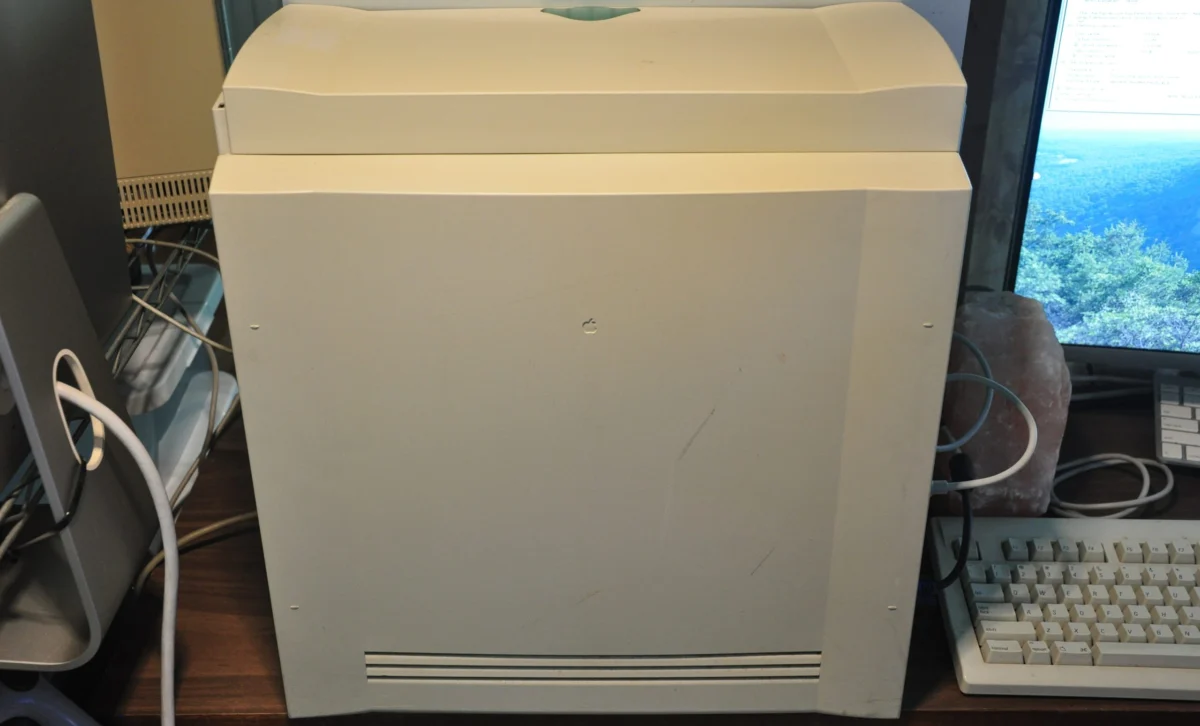
The acquisition of a heavily upgraded Power Macintosh 9600/300 following the recent VCF Midwest exhibition provides a rare window into the late-1990s enthusiast culture of Apple hardware modification. This specific unit, salvaged from the collection of Low End Mac contributors, stands as a testament to the longevity of the PowerPC architecture. Originally released on August 5, 1997, the 9600 series represented the pinnacle of Apple’s professional desktop line before the company transitioned toward the G3 and G4 architectures. Discontinued on March 17, 1998, the model had a relatively short market lifespan, yet its expandability made it a primary target for third-party performance upgrades that allowed owners to keep pace with the rapidly evolving computing landscape of the late 20th century.
Historical Context and Market Positioning
In 1997, the Power Macintosh 9600 was marketed as a high-end workstation designed for graphic designers, video editors, and prepress professionals. At its base configuration, the 300 MHz model was a formidable machine, but the rapid acceleration of processor speeds during the "MHz Wars" of the era meant that owners were quick to adopt aftermarket cards. The unit currently under examination is equipped with a 445 MHz Newer Technology MaxPowr G3 processor upgrade. This component was emblematic of the thriving "upgrade culture" of the late 90s, where companies like Newer Technology, Sonnet, and PowerLogix provided the means for users to extend the lifecycle of their investment by replacing the original PowerPC 604e CPUs with newer G3 (PowerPC 750) or G4 (PowerPC 7400) technology.

The 9600 was unique in its design, offering a massive tower chassis with 12 memory slots and six PCI expansion slots, providing an unprecedented level of modularity. This specific machine arrived in remarkably pristine condition, with its internal components appearing largely untouched by the environmental degradation that often plagues vintage electronics. The current plan for the machine involves a comprehensive restoration of the chassis, including the removal of yellowing from the original Apple Platinum plastic housing—a process known as "retrobriting"—which utilizes hydrogen peroxide and UV exposure to revert the flame-retardant additives to their original aesthetic state.
Technical Specifications and Upgrades
The hardware configuration of this particular Power Mac 9600/300 serves as a snapshot of a high-end workstation as it would have appeared in the early 2000s. Beyond the processor upgrade, the system features a robust suite of expansion cards that allow it to interface with modern storage and networking standards:
- Processor: Newer Technology MaxPowr G3 (445 MHz).
- Storage Interface: Sonnet Tempo HD Ultra ATA/133 (Ultra-Tek133P+) PCI card, allowing for high-capacity IDE drive support.
- Networking: D-Link DFE-530TX+ 10/100 PCI Ethernet controller, a necessary upgrade for machines that predated built-in 100 Mbps networking.
- Graphics: Dual-card configuration featuring an ATI 3D Rage II and an ATI Rage LT Pro with 8 MB of SDRAM.
- Connectivity: A Lucent-based USB and FireWire PCI combo card, which was essential for bringing legacy machines into the era of peripheral standardization.
- Legacy Storage: ATTO 68-Pin Express PCI SCSI controller, providing high-speed connectivity to professional-grade storage arrays of the period.
The Memory Architecture Challenge
One of the most complex aspects of the Power Macintosh 9600 is its memory subsystem. The machine is currently reporting 1.18 GB of RAM, a massive amount for a system released in 1997. Expert consultation with vintage computing historians, such as Dan Bashur, highlights the extreme costs associated with such configurations at the time. In 1997, 128 MB DIMMs were cutting-edge, and filling all 12 slots could cost upwards of $20,000, depending on the market price of memory at the time.

The complexity of the memory configuration in this unit suggests a mix of 128 MB, 64 MB, and 32 MB modules. The system architecture of the 9600 requires precise matching of DIMMs to maintain optimal performance. The use of EDO (Extended Data Out) RAM at 60ns was the gold standard for these machines, as it offered the lowest latency. The fact that this unit boots slowly is not a result of a failing drive, but rather a characteristic of the high-capacity RAM modules, which require significant initialization time during the Power-On Self-Test (POST) process.
Modern Implications for Vintage Computing
The decision to keep this machine as a dedicated Mac OS 9 workstation, rather than attempting to force modern operating systems like Mac OS X onto it, reflects a shift in the vintage computing community. While earlier investigations considered installing Mac OS X Tiger and utilizing a PCI-to-PCIe graphics adapter, technical limitations made this path impractical. A GeForce 6600 LE graphics card, for instance, requires more power than the 25W limit imposed by the PCI bus on the 9600’s logic board, and the overhead of such a card would bottleneck the system’s narrow bus bandwidth.
By committing to OS 9, the user gains access to a software ecosystem that defined a generation of digital creativity. With Adobe Photoshop 5.5 already installed, the machine remains a functional tool for processing legacy files. Future plans include the implementation of a local FTP server to facilitate file transfers over a network, effectively bridging the gap between this machine and modern workstations.

Sociological Impact: The "Familiar Era"
For many enthusiasts, the late 1990s and early 2000s represent the "familiar era" of computing—a time when home PCs became accessible, and school computer labs introduced students to the internet and educational software. For the current owner, this 9600 acts as a bridge to that period. While their first personal machine may have been an HP Pavilion a430n, the Power Mac 9600 represents the professional counterpart that was often out of reach for the average household.
The collaborative nature of this project, involving the trade and exchange of hardware among enthusiasts at Low End Mac, underscores the importance of community in the preservation of computing history. By maintaining these machines, the community is not merely hoarding electronics; they are documenting the evolution of human-computer interaction.
Conclusion
The restoration of this Power Mac 9600/300 is more than a technical exercise; it is an act of preservation. The machine is a relic of a time when Apple’s professional hardware was characterized by extreme modularity and a clear path for user-driven upgrades. Whether or not the machine is eventually fitted with an IDE-to-SD or IDE-to-mSATA storage solution, the primary goal remains the same: to keep this piece of history operational. As it stands, the 9600 is a fully functioning, high-performance workstation that continues to demonstrate why the Power Macintosh line remains one of the most respected series in the history of personal computing. Through careful maintenance and the application of contemporary connectivity standards, this vintage tower will continue to serve as a functional reminder of a pivotal decade in technology.