Farhan hamdan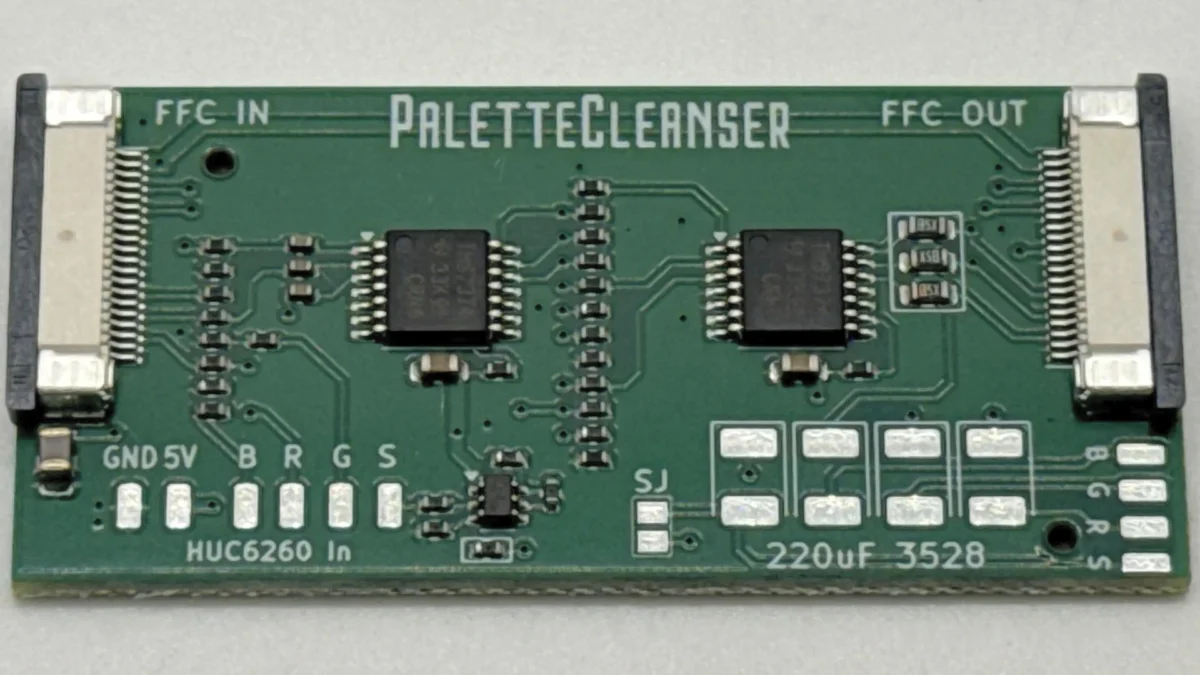
The landscape of retro video game hardware modification has achieved a notable technical milestone with the introduction of the "Palette Cleanser," a new internal RGB modification designed for NEC’s PC Engine and TurboGrafx-16 consoles. Developed by hardware creator Zaxour, the device permanently resolves a long-standing color-reproduction anomaly that has affected RGB-modded versions of the hardware for decades. Historically, modifying these systems to output RGB video signals resulted in color palettes that deviated noticeably from the original composite video (CVBS) standard intended by the console’s designers. The Palette Cleanser addresses this discrepancy at the hardware level on original systems, bridging the gap between crisp modern display compatibility and authentic visual presentation.
Background and Technical Context of the PC Engine Color Issue
The core technical challenge dates back to the architecture of the NEC PC Engine, originally released in Japan in October 1987, and its North American counterpart, the TurboGrafx-16, launched in August 1989. Designed primarily around composite video output standards of the late 1980s, the console generated colors using a specialized video encoder chip that mapped pixel data in a way that inherently relied on composite artifacts for intended hue perception.
When retro-gaming enthusiasts first began developing internal RGB bypass modifications decades ago to achieve sharper image quality on modern monitors and upscalers, they unlocked high-resolution clarity, but at a severe aesthetic cost. The direct translation of digital color data to an RGB format bypassed the natural color blending and saturation characteristics inherent to the native composite video signal. Consequently, games frequently appeared overly saturated, washed out, or exhibited shifted hues compared to how developers viewed them on period-accurate cathode-ray tube (CRT) televisions using composite or RF connections.
For years, the community consensus was that achieving an authentic color palette over a pure RGB connection on original hardware was virtually impossible without resorting to software emulation, FPGA-based retro consoles, or complex digital-to-analog decoding arrays analogous to an internal "HDMI-to-RGB" converter. The technical community largely accepted these color inaccuracies as an unavoidable compromise of achieving pristine signal sharpness.
The Chronology of Discovery and Development
The modern path toward correcting this hardware limitation began in earnest roughly five years ago, marked by extensive investigative research published by software and hardware engineer Dan Mons. Mons conducted a deep technical analysis into the mechanics of the PC Engine’s color generation, publicly documenting the exact mathematical and electronic divergences between the console’s native output and standard RGB interpretations. His findings provided the foundational data necessary for hardware modders to understand why standard RGB bypasses failed to render accurate tones.

Building upon Mons’s foundational research, hardware developer Zaxour engineered the Palette Cleanser to intervene directly within the console’s video pipeline. Rather than simply rerouting signals, the device recalibrates the color matrix to mirror the intended aesthetic of the original composite signal while maintaining the geometric sharpness and lack of interference characteristic of an RGB connection.
The release of the hardware was previewed extensively through technical demonstrations, including a collaborative overview by the prominent retro-gaming preservation channel My Life In Gaming, alongside detailed implementation walkthroughs provided by Zaxour.
Pricing, Hardware Compatibility, and Installation Requirements
The Palette Cleanser is currently available for purchase through Zaxour’s official Ko-fi storefront at a base price of $50 for the modification board itself. However, because NEC released numerous hardware revisions of the PC Engine ecosystem over its lifespan, prospective buyers must acquire an additional console-specific adapter board to match their exact hardware model.
Comprehensive installation documentation has been made publicly available via dedicated digital repositories, detailing compatibility across a wide array of system revisions. Supported hardware includes:
- Original white PC Engine models
- PC Engine CoreGrafx and CoreGrafx II
- PC Engine Duo, Duo-R, and Duo-RX variants
- North American TurboGrafx-16 systems
- The Pioneer LaserActive system utilizing the PCE-PAC video module
A vital consideration for prospective installers is the modular nature of the hardware ecosystem. Zaxour has emphasized that most users will need to purchase a bundle containing both the primary Palette Cleanser board and a secondary interface adapter tailored to their specific console revision or pre-existing modification infrastructure. Installers who pair the Palette Cleanser with Zaxour’s existing "TurboNanza" modification kit also gain full S-Video output functionality, ensuring that composite, S-Video, and RGB signals achieve uniform, synchronized color accuracy across all active ports.
Alternative Solutions and External Plug-and-Play Adapters
While internal hardware modifications remain the gold standard for comprehensive system overhauls—particularly for monolithic units like the PC Engine Duo series and specialized peripheral modules where internal space is at a premium—the market has also seen simultaneous developments in external solutions.

Recent months have introduced external plug-and-play adapter modules, such as those developed by Polykubos, which attempt to correct the PC Engine’s color palette externally without requiring soldering or console disassembly. While initial reports from early adopters indicate that external modules show significant promise for users averse to permanent hardware modifications, the technology remains in an iterative phase. Minor implementation hurdles and hardware quirks are still being ironed out by developers.
Consequently, internal solutions like the Palette Cleanser remain the most robust, reliable, and universally compatible option for owners of complex console variants, while external adapters cater to users seeking reversible, non-invasive enhancements for standard console shells.
Implications for Retro-Gaming Preservation and Display Standards
The commercial release of the Palette Cleanser represents a significant step forward in the niche yet dedicated field of retro-video preservation. As original gaming hardware ages, the community’s standards for fidelity have shifted from mere functional operation to absolute historical accuracy.
For decades, purists faced a difficult dilemma: accept the blurry, artifact-laden picture of native composite video to experience authentic color art direction, or adopt clean RGB modifications at the cost of distorted palettes that developers never intended players to see. By reconciling signal clarity with chromatic authenticity, modifications of this caliber ensure that classic titles developed for the PC Engine and TurboGrafx-16—ranging from atmospheric role-playing games to fast-paced action titles—can be experienced on modern high-definition displays and upscalers precisely as they appeared on Japanese development monitors in the late 1980s.
As independent hardware developers continue to reverse-engineer and rectify vintage hardware limitations, the boundaries of what original 8-bit and 16-bit systems can achieve on modern display technology continue to expand, offering hardware enthusiasts unprecedented control over their retro-gaming environments.