
 Jia Lissa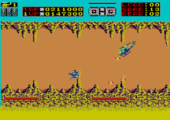
The 1986 release of Choplifter on the Sega Master System marked a significant milestone in the evolution of home console gaming, representing a sophisticated bridge between the burgeoning arcade industry and the home entertainment market. Originally conceived by Dan Gorlin for the Apple II in 1982 and published by Brøderbund, the title underwent a transformative evolution when Sega Enterprises acquired the rights for an arcade adaptation in 1985. This arcade version, developed by Sega’s internal teams under the guidance of Rikiya Nakagawa, introduced mechanical refinements and environmental variety that would eventually define the Master System port. By the time the game reached the Sega Master System (known as the Mark III in Japan), it had transitioned from a monochromatic computer simulation into a vibrant, high-stakes action title that utilized the superior 8-bit hardware of Sega’s console to outperform many of its contemporaries.
Historical Context and Development Origins
To understand the impact of Choplifter on the Sega Master System, one must examine the state of the video game industry in the early-to-mid 1980s. The original 1982 Apple II version was a technical marvel for its time, featuring physics-based movement and a focus on non-combat objectives—namely, the rescue of hostages. However, the 1985 arcade conversion by Sega Enterprises USA reimagined the title for a more demanding audience. Debuting as a conversion kit alongside the motorcycle racer Hang-On, the arcade Choplifter was a product of the Sega System 1 hardware.
Rikiya Nakagawa, a developer who would later become synonymous with Sega classics such as Alien Syndrome and Thunderblade, was tasked with modernizing the gameplay. Nakagawa’s revisions were fundamental: he reduced the number of hostages per "wave" from 16 to eight to increase the frequency of tense landing sequences and introduced three distinct environments. These included the classic desert, a naval fleet on the open ocean, and a subterranean cave system. When Sega ported this version to the Master System in 1986, the goal was to retain the arcade’s visual fidelity and increased difficulty, providing a "killer app" for the console to compete against the Nintendo Entertainment System (NES).
Core Gameplay Mechanics and Mission Structure
The Master System iteration of Choplifter centers on the operation of a combat search-and-rescue helicopter. Unlike traditional "shoot ’em ups" (shmups) of the era, which often focused on the total destruction of enemy forces, Choplifter introduced a delicate balancing act between offensive maneuvers and humanitarian rescue. Players are tasked with infiltrating enemy territory to retrieve 64 hostages held in various barracks and enclosures.
The rescue process is a multi-stage operation requiring precision and spatial awareness. First, the pilot must navigate a side-scrolling environment filled with anti-aircraft tanks, jet fighters, and stationary turrets. Upon reaching the hostage sites, the player must use the helicopter’s weaponry to breach the buildings. Once the hostages emerge, the player must land the helicopter—a maneuver fraught with risk, as landing directly on a hostage results in an immediate fatality for the civilian.
The helicopter’s capacity is limited to 16 passengers. This constraint forces the player to make multiple sorties back to the home base (the "Post"). The tension is exacerbated by the fact that the further the player progresses into the stage, the longer and more dangerous the return trip becomes. To advance to the subsequent stage, the player must successfully return 40 hostages to safety. With a total of 48 hostages available per stage (across three environments looped twice for a total of six levels), the margin for error is slim, particularly in the later, more claustrophobic stages.
Technical Specifications and Visual Innovation
From a technical standpoint, Choplifter was a showcase for the Sega Master System’s VDP (Video Display Processor). The Master System boasted a palette of 64 colors, with 32 available on-screen simultaneously, a significant advantage over the NES’s more restricted color capabilities. Sega utilized this hardware to implement parallax scrolling, a technique where background layers move slower than the foreground to create an illusion of depth.
The environmental design of the three primary stages demonstrated the console’s versatility:
- The Desert Stage: Utilized bright oranges and yellows, featuring heat-shimmer effects and smooth scrolling as tanks and jets converged on the player.
- The Sea Stage: Introduced a fleet of battleships and submarines. A notable detail in this version is the animation of hostages swimming from the wreckage of submarines to the landing struts of the helicopter.
- The Cave Stage: Widely considered the most difficult portion of the game, this stage utilized the Master System’s ability to handle complex tile-based environments. The narrow corridors and stalactites required pixel-perfect navigation, pushing the Zilog Z80 CPU to its limits to maintain a consistent frame rate despite the increased number of on-screen hazards.
Sega also included "Easter eggs" to reward high-level play. If a player managed to destroy 16 rockets in a single life, icons of Superman or E.T. the Extra-Terrestrial would appear in the background, a nod to the pop culture landscape of 1986 and a demonstration of the developers’ attention to detail.
Chronology of the Choplifter Franchise (1982–1986)
The development and release timeline of Choplifter illustrates the rapid maturation of the gaming industry during the 8-bit era:
- May 1982: Dan Gorlin releases Choplifter for the Apple II. It becomes a top-seller for Brøderbund.
- 1982–1984: The game is ported to various home computers, including the Atari 8-bit family, Commodore 64, and VIC-20.
- October 1985: Sega Enterprises USA releases the arcade conversion kit. This version introduces the "Sega style" of gameplay: higher difficulty, enhanced graphics, and the three-stage loop.
- June 1986: Sega releases the Master System (Mark III) version in Japan.
- September 1986: The game sees a wide release in North America and Europe, becoming a cornerstone of the Master System’s early library.
- Late 1986: A Famicom/NES version is developed by Tokuma Shoten, though it is often criticized for lacking the graphical polish and smooth controls found in the Sega iteration.
Comparative Analysis and Market Reception
At the time of its release, Choplifter was positioned as a premium arcade port. Internal Sega marketing materials from 1986 emphasized the "Arcade Quality" of the Master System, often contrasting its titles with the visually simpler games found on the Nintendo Entertainment System. The Master System version of Choplifter was praised for its faithful recreation of the arcade experience, a feat that was difficult to achieve with mid-80s home hardware.
However, the game was not without its criticisms. Contemporary reviews noted the "steep difficulty curve," particularly regarding the cave stage. The lack of traditional boss encounters—a staple of the shmup genre—meant that the challenge was derived entirely from environmental hazards and enemy density. Furthermore, the game’s length was a point of contention; a skilled player could complete all three environments in approximately 15 minutes. While the game looped to provide a "second loop" with increased difficulty and a night-time palette swap for the desert stage, the lack of additional unique content limited its long-term replayability for some.
Despite these factors, the game was a commercial success for Sega. It helped establish the Master System as a haven for arcade enthusiasts and proved that Sega’s internal development teams could successfully translate complex arcade logic into a home format.
Broader Impact and Industry Legacy
The legacy of Choplifter on the Sega Master System extends beyond its 1986 sales figures. It represents an early example of "Rescue-based Action," a sub-genre that would later influence titles like Desert Strike and Resogun. By prioritizing the safety of non-player characters (NPCs) over the simple destruction of enemies, Choplifter introduced a moral and strategic layer to the action genre.
Furthermore, the game’s transition from a Western computer game to a Japanese arcade hit and back to a global console success story highlights the cross-pollination of ideas between the U.S. and Japanese gaming markets in the 1980s. Sega’s willingness to take a pre-existing American property and refine it through the lens of Japanese arcade design standards created a hybrid experience that appealed to a global audience.
Today, Choplifter is remembered as a quintessential Master System title. Its inclusion in various retro collections and its influence on modern indie developers who favor high-stakes, physics-based rescue mechanics ensure its place in the canon of video game history. For the Sega Corporation, Choplifter served as an early demonstration of their ability to curate a library that offered more than just simple distractions, providing instead a tense, atmospheric, and technically impressive experience that defined the 8-bit generation.








