Vera Clarissa
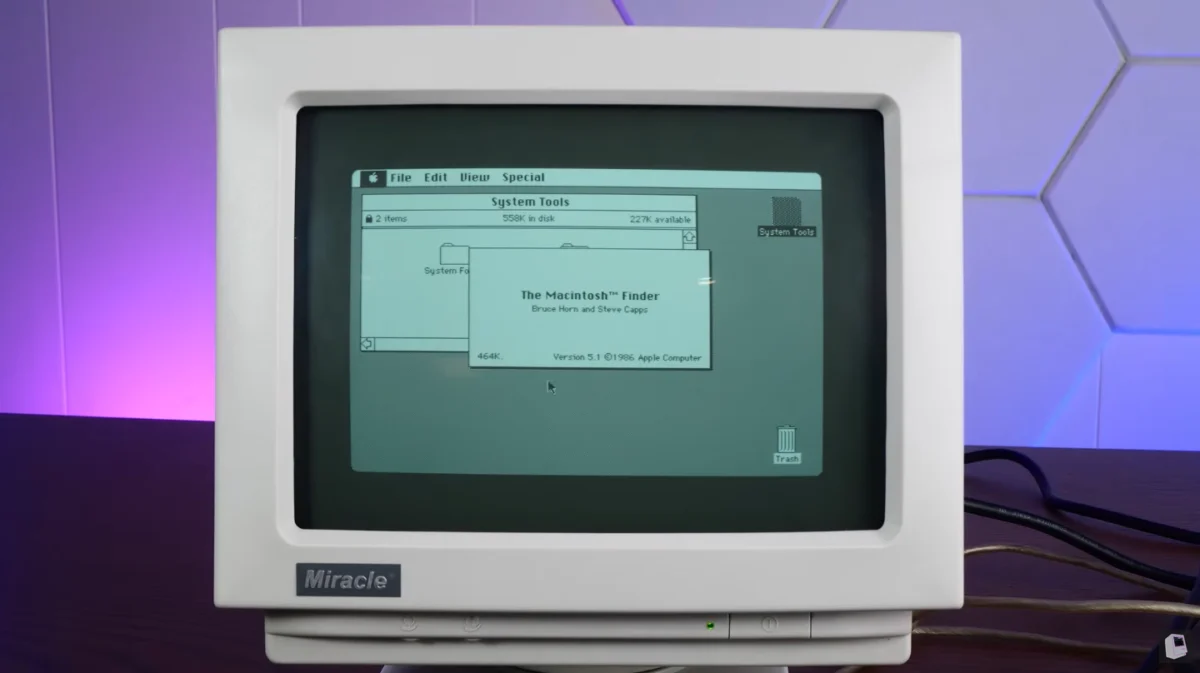
The evolution of personal computing has reached a definitive milestone with the introduction of the Pico Micro Mac, a device that effectively shrinks the architectural footprint of the original 1984 Macintosh 128K into a form factor roughly equivalent to a standard tin of mints. Spearheaded by the enthusiast collective associated with Ron’s Computer Videos and recently brought to the broader public consciousness via the Action Retro YouTube channel, this project represents a significant departure from traditional emulation. By leveraging modern microcontroller technology, the Pico Micro Mac provides a hardware-level replication of the original Macintosh experience, offering a functional bridge between 1980s computing history and contemporary minimalist hardware design.
Historical Context and Technical Evolution
To understand the significance of the Pico Micro Mac, one must first consider the technological constraints of the original Apple Macintosh 128K. Released in January 1984, the original machine featured a Motorola 68000 processor running at 7.8336 MHz, accompanied by 128 kilobytes of RAM. At the time, its all-in-one chassis was considered a marvel of space efficiency, though it occupied a significant portion of a standard office desk. Over the subsequent four decades, the preservation of these machines has become increasingly difficult due to the degradation of electrolytic capacitors, the scarcity of proprietary components, and the sheer physical space required to maintain a collection of vintage hardware.
The Pico Micro Mac enters this landscape not as a high-fidelity emulator running on a modern operating system, but as a dedicated microcontroller-based solution. It utilizes the processing power of the Raspberry Pi Pico—a microcontroller board built around the RP2040 chip—to handle the complex timing requirements of the 68000 instruction set. This approach allows the device to interface with modern peripherals while maintaining the software compatibility expected of a vintage Macintosh.
Chronology of the Pico Micro Mac Development
The development of the Pico Micro Mac follows a growing trend in the "maker" community toward the miniaturization of classic computing platforms. While early retro-computing projects focused on field-programmable gate arrays (FPGAs) to recreate hardware logic, the shift toward microcontrollers has lowered the barrier to entry significantly.

In the months leading up to its public release, the project underwent several iterations. Early prototypes focused on basic cycle accuracy, ensuring that the software would interpret the hardware as a genuine 1984 Macintosh. As the project moved from breadboard prototypes to production-ready printed circuit boards (PCBs), the designers prioritized accessibility. By mid-2026, the device reached a level of maturity that allowed for the small-batch commercial production currently seen through the JCM-1 distribution platform. The recent exposure on major retro-computing digital platforms served as a catalyst, propelling the project from a niche hobbyist effort to a sought-after piece of consumer hardware.
Technical Specifications and Operational Requirements
The Pico Micro Mac is designed with modularity at its core. The base unit is an exceptionally small PCB that serves as the heart of the system. To achieve a functional computing experience, the end-user is required to integrate several contemporary components:
- Display: The system outputs to standard VGA, supporting resolutions of 640 x 480 at 60 Hz. While any modern monitor capable of these specifications will function, enthusiasts frequently pair the device with vintage CRT monitors to maintain the aesthetic and visual characteristics of the original 1984 output.
- Input Devices: The board supports standard USB keyboards and mice, provided they are routed through a USB hub to facilitate connection to the microcontroller’s interface.
- Power Supply: The unit operates on a standard 5V power supply delivered via a Micro-B USB connector, a common standard that ensures universal compatibility with existing power bricks and cables.
- Memory: While the system defaults to the original 128K memory configuration to ensure maximum compatibility with early Macintosh software, it includes an expanded mode allowing users to access up to 208K of RAM, providing a slight performance cushion for more demanding legacy applications.
The Economics of Retro Preservation
The pricing structure of the Pico Micro Mac is notable within the context of the vintage hardware market. With the base kit priced between $19.99 and $24.99, it represents one of the most cost-effective entry points into the Macintosh ecosystem. In contrast, a restored, original 1984 Macintosh 128K can command prices ranging from $800 to over $2,000 depending on its condition, provenance, and the status of its internal components.
This price point democratizes access to vintage computing. It allows students, researchers, and hobbyists to experience the "System 1" interface and the early constraints of graphical user interface (GUI) development without the financial burden or the risk of damaging rare, original hardware. The availability of a 3D-printed case for an additional $5.00 further underscores the project’s commitment to aesthetic authenticity, providing a physical housing that mimics the iconic "Snow White" design language established by Apple in the 1980s.
Broader Implications for Computing History
The success of the Pico Micro Mac signals a shift in how society preserves digital history. For years, the museum-grade approach to preservation—keeping physical hardware in climate-controlled environments—was the standard. However, the rise of "active preservation," where the goal is to keep the software functional on new, readily available hardware, is gaining momentum.

By abstracting the Macintosh hardware into a microcontroller-based solution, the Pico Micro Mac effectively "future-proofs" the experience. As long as the RP2040 or similar microcontrollers remain in production, the software and the user experience associated with the original Macintosh are safe from the inevitability of component rot.
Furthermore, the project highlights the incredible trajectory of computing power. In 1984, the Macintosh required a dedicated, substantial power supply, a heavy CRT monitor, and custom silicon to achieve its performance. Today, that same logic is replicated by a chip that is significantly smaller than a postage stamp, consuming mere milliwatts of power. The ability to hold the entire architecture of a 1984 computing icon in the palm of one’s hand is a poignant demonstration of the exponential growth described by Moore’s Law.
Market Outlook and Future Availability
As of the latest industry reports, the high demand for the Pico Micro Mac has led to temporary stock depletion, a common occurrence for open-source hardware projects that rely on small-batch manufacturing. However, the project’s documentation and open-source nature ensure that its influence will continue to expand. The designers have indicated that production cycles are ongoing, and the community-driven nature of the project suggests that additional iterations and software updates are likely.
The Pico Micro Mac is not merely a novelty item; it is a serious contribution to the field of computational archaeology. By simplifying the hardware requirements, it allows a new generation of users to understand the foundation of modern computing. Whether used as a pedagogical tool in computer science classrooms or as a centerpiece for a desktop retro-computing setup, the device proves that the legacy of the 1984 Macintosh is not tethered to its original physical components, but rather to the software and the user experience that defined an era. As technology continues to advance, projects like this ensure that the origins of the digital revolution remain accessible, functional, and deeply relevant to our understanding of the present.