Vera Clarissa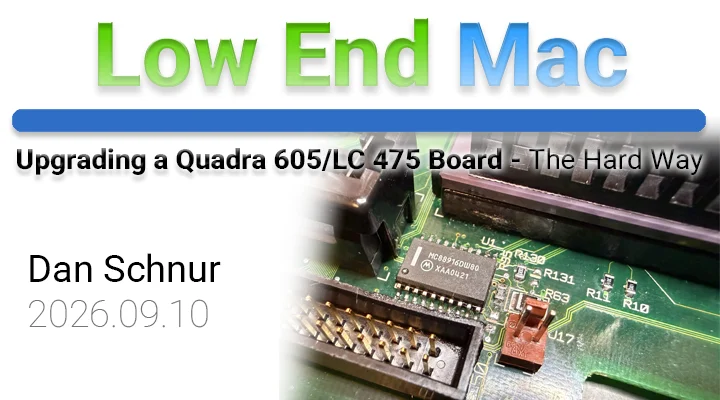
The restoration and modification of vintage computing hardware require a precise intersection of archival research, electrical engineering, and technical patience. A recent project involving the Macintosh Quadra 605—a quintessential compact Mac from the early 1990s—demonstrates the feasibility of pushing legacy hardware beyond its original factory specifications through the precise application of period-correct modifications. By replacing a damaged microprocessor and reconfiguring the logic board’s timing circuitry, technicians can effectively elevate the system from its baseline 25 MHz performance to a 33 MHz configuration, complete with Floating Point Unit (FPU) support.
Historical Context and Technical Specifications
The Macintosh Quadra 605, released in October 1993, served as a lower-cost entry point into the Motorola 68040 ecosystem. Designed to replace the aging Macintosh LC III, the 605 was marketed primarily toward the education and home markets. At the time of its release, Apple configured the machine with the MC68LC040 processor, a "low-cost" variant of the 68040 that lacked an internal FPU. While this decision significantly reduced the manufacturing cost, it created a notable performance bottleneck for users running scientific, engineering, or high-end design software that relied on floating-point calculations.

The original logic board was designed with a degree of modularity that allowed for different processor clock speeds, a common practice for Apple engineers in the early 1990s who often utilized a single PCB layout for multiple product tiers. The Quadra 605 board contains the necessary infrastructure to support 20, 25, 33, and 40 MHz clock speeds. Despite this capability, the commercial version remained locked to the 25 MHz speed grade to differentiate it from the higher-tier Quadra 650 and 800 models.
Chronology of the Restoration Process
The restoration of this specific logic board began with the discovery of a non-functional MC68LC040 microprocessor. Upon identifying the fault, the decision was made to not merely replace the unit with an identical part, but to perform a "speed bump" upgrade using an MC68040RC33, a full-featured 33 MHz processor. The conversion process required a multi-step sequence of hardware modifications to ensure that the board’s timing signals remained synchronized with the faster processor clock.
The process unfolded over a one-week period, involving the following technical phases:

- Clock Configuration (Resistor Arrays): The board’s clock speed is governed by a series of four surface-mount resistors (R21, R22, R24, and R25). By shifting these components according to the original Apple schematics, the board was re-indexed from the factory 25 MHz setting to the 33 MHz standard.
- Voltage and Signal Adjustment (R13): The R13 resistor, situated directly beneath the processor, dictates critical signal integrity parameters. Transitioning to 33 MHz required a precise 140-ohm resistance. Because 140 ohms is a non-standard value for modern inventory, a custom solution was implemented using two resistors in series (120 ohms and 20 ohms), ensuring the logic board operated within the required 1% tolerance.
- Frequency Multiplier Routing (R95 and R96): The final routing change involved relocating a surface-mount resistor from the R95 position to the R96 position, effectively enabling the higher clock multiplier required for the 33 MHz operational cycle.
- Clock Generator Replacement (U1): The most significant hurdle involved the replacement of the MC88920 clock driver with the obsolete MC88916 chip. This component is essential for managing the clock distribution across the system. The acquisition of this long-discontinued part necessitated sourcing "new-old-stock" from secondary markets, followed by a delicate desoldering and reflow process using hot-air station equipment.
Analysis of Technical Implications
The decision to modify the hardware rather than rely on software-based overclocking—such as the widely used "Soft 475" utility—highlights a preference for hardware-level reliability. While software utilities can manipulate the clock speed via memory-mapped I/O, they often lack the ability to correct the timing signals generated by the clock distribution chip (U1). By manually replacing the clock driver and adjusting the resistor networks, the board functions as if it were a factory-original 33 MHz design.
The inclusion of the MC68040RC33 brings a functional FPU to a machine that was previously handicapped in mathematical operations. In modern terms, the implications are largely academic; the Quadra 605, even at 33 MHz, is significantly outperformed by modern embedded processors. However, for the vintage computing community, these modifications provide a window into the design philosophy of early 1990s hardware, where modularity was baked into the silicon, and where performance tiers were often defined more by artificial software or configuration limits than by fundamental hardware incompatibility.
Industry Perspectives on Vintage Hardware Maintenance
Industry experts in the field of legacy system restoration note that projects of this nature are becoming increasingly common as the supply of original, functioning logic boards dwindles. The ability to repair and upgrade these systems is critical to the preservation of computing history. According to observers within the vintage hardware community, the primary challenge is no longer the availability of the central processing units, but the degradation of passive components, such as electrolytic capacitors and the scarcity of specific logic-control chips like the MC88916.

The successful boot of the upgraded Quadra 605 serves as a case study in effective reverse engineering. While the performance delta between 25 MHz and 33 MHz may be imperceptible in standard word processing or basic Finder operations, the upgrade fundamentally alters the machine’s architecture to support the full 68040 instruction set.
Broader Impact and Future Outlook
The modification of the Quadra 605 underscores a growing trend in the "Low End Mac" community: the transition from simple repair to active modification. As these systems move from "obsolete equipment" to "collectible artifacts," the desire to maximize their original potential has intensified. The methodologies employed in this project—specifically the use of original Apple schematic documentation to perform precision soldering—set a standard for future restorations.
Looking forward, the scarcity of these original components will likely necessitate the development of FPGA-based replacements for chips like the MC88916. The industry is already seeing a surge in demand for such parts, as enthusiasts seek to keep legacy systems running indefinitely. This project stands as a testament to the fact that with sufficient technical documentation and specialized tools, the life cycle of hardware designed three decades ago can be extended, ensuring that these machines remain not just museum pieces, but functional tools for those interested in the evolution of personal computing.

In conclusion, the upgrade of the Quadra 605 was more than a technical exercise; it was an act of preservation. By successfully navigating the complexities of the system’s timing logic and replacing the faulty components, the logic board was brought back into service with improved capabilities, proving that even the most "low-cost" hardware of the 1990s holds the potential for performance, provided the operator has the right schematics and the willingness to perform the work.