Jia Lissa
In a comprehensive assessment of the burgeoning amusement industry, Sega Enterprises, Ltd. has signaled a definitive shift in its corporate trajectory, prioritizing television-based electronic games as the cornerstone of its global operations. In a detailed briefing conducted in August 1980, Hayao Nakayama, Sega’s Executive Vice President and Representative Director, articulated a vision for the company that leverages its unique position as a "grandchild" subsidiary of the American conglomerate Gulf & Western (G&W). This strategic realignment comes at a pivotal moment in the "Golden Age" of arcades, as the industry transitions from electromechanical machines to sophisticated microprocessor-driven video games.
The corporate structure of Sega in 1980 reflects an intricate web of international interests designed to capitalize on the strengths of both the Japanese and North American markets. Following the acquisition of Sega Enterprises by Gulf & Western in 1974, the company underwent a formal restructuring. Under the leadership of President David Rosen, Sega of America was established as a primary entity under G&W, which subsequently holds ownership of Sega of Japan. This hierarchy effectively positions the Tokyo headquarters as a functional subsidiary of the American division, though Nakayama emphasizes that the operational synergy remains seamless. This structure was further bolstered by the 1976 acquisition of Gremlin Industries in the United States and the 1979 acquisition of Esco Trading in Japan, creating a dual-hemisphere manufacturing and distribution powerhouse.
Financial Performance and Institutional Growth
The fiscal year ending in April 1979 marked a period of robust economic expansion for Sega’s Japanese operations. The company reported annual sales reaching 24 billion yen, with a declared income of 5.37 billion yen. This financial success is supported by a massive organizational infrastructure consisting of 1,200 employees and an expansive domestic network. Sega currently operates three major branch offices in Sapporo, Osaka, and Fukuoka, supplemented by four sales offices and 89 operational centers across the Japanese archipelago.

Nakayama attributes this growth to a balanced business model that maintains a dual presence as both a manufacturer and an operator. While some industry critics have questioned the potential for conflict of interest in this model, Nakayama maintains that Sega’s roots as an operator provide the necessary insight to support third-party arcade owners. By managing a vast number of game centers, the company claims it can achieve economies of scale and pursue long-term sustainability that smaller, single-focus entities cannot match.
The Strategic Pivot to Television-Based Gaming
The most significant revelation in the 1980 policy outline is the decision to dedicate 70% to 80% of Sega’s research and development resources to "TV games." This decision aligns with a global trend where visual entertainment and digital novelty are increasingly outperforming traditional mechanical amusements. Nakayama acknowledges that while some purists criticize the industry’s heavy reliance on visual content, the market demand for innovative video experiences is undeniable.
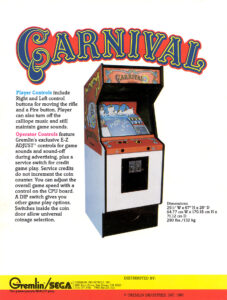
This pivot is exemplified by the collaborative relationship between Sega in Japan and Gremlin Industries in the United States. While both entities operate as independent manufacturers, they engage in cross-continental technology transfers. For instance, games developed in Japan are manufactured and marketed by Gremlin for the North American audience, while Sega handles the localization and distribution of American-developed titles for the Japanese market. Notable successes in this pipeline include Carnival—designed by Lane Hauck and recognized as the first video game to feature a dedicated bonus round—and Mini Monaco, which achieved unexpected popularity in Western markets despite a lukewarm reception in Japan.
The Evolution of Arcade Cabinetry: Table-top vs. Upright
A distinct challenge facing Sega in the 1980 market is the divergence in hardware preferences between Japan and the West. In the domestic Japanese market, table-type (cocktail) cabinets have become the dominant form factor, largely due to space constraints in urban game centers and the "invader house" phenomenon. Nakayama admits that while upright cabinets offer more aesthetic "added value" and branding opportunities, the company must follow market demand toward table-top units for the time being.

However, the company is not ready to abandon the upright format entirely. Sega’s strategy involves a period of "trial and error," testing various conversions and trade-in programs to see if the traditional upright cabinet can be revived. The success of titles like Head-On, Car Hunt, and Deep Scan suggests that the content of the game screen remains the primary driver of revenue, regardless of the cabinet’s physical orientation.
Intellectual Property and the Legal War Against Counterfeiting
As the video game industry matures, it has been plagued by a rampant "copycat" culture. During the initial boom of titles like Space Invaders, a shortage of supply led many operators to turn to unauthorized clones. Nakayama notes that in the late 1970s, the legal framework for protecting video game software was virtually non-existent in Japan. This has begun to change as Sega takes an aggressive stance on intellectual property rights.
A landmark case in the United States involving Sega/Gremlin and Exidy over the game Head-On has set a significant precedent. Exidy ultimately admitted fault in the copyright dispute, empowering Sega to use trademarks and unfair competition laws to protect its investments. Nakayama warns that the proliferation of counterfeit boards not only harms manufacturers but eventually leads to higher costs for operators, as legitimate companies must invest more in security and complex hardware to deter pirates. Sega is currently strengthening its distribution network to ensure that only genuine products reach the market, while simultaneously pursuing legal action against defiant copycats in Japan.
Diversification and the Leisure Sector
Beyond the digital screen, Sega is exploring diverse avenues of the leisure industry under the Gulf & Western umbrella. This includes the management of the "Sega Center" arcade chain and the launch of "PJ Pizzazz," a pizza restaurant concept that integrates electronic gaming with family dining. These ventures are managed through Sega of America and represent an attempt to institutionalize the arcade experience within the broader hospitality sector.
Domestically, the company continues to support traditional amusements such as pinball and medal games. While video games are the primary focus, Sega maintains a consistent supply of pinball machines from manufacturers like Williams and Stern. Furthermore, the company is engaged in a program to "eliminate waste" by refurbishing older medal games, such as Blackjack, Faro II, and Punto Banco, offering them to operators at lower price points with improved game logic.
Chronology of Key Events Leading to 1980
- 1965: Sega Enterprises is formed via the merger of Rosen Enterprises and Nihon Goraku Bussan.
- 1974: Gulf & Western acquires Sega, integrating it into its Manufacturing and Leisure groups.
- 1976: Sega of America acquires Gremlin Industries, a pioneer in microprocessor-based arcade hardware.
- 1979 (April): Sega reports record annual sales of 24 billion yen.
- 1979 (July): Sega acquires Esco Trading to bolster its domestic distribution and operations.
- 1980 (August): Executive VP Hayao Nakayama confirms the 80% focus on TV games and the escalation of anti-piracy legal efforts.
Analysis of Global Market Implications
The strategy outlined by Nakayama reflects a maturing industry that is moving away from the "wild west" era of the 1970s toward a more structured, corporate-led future. By leveraging the financial might of Gulf & Western—a conglomerate with $5.3 billion in sales and interests ranging from Paramount Pictures to automotive energy—Sega is positioned to weather the volatility of the amusement market.
The emphasis on global synergy between the U.S. and Japan is particularly significant. As Europe remains primarily a "buyer’s market," the competition for dominance in game design and manufacturing is essentially a duopoly between American firms like Atari and Midway and Japanese giants like Sega and Taito. Nakayama’s focus on high-quality, difficult-to-copy hardware suggests that the next generation of games will be defined by technological barriers to entry, favoring large-scale manufacturers with significant R&D budgets.
Ultimately, Sega’s 1980 roadmap emphasizes a transition from being a mere provider of novel machines to a sophisticated technology and leisure company. As the industry looks toward the new decade, the balance between manufacturing innovation and operational excellence will determine whether Sega can maintain its momentum in an increasingly crowded and litigious global marketplace. Through the protection of its intellectual property and the aggressive pursuit of television-based gaming, Sega aims to define the standards of the modern electronic entertainment era.