Edi Durjana
The highly anticipated release of RetroArch 1.20.0 marks a significant milestone for the open-source emulation frontend, introducing a suite of innovations designed to elevate the retro gaming experience on modern hardware. Available immediately for download across its extensive range of supported platforms, this update distinguishes itself through two particularly noteworthy features: a cutting-edge CRT beam simulation shader developed in collaboration with industry luminaries, and the pioneering integration of illuminance sensor support for Linux, enabling a new dimension of authentic gameplay for titles that originally relied on ambient light.
RetroArch, a core component of the Libretro ecosystem, has long been revered by the digital preservation and retro gaming communities for its universal frontend capabilities, allowing users to run a vast array of emulators, game engines, and media players through a unified, highly customizable interface. Since its inception, the project has championed a user-centric philosophy, steadfastly refusing to incorporate in-app advertisements, monetization SDKs, or paywalled features. This commitment to an unadulterated user experience is sustained entirely by community support, with users encouraged to contribute via platforms like Patreon, GitHub Sponsors, and the official Teespring merchandise store. The 1.20.0 release is a testament to the continued viability of this model, demonstrating that significant technological advancements can be achieved through collaborative, open-source efforts driven by passion and community funding.
Advancing Visual Fidelity: The Revolutionary CRT Beam Simulation Shader
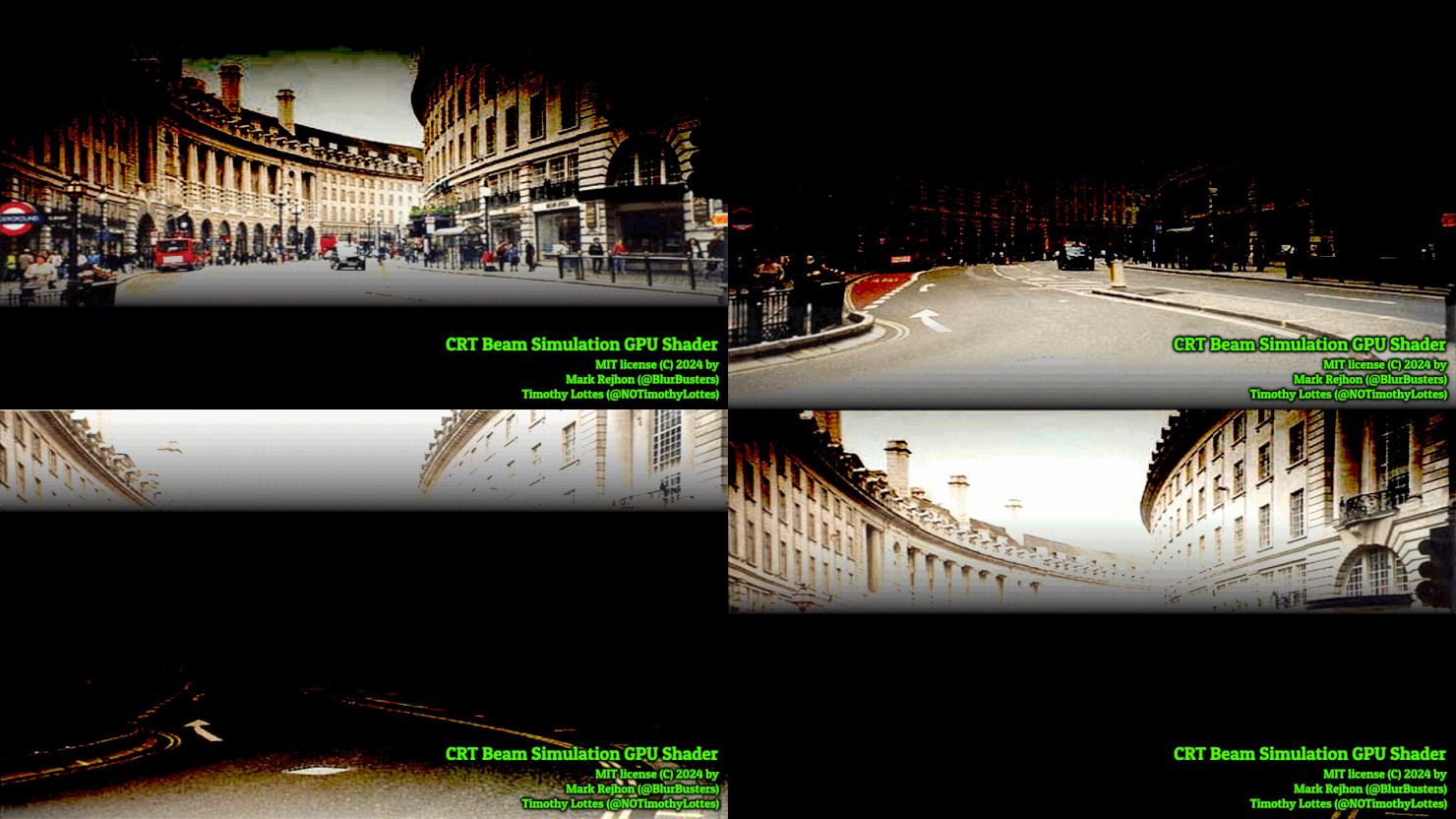
At the forefront of RetroArch 1.20.0’s visual enhancements is a groundbreaking CRT beam simulation shader, meticulously crafted through a collaborative effort involving Mark Rejhon of BlurBusters and Timothy Lottes, the acclaimed creator of the original FXAA shader and the highly regarded crt-lottes shaders. This new shader leverages RetroArch’s recently introduced “subframe” shader capabilities, a technical innovation poised to redefine how classic games are displayed on contemporary screens.
The pursuit of authentic CRT aesthetics on modern displays has been a long-standing challenge for the retro gaming community. Traditional cathode ray tube displays, characterized by their progressive scanlines, phosphor decay, and inherent motion blur, presented a visual experience fundamentally different from today’s sample-and-hold LCD and OLED panels. While modern displays offer superior resolution, color accuracy, and refresh rates, they often struggle to replicate the unique motion characteristics of CRTs, leading to a phenomenon known as "sample-and-hold motion blur."
Previous attempts to mitigate this on modern displays have often relied on techniques like Black Frame Insertion (BFI). BFI works by inserting a black frame between each displayed game frame, effectively reducing the persistence of the image on the retina and simulating the impulse-driven nature of CRT displays. While effective in reducing motion blur, BFI comes with significant drawbacks: it drastically reduces screen brightness, can dull colors, and carries a risk of image persistence—a non-permanent but still concerning form of "burn-in"—on certain LCD and OLED panel types. These compromises have limited its widespread adoption, leaving many users searching for a more ideal solution.
The new CRT beam simulation shader, enabled by RetroArch’s "subframe" capabilities, offers a paradigm shift. Subframe rendering allows the display to process and present multiple partial frames or variations of a frame within a single display refresh cycle. Instead of simply inserting a black frame, this advanced technique enables a more nuanced and dynamic control over how pixels are lit and darkened across the screen, mimicking the intricate electron beam dynamics of a CRT. This means the shader can simulate individual scanlines, phosphor persistence, and the gradual decay of light across the screen with unprecedented accuracy, all without the typical drawbacks of BFI.
Mark Rejhon, known for his pioneering work at BlurBusters in display technology and motion clarity, has long advocated for technologies that reduce motion blur and enhance visual fluidity. His insights into display response times and human visual perception have been instrumental in the development of this shader. Timothy Lottes, with his deep expertise in real-time graphics algorithms, brought the technical prowess to translate these concepts into an efficient and visually convincing shader. Their combined contributions have resulted in a solution that not only enhances motion clarity but also faithfully recreates the unique aesthetic qualities of CRT displays, including their characteristic glow and subtle distortions, without sacrificing brightness or color vibrancy. The animated GIF provided by Libretro vividly illustrates the shader’s ability to transform the appearance of emulated content, offering a level of authenticity previously unattainable on non-CRT hardware. This innovation sets a new benchmark for visual fidelity in emulation, promising a truly immersive experience for enthusiasts seeking to relive classic games as they were originally intended to be seen.
Real-World Interaction: Illuminance Sensor Support for Linux
Beyond visual fidelity, RetroArch 1.20.0 breaks new ground in interactive emulation with the introduction of illuminance sensor support for Linux. This feature, spearheaded by developer Jesse Talavera, addresses a long-standing challenge for emulating specific titles that leveraged unique hardware functionalities of their original platforms.
The most prominent example is the Boktai series for the Game Boy Advance (GBA) and its spiritual successor, Lunar Knights for the Nintendo DS. These games famously incorporated a solar sensor into their cartridges, requiring players to expose the device to real sunlight to charge their in-game weapons and solve environmental puzzles. Without this sensor, large portions of the games were either unplayable or significantly more challenging, diminishing the intended gameplay experience. Emulating these titles authentically on modern hardware has always presented a hurdle, often requiring users to resort to manual cheats, specific emulator patches, or even cumbersome hardware modifications to simulate light input.
Jesse Talavera’s work on illuminance sensor support for Linux provides an elegant and integrated solution. By leveraging standard Linux hardware APIs, RetroArch can now interface directly with ambient light sensors present in many modern devices, including laptops and, crucially, portable gaming systems like the Steam Deck. The demonstration video showcases Lunar Knights running on a Steam Deck, with the game dynamically responding to changes in ambient light as the device is exposed to varying illumination levels. This seamless integration allows players to experience these unique titles precisely as their creators envisioned, bridging the gap between historical hardware quirks and contemporary emulation platforms.
The significance of this development extends beyond the Boktai series. The announcement also hints at future expansions: "melonDS DS’s next update will include solar sensor support (among other things), so look forward to that!" This indicates a concerted effort within the Libretro ecosystem to integrate such features at the core level, ensuring broader compatibility and ease of use across different emulator cores. Furthermore, the promise of "camera support for more platforms" following the 1.20.0 release opens up exciting possibilities for other games that utilized external peripherals, such as the Game Boy Camera, various PlayStation EyeToy titles, and numerous Nintendo DS games that relied on the console’s built-in camera. This commitment to replicating novel hardware interactions underscores RetroArch’s dedication to comprehensive game preservation and immersive emulation.
The Foundation of Open-Source Excellence: Libretro’s Philosophy and Sustainability
The innovations delivered in RetroArch 1.20.0 are a direct reflection of the project’s foundational philosophy and its unique sustainability model. In an era dominated by proprietary software, microtransactions, and aggressive monetization strategies, Libretro stands as a bulwark for open-source principles and user empowerment. The project explicitly states its commitment: "We have always prioritized the endusers experience, and unlike others, we have never emburdened them with in-app ads, monetization SDKs or paywalled features, and we intend to continue to do so."
This steadfast adherence to user-first development necessitates a reliance on community support. RetroArch, along with the broader Libretro API and its myriad emulator cores, is developed by a dedicated team of volunteers and contributors who pour countless hours into coding, debugging, documentation, and community management. The ongoing maintenance of servers, infrastructure, and development tools also requires financial resources. Therefore, the project actively encourages donations, offering multiple avenues for supporters to contribute. Patreon, a popular platform for creators, allows for recurring monthly contributions, providing a stable income stream. GitHub Sponsors offers a similar mechanism, integrating support directly within the developer community’s preferred platform. For those who prefer tangible contributions, the official Teespring store offers merchandise, allowing users to proudly display their support while also funding development efforts.
This sustainability model, while reliant on goodwill, has proven remarkably effective. The continuous stream of updates, feature additions, and platform expansions, exemplified by the 1.20.0 release, demonstrates that a community-driven, non-commercial approach can not only survive but thrive and innovate at the cutting edge of technology. The absence of commercial pressures allows developers to focus purely on technical excellence and user experience, rather than revenue generation, fostering an environment where truly groundbreaking features like subframe shaders and real-world sensor integration can emerge.
Broader Impact and Future Trajectories
The release of RetroArch 1.20.0 solidifies its position as a leading platform for digital game preservation and retro gaming. The advancements in visual fidelity with the new CRT beam simulation shader will undoubtedly become a benchmark for how classic games are presented on modern displays, potentially influencing other emulation projects and even commercial retro re-releases. This feature caters directly to a core desire within the retro community: to experience games not just functionally, but aesthetically, as close to their original presentation as possible. The collaboration with figures like Mark Rejhon and Timothy Lottes also underscores RetroArch’s capacity to attract and integrate top-tier talent from the display and graphics industries, further cementing its technical authority.
The illuminance sensor support for Linux, and the promised expansion to camera support for more platforms, signifies a crucial step towards comprehensive hardware-agnostic emulation. By enabling interaction with unique, often overlooked hardware features of original consoles, RetroArch ensures that the full breadth of a game’s design can be experienced. This not only enhances immersion for players but also serves a vital role in game preservation, preventing unique gameplay mechanics from being lost to time due or inaccessible due to technological obsolescence. As the Steam Deck continues to gain traction as a portable gaming and emulation device, the seamless integration of such features further enhances its appeal and utility for retro enthusiasts.
While the provided content did not detail the full changelog for 1.20.0, major releases of RetroArch invariably include a multitude of other improvements, bug fixes, performance optimizations, and updates to various emulator cores. These often less-heralded changes are crucial for the overall stability, compatibility, and responsiveness of the platform, forming the bedrock upon which headline features are built. The collective effort involved in these granular updates ensures that RetroArch remains a robust, reliable, and evolving solution for digital entertainment.
In conclusion, RetroArch 1.20.0 is more than just another update; it represents a significant leap forward in the ongoing quest for perfect retro gaming emulation. By pushing the boundaries of visual authenticity and interactive immersion, all while maintaining its principled open-source and user-funded model, RetroArch continues to demonstrate the power of community-driven development in shaping the future of digital preservation and gaming experiences. The project invites all users to explore the new features, provide feedback, and consider supporting its mission to keep retro gaming alive and thriving for generations to come.