Edi Durjana
The global retro gaming community is abuzz with the release of RetroArch version 1.20.0, a landmark update that introduces several significant advancements poised to redefine the digital emulation landscape. Available immediately for download across its myriad supported platforms, this latest iteration from the Libretro team underscores a steadfast commitment to enhancing user experience through cutting-edge technological innovation and an unwavering dedication to open-source principles. The update’s marquee features include a revolutionary CRT beam simulation shader developed in collaboration with industry luminaries Mark Rejhon of BlurBusters and Timothy Lottes, alongside pioneering illuminance sensor support for Linux, which promises to unlock authentic gameplay experiences for titles historically reliant on unique hardware peripherals.
RetroArch, a free, open-source, and cross-platform frontend for emulators, game engines, video games, media players, and other applications, has long been a cornerstone of the digital preservation and retro gaming movements. Its modular design, utilizing "cores" for various systems, allows users to enjoy a vast library of classic games from a single, unified interface. The project’s longevity and consistent evolution are testaments to its community-driven development model, which explicitly eschews commercial monetization strategies such as in-app advertisements, intrusive monetization SDKs, or paywalled features. This philosophy, reiterated with each major release, positions RetroArch as a pure passion project, sustained entirely by the voluntary support and belief of its user base. Individuals wishing to contribute to this vital ecosystem can do so via Patreon, Github Sponsors, or by purchasing official merchandise from the RetroArch Teespring store, ensuring the continued development of a platform that prioritizes player immersion and access above all else.
Revolutionary CRT Beam Simulation with Subframe Technology
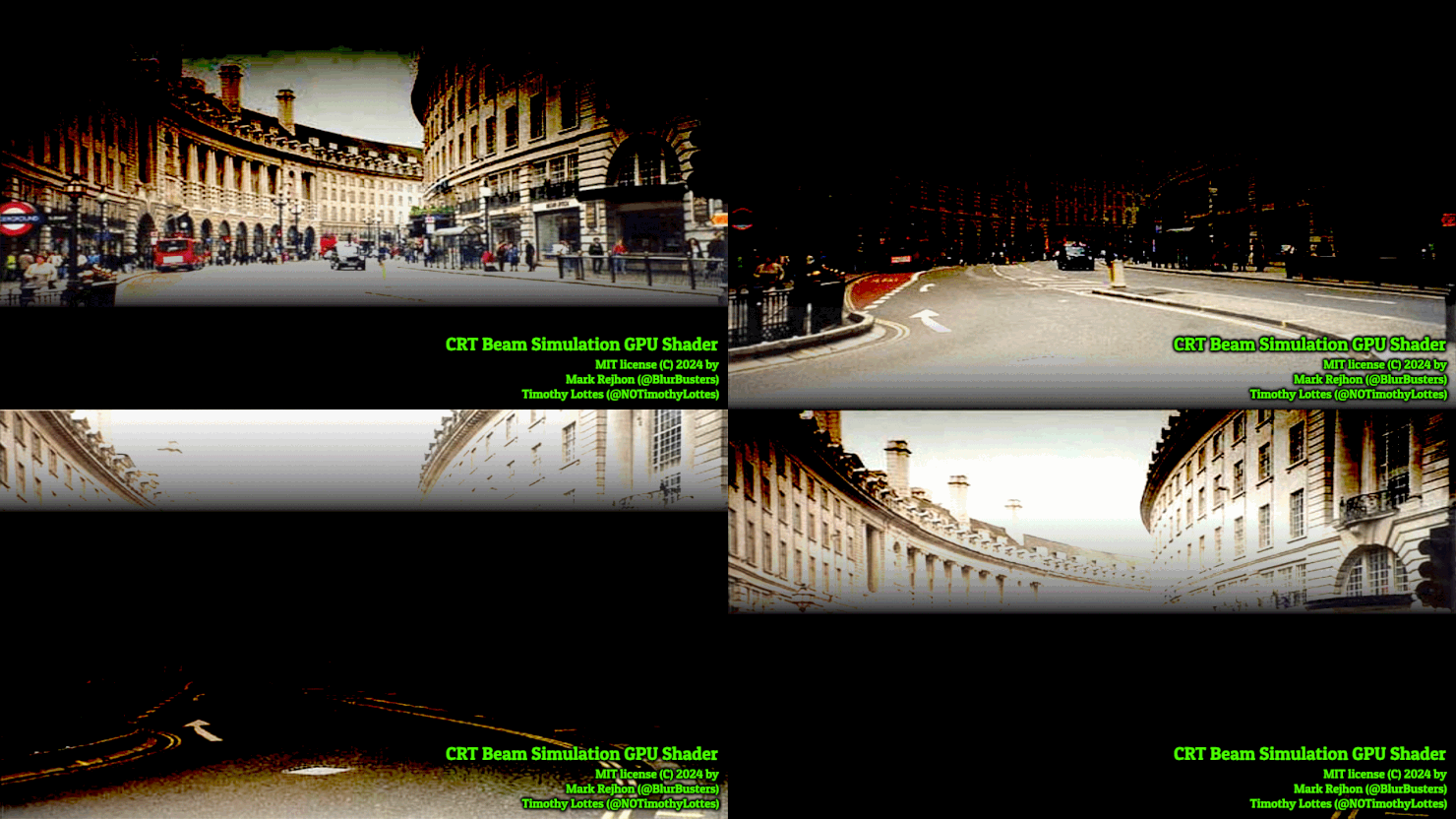
At the forefront of RetroArch 1.20.0’s enhancements is the introduction of a sophisticated CRT beam simulation shader, a collaborative effort that marries the expertise of display motion clarity specialist Mark Rejhon from BlurBusters.com and graphics programming legend Timothy Lottes, widely recognized for creating the original FXAA shader and the highly regarded crt-lottes shaders. This new shader represents a significant leap forward in replicating the authentic visual characteristics of classic cathode ray tube displays on modern digital screens.
The enduring appeal of retro gaming often lies not just in the gameplay mechanics but also in the distinct aesthetic produced by the display technology of its era. CRT monitors, with their phosphorescent glow, scanlines, and unique motion blur properties, contributed significantly to the intended visual experience of games from the 1970s through the early 2000s. Modern LCD, OLED, and other flat-panel displays, while offering superior resolution, brightness, and color accuracy, fundamentally operate differently, often leading to a "too perfect" or "sterile" image that lacks the nostalgic charm and subtle visual cues of CRTs. Previous attempts to bridge this gap have included various shader techniques to simulate scanlines and color bleeding, as well as hardware-level solutions like black-frame insertion (BFI). While BFI can improve motion clarity by reducing sample-and-hold blur inherent in modern displays, it typically comes with significant drawbacks: a noticeable reduction in brightness, dulled colors, and an increased risk of image persistence – a non-permanent but still concerning form of "burn-in" that can affect many common LCD panel types.
RetroArch 1.20.0’s new CRT beam simulation shader sidesteps these limitations by leveraging the platform’s recently integrated "subframe" shader capabilities. This advanced technique allows for highly precise control over individual display frames, enabling the shader to mimic the rapid, sequential illumination of a CRT’s electron beam across the screen. Instead of simply inserting black frames, the subframe approach dynamically modulates pixels and display timing on a much finer granularity. The result is a dramatic improvement in perceived motion clarity, particularly crucial for fast-paced action games or scrolling environments, without the compromises associated with traditional BFI. Users can now experience the fluid motion and subtle visual nuances of classic arcade and console games with unparalleled accuracy, preserving the artistic intent and nostalgic feel that modern displays often struggle to reproduce. This innovation not only elevates the visual fidelity of emulated games but also serves as a crucial tool in the ongoing effort to preserve the authentic experience of historical gaming hardware. For a deeper dive into the technical intricacies of this groundbreaking development, RetroArch has provided a dedicated article detailing its implementation as the first program to support the BlurBusters CRT Beam Racing Simulator Shader.
Illuminance Sensor Support: Bringing Sunlight to Your Steam Deck
Beyond graphical enhancements, RetroArch 1.20.0 introduces another groundbreaking feature: illuminance sensor support for Linux, spearheaded by developer Jesse Talavera. This innovative addition allows for the emulation of games that historically relied on external light sensors to influence gameplay, most notably the Boktai series on the Game Boy Advance and Lunar Knights on the Nintendo DS. These titles, designed by Hideo Kojima, uniquely integrated real-world sunlight exposure into their mechanics, requiring players to literally "charge" their in-game weapons or powers by exposing the cartridge’s solar sensor to light.
For years, playing these games on emulators meant either bypassing these mechanics through cheats or experiencing a significantly altered, less immersive version of the game. Jesse Talavera’s work changes this paradigm entirely, bringing an unprecedented level of authenticity to the emulation of such hardware-dependent titles. The implementation on Linux systems, particularly showcased on Valve’s popular Steam Deck handheld PC, allows the device’s built-in ambient light sensor to directly feed data into the emulator. A compelling demonstration, available via a YouTube clip, illustrates Lunar Knights running on a Steam Deck, with the in-game environment dynamically reacting as the user adjusts the ambient lighting around the device. This capability transforms a previously emulated limitation into an interactive feature, allowing players to experience these games as originally intended, truly "cooking with sunlight."
This development is not merely a novelty; it represents a significant step forward in game preservation and the comprehensive emulation of unique hardware features. Many classic consoles incorporated bespoke peripherals or environmental interactions that are notoriously difficult to replicate in a software-only environment. By tapping into modern device sensors, RetroArch opens doors for future authentic emulation of other such hardware-specific functionalities. Looking ahead, Talavera confirmed that the next update for the melonDS DS core will include full solar sensor support, alongside other anticipated features. Furthermore, the RetroArch team has plans to extend camera support to a wider array of platforms shortly after the 1.20.0 release, hinting at future possibilities for games that utilized camera peripherals or augmented reality mechanics. This continuous drive to integrate real-world inputs into the emulated environment reinforces RetroArch’s position at the forefront of immersive and accurate digital game preservation.
RetroArch’s Enduring Philosophy: A Beacon of Open-Source Excellence
The release of RetroArch 1.20.0 is more than just an update; it is a reaffirmation of the project’s foundational philosophy: to provide an unparalleled, user-centric emulation experience free from commercial encumbrances. In an era where many software projects, even those initially open-source, eventually succumb to pressures of monetization through advertisements, subscription models, or feature paywalls, RetroArch stands as a defiant outlier. Its commitment to never burdening users with in-app ads, monetization SDKs, or paywalled features is a cornerstone of its identity and a key differentiator in the crowded software landscape.
This philosophy is deeply rooted in the broader Libretro ecosystem, which emerged from the early days of multi-emulator frontends. The Libretro API, on which RetroArch is built, was designed to create a standardized interface for emulators (cores), allowing them to run seamlessly within a single application and benefit from shared features like shaders, savestates, and input configurations. This modular approach has fostered a vibrant developer community, contributing to hundreds of cores that support systems ranging from the earliest arcade machines and home consoles to more recent handhelds and personal computers. The project’s inception was driven by a desire for a unified, powerful, and highly customizable platform for digital game preservation and enjoyment, a vision that has remained steadfast for over a decade.
The financial sustenance of such an ambitious, non-commercial project relies entirely on the generosity of its community. RetroArch openly solicits donations, offering multiple avenues for supporters to contribute. Patreon, a popular platform for creators, allows users to provide recurring monthly support, offering a stable income stream for ongoing development. GitHub Sponsors provides another avenue for direct financial contributions, often favored by developers and tech enthusiasts within the open-source community. Additionally, the RetroArch Teespring store offers official merchandise, allowing fans to show their support while acquiring unique branded apparel and accessories. These diverse funding mechanisms are crucial for covering operational costs, supporting core developers, and acquiring necessary hardware for testing and development, enabling the team to continue pushing the boundaries of what is possible in emulation without compromising their user-first principles. This model not only ensures the project’s independence but also strengthens the bond between the developers and their dedicated user base, fostering a truly collaborative spirit.
Broader Impact and Implications for the Emulation Landscape
The advancements introduced in RetroArch 1.20.0 carry significant implications for the future of digital preservation and retro gaming. The new CRT shader technology, for instance, sets a new benchmark for visual authenticity. By addressing the long-standing challenge of accurately replicating CRT aesthetics without the drawbacks of previous methods, RetroArch ensures that new generations of players can experience classic games with the visual fidelity intended by their creators, bridging the gap between historical hardware and modern display technology. This contributes not only to nostalgia but also to a deeper appreciation of game art direction and technical achievements of past eras.
Similarly, the illuminance sensor support for Linux is a testament to the ongoing efforts to achieve complete and accurate hardware emulation. Games like Boktai represent a unique facet of gaming history, where physical interaction with the environment was integral to the experience. By enabling this interaction in an emulated setting, RetroArch not only preserves the gameplay mechanics but also highlights the innovative, sometimes quirky, design choices of historical game developers. This paves the way for future integrations of other esoteric hardware features, ensuring that no game, however unique in its original implementation, is lost to the vagaries of technological obsolescence.
Moreover, the continued commitment to open-source development and a non-commercial model positions RetroArch as a vital counter-narrative in an industry increasingly dominated by proprietary platforms and aggressive monetization strategies. It demonstrates that high-quality, cutting-edge software can be developed and maintained through community effort and direct user support, fostering an environment of trust and shared passion. This approach is particularly critical for game preservation, as it ensures that access to gaming history remains open and democratic, free from corporate gatekeeping or profit motives that might limit availability or alter original experiences.
While the provided changelog snippet for 1.20.0 was empty, typical major releases from RetroArch usually encompass a wide array of other improvements and refinements. These often include general performance enhancements, leading to smoother gameplay and more efficient resource utilization across various hardware configurations. Bug fixes are a constant endeavor, addressing issues reported by the community and improving overall stability. Core updates for existing emulators are also common, bringing compatibility improvements, new features, and performance optimizations for specific systems. Furthermore, user interface and experience (UI/UX) refinements are frequently integrated, making the platform more intuitive and accessible to a broader audience. These under-the-hood optimizations, though less visible than headline features, are crucial for maintaining RetroArch’s status as a robust and reliable emulation solution.
A Look Ahead: The Evolving Horizon of Emulation
The release of RetroArch 1.20.0 solidifies the platform’s position as a dynamic and indispensable tool for digital game enthusiasts and preservationists worldwide. The continuous evolution of RetroArch, marked by features like advanced shader technology and innovative hardware sensor integration, indicates a future where emulation increasingly blurs the lines between original hardware and digital recreation. The ongoing research and development into sophisticated rendering techniques and the relentless pursuit of authentic peripheral support promise an even richer and more immersive retro gaming experience.
As technology progresses, so too does the potential for emulation. The team’s stated intentions for broader camera support and continued core updates suggest a pipeline of exciting developments that will further expand the scope and accuracy of RetroArch. The project remains a living testament to the power of open-source collaboration, demonstrating that with community support and a clear vision, it is possible to not only preserve the past but also innovate for the future of interactive entertainment. RetroArch 1.20.0 is not merely an update; it is a declaration of intent, signaling a continued commitment to pushing the boundaries of what is possible in the realm of digital game preservation and authentic retro gaming.