Edi Durjana
The highly anticipated RetroArch 1.20.0, the latest iteration of the universal frontend for the Libretro API, has officially been released, marking a significant milestone in the ongoing evolution of game emulation. This update brings a suite of groundbreaking features and enhancements designed to elevate the user experience, most notably the introduction of advanced CRT beam simulation via "subframe" shader capabilities and real-world illuminance sensor support for Linux. Available immediately for download across its myriad supported platforms, this release underscores RetroArch’s unwavering commitment to pushing the boundaries of accuracy, preservation, and accessibility in the retro gaming landscape, all while maintaining its core principle of being entirely free from in-app advertisements, monetization SDKs, or paywalled features.
Revolutionizing Retro Gaming: An Overview of RetroArch 1.20.0
RetroArch has long stood as a pillar in the emulation community, providing a unified interface for a vast array of emulators (known as "cores") and game engines. Its cross-platform compatibility, spanning Windows, macOS, Linux, Android, iOS, and various gaming consoles, has made it an indispensable tool for enthusiasts and preservationists alike. The 1.20.0 update reinforces this position by introducing innovations that address long-standing challenges in emulation fidelity and gameplay authenticity. The two standout features, the advanced CRT shader and illuminance sensor support, are testament to the project’s dedication to meticulous detail and immersive experiences.
The development of RetroArch is a continuous, collaborative effort driven by the Libretro team and a global community of contributors. Each release typically encompasses not only headline features but also a multitude of bug fixes, performance optimizations, and core updates that refine the overall stability and functionality. This iterative improvement process ensures that RetroArch remains at the forefront of emulation technology, adapting to new hardware, operating systems, and user demands. The 1.20.0 release is a culmination of extensive research, development, and testing, reflecting thousands of hours of work dedicated to enhancing the digital preservation and enjoyment of classic games.
A Deep Dive into Visual Fidelity: Subframe Shaders and CRT Beam Simulation
One of the most profound additions in RetroArch 1.20.0 is the new CRT beam simulation shader, a collaborative effort by display technology expert Mark Rejhon of BlurBusters and graphics programming luminary Timothy Lottes. This innovation addresses a critical aspect of retro gaming authenticity: replicating the distinct visual characteristics of Cathode Ray Tube (CRT) displays on modern LCD and OLED screens. CRTs, with their scanlines, phosphors, and unique motion blur properties, contributed significantly to the aesthetic and feel of classic video games. Modern displays, while offering higher resolutions and vibrant colors, often present a "too perfect" image that lacks the nostalgic charm and motion clarity inherent to CRTs.
The Quest for Authentic Visuals
For years, emulation enthusiasts have sought to bridge this visual gap. Early attempts involved simple scanline filters, which, while adding a superficial resemblance, failed to capture the dynamic nuances of CRT displays. More advanced shaders emerged, simulating phosphor masks and geometry, but true motion clarity remained elusive without significant compromises. The primary challenge has been the sample-and-hold nature of modern LCD and OLED panels, where pixels remain lit for the entire frame duration, leading to motion blur that was absent on CRTs, which rapidly scanned lines across the screen.
Technical Breakthrough: How Subframe Shaders Work
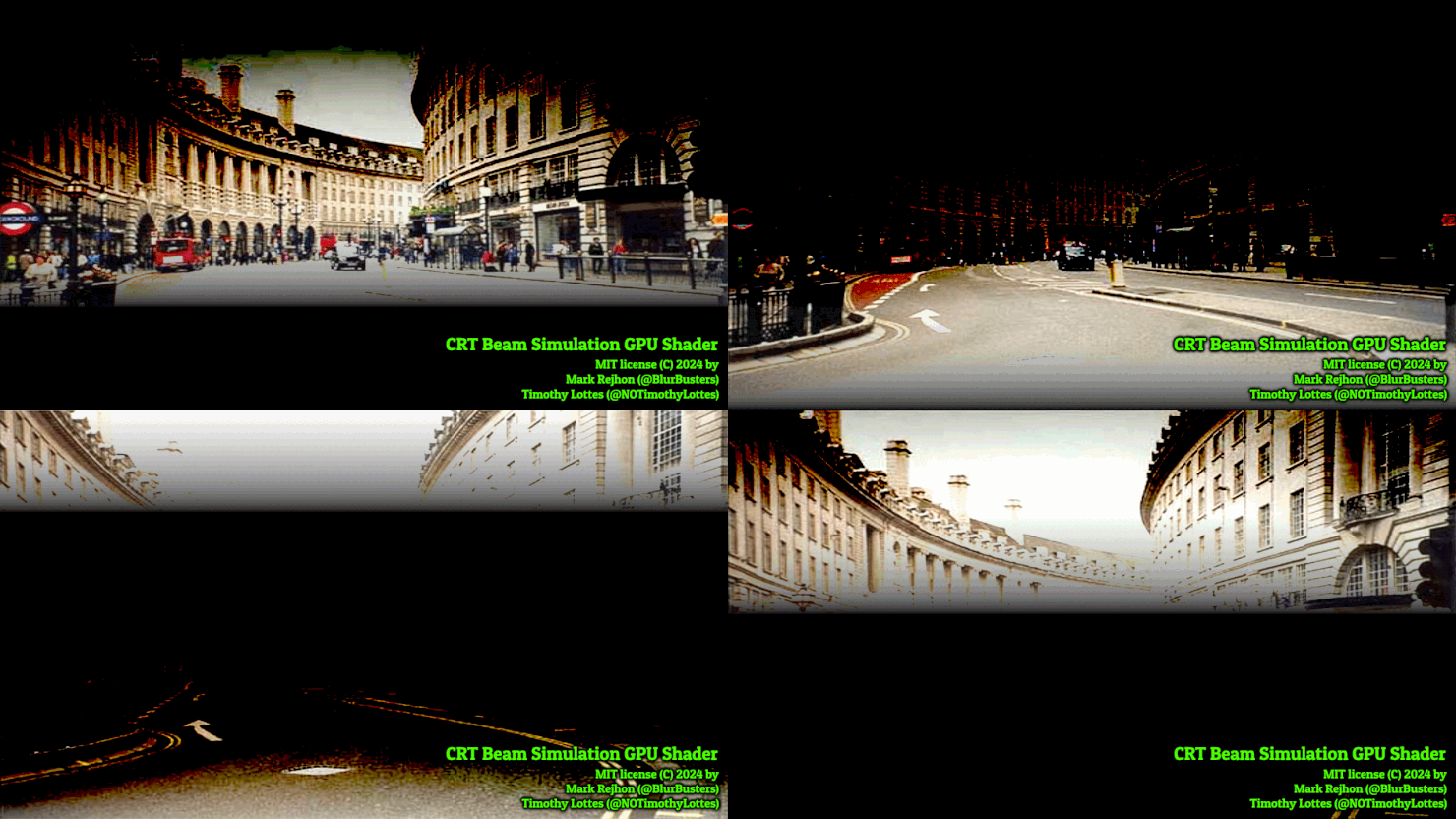
The new CRT beam simulation shader leverages RetroArch’s recently integrated "subframe" shader capabilities. This is a significant technical leap. Traditional shaders operate on a per-frame basis, processing an entire image at once. Subframe shaders, however, allow for rendering at a much higher temporal resolution, effectively breaking down a single display frame into multiple sub-frames. This enables the simulation of the rapid, sequential illumination of individual scanlines or even sub-pixels, mimicking how an electron beam would physically draw an image on a CRT screen. By rapidly alternating between different visual states within a single display refresh cycle, the shader can create the illusion of CRT-like motion clarity, where each "virtual" scanline or pixel appears only briefly, much like the transient glow of a CRT phosphor.
Pioneering Minds Behind the Innovation
The involvement of Mark Rejhon and Timothy Lottes highlights the caliber of expertise brought to this feature. Mark Rejhon, known for his work at BlurBusters, is a leading authority on display motion clarity and high refresh rate technologies. His insights into human perception of motion and the mechanics of various display types have been instrumental in understanding and mitigating motion blur. Timothy Lottes, on the other hand, is a revered graphics programmer, best known for creating the influential FXAA (Fast Approximate Anti-Aliasing) shader and the popular crt-lottes shaders, which have been staples in the emulation community for their accurate visual representations. Their combined knowledge has resulted in a shader that is not merely an aesthetic filter but a sophisticated simulation of display physics.
Beyond Black Frame Insertion: A Superior Approach
Prior attempts to improve motion clarity on modern displays often relied on Black Frame Insertion (BFI). BFI works by inserting a black frame between each rendered game frame, effectively reducing the "sample-and-hold" time and making individual frames appear more distinct. While BFI can improve motion clarity, it comes with significant drawbacks:
- Reduced Brightness: Inserting black frames halves the overall light output, making the image noticeably dimmer.
- Dulled Colors: The perceived vibrancy of colors can be diminished due to the reduced brightness.
- Image Persistence/Burn-in Risk: On certain LCD and OLED panels, the rapid switching between bright images and black frames can contribute to temporary image persistence (often mistakenly called "burn-in"), where static elements from previous frames can briefly linger, especially if BFI is used extensively.
The new subframe-based CRT beam simulation shader circumvents these issues. By manipulating the display at a sub-frame level, it achieves superior motion clarity without the drastic brightness reduction or the risk of image persistence associated with BFI. This represents a significant leap forward, offering an authentic retro visual experience that is both visually accurate and gentle on modern display hardware. The deeper technical details and the philosophical underpinnings of this breakthrough are further explored in a dedicated article on the Libretro website, providing invaluable context for those interested in the intricacies of display technology.
Bringing Games to Life: Illuminance Sensor Support for Linux
Another remarkable feature introduced in RetroArch 1.20.0 is the illuminance sensor support for Linux, spearheaded by developer Jesse Talavera. This addition is particularly exciting for fans of niche games that originally incorporated real-world environmental interactions into their gameplay, most notably the Boktai series on the Game Boy Advance.
Recreating Unique Gameplay Mechanics
The Boktai games, developed by Konami and designed by Hideo Kojima, featured a unique solar sensor cartridge that required players to expose their Game Boy Advance to real sunlight to charge protagonist Django’s "Gun Del Sol." This mechanic was integral to combat, puzzle-solving, and even story progression, forcing players to engage with their environment in an unprecedented way. Emulating this feature accurately has always been a challenge. Previous solutions often involved crude workarounds, such as using hotkeys to simulate sunlight levels or relying on modified ROMs that bypassed the sensor altogether, stripping the games of their intended interactive charm.
The Technical Integration on Linux
Jesse Talavera’s work directly addresses this by integrating real-world illuminance sensor data into RetroArch on Linux. Modern Linux systems, particularly portable devices like the Steam Deck, often come equipped with ambient light sensors (ALS) that measure environmental brightness. RetroArch 1.20.0 can now tap into these sensors, translating real-time light data into the game environment. This means players can now experience Boktai and other sensor-reliant titles (like Lunar Knights on the Nintendo DS, which also utilized a solar sensor) exactly as their creators intended, by physically adjusting their device’s exposure to light.
The demonstration of Lunar Knights running on a Steam Deck, with the game’s in-world light levels dynamically responding to external light changes, is a powerful testament to this feature’s potential. It transforms what was once an obscure, difficult-to-replicate gameplay mechanic into a seamless and immersive experience on modern hardware. This level of hardware-software integration exemplifies RetroArch’s commitment to preservation not just of the game code, but of the entire original gameplay experience.
A Glimpse into the Future: Expanding Sensor Capabilities
The introduction of illuminance sensor support for Linux is just the beginning. The announcement hints at broader implications for other sensor-dependent titles and platforms. The next update for the melonDS DS core is slated to include solar sensor support, further enhancing the Nintendo DS emulation experience within RetroArch. More excitingly, the development team is working on camera support for additional platforms, which could open doors for emulating games that utilized camera peripherals, such as Game Boy Camera or certain PlayStation 2 titles that integrated camera input. This ongoing effort to integrate real-world hardware interactions is a significant step towards achieving total fidelity in game preservation, ensuring that even the most idiosyncratic gameplay mechanics are not lost to time.
RetroArch’s Enduring Commitment: A User-Centric Development Philosophy
At the heart of RetroArch’s success and continuous innovation lies its steadfast commitment to a user-centric development philosophy. In an era where many software projects, even open-source ones, explore various monetization strategies, RetroArch stands firm on its principles: "This project exists for the benefit of our users… we have never emburdened them with in-app ads, monetization SDKs or paywalled features, and we intend to continue to do so."
The Open-Source Ethos
This declaration is not merely a statement but a core tenet that guides every development decision. It reflects a deep belief in the open-source ethos, where software is a public good, freely accessible and modifiable by anyone. By eschewing commercial pressures, RetroArch ensures that its development is solely driven by technical excellence, community needs, and the pursuit of perfect emulation. This approach fosters trust within its user base and encourages a vibrant community of developers and enthusiasts who contribute their time and expertise without the expectation of direct financial gain. The project’s transparency and open development model allow users to inspect the code, report issues, and even contribute fixes or new features, creating a truly collaborative ecosystem.
Sustaining Innovation: Community Support and Funding Models
Maintaining such an ambitious project without commercial backing requires robust community support. RetroArch openly encourages donations, providing multiple avenues for users to contribute financially. Beyond traditional methods, the project has embraced modern crowdfunding platforms like Patreon, where supporters can offer recurring contributions, and Github Sponsors, which integrates directly into the developer ecosystem. Additionally, a Teespring store offers official RetroArch merchandise, allowing fans to show their support while acquiring branded apparel and accessories. These diverse funding channels are crucial for covering server costs, development hardware, and compensating core contributors for their invaluable time and effort. This model demonstrates that high-quality, ad-free software can thrive through the collective generosity and belief of its community, proving that user satisfaction and ethical development can be sustainable.
Broader Implications: Preservation, Accessibility, and the Future of Emulation
The release of RetroArch 1.20.0 has implications far beyond just improved gameplay experiences for individual users. It represents a significant stride in several key areas:
- Digital Preservation: By accurately replicating the visual and interactive nuances of classic games, RetroArch contributes profoundly to digital preservation. It ensures that future generations can experience these titles not as mere digital relics, but as living pieces of cultural history, complete with their original aesthetic and functional integrity. The CRT shader brings visual authenticity, while sensor support revives unique gameplay mechanics that might otherwise be lost.
- Accessibility: RetroArch’s cross-platform nature already makes emulation accessible to a broad audience. The continuous improvement in its feature set further enhances this accessibility, allowing more games to be played accurately on more devices. Features like sensor integration remove barriers for enjoying games that previously required specific, often rare, original hardware.
- Innovation in Emulation Technology: RetroArch, through the Libretro API, consistently pushes the boundaries of what’s possible in emulation. The subframe shader capability, for instance, is a novel approach to display simulation that could influence future display technologies or other graphics applications. Its ability to attract top-tier talent like Mark Rejhon and Timothy Lottes speaks to its reputation as a hub for cutting-edge development.
- Influence on the Gaming Industry: The pursuit of authentic retro experiences in emulation can also subtly influence the commercial gaming industry. As developers see the demand and technical feasibility of highly accurate retro presentations, it might encourage them to incorporate similar features into official remasters or virtual console offerings, raising the bar for how classic games are re-released.
Comprehensive Improvements: Beyond the Marquee Features
While the subframe shaders and illuminance sensor support are the headline features of RetroArch 1.20.0, a release of this magnitude always includes a comprehensive array of under-the-hood improvements that enhance the overall stability, performance, and user experience. Although the full changelog requires external consultation, such updates typically include:
- Core Updates: Integration of newer versions of various Libretro cores, bringing performance enhancements, bug fixes, and increased compatibility for specific emulators.
- Performance Optimizations: General code optimizations across the RetroArch frontend to improve responsiveness, reduce latency, and ensure smoother gameplay, particularly on lower-end hardware.
- Bug Fixes: Resolution of numerous reported bugs, ranging from minor graphical glitches to critical stability issues across different platforms and cores.
- UI/UX Enhancements: Subtle refinements to the user interface for better navigation, clearer presentation of options, and improved overall usability. This might include tweaks to menus, hotkey configurations, or accessibility features.
- Platform-Specific Fixes: Addressing issues unique to certain operating systems or hardware configurations, ensuring a more consistent experience across the wide array of devices RetroArch supports, from desktop PCs to mobile phones and dedicated emulation handhelds.
- Build System Improvements: Updates to the build infrastructure and development tools, making it easier for developers to contribute and maintain the project.
Conclusion: A Milestone in Emulation Excellence
RetroArch 1.20.0 stands as a testament to the power of open-source development and a dedicated community. By introducing revolutionary features like subframe shader-based CRT beam simulation and real-world illuminance sensor integration, the Libretro team has once again redefined the standards for emulation. This release not only enhances the immediate user experience but also makes significant contributions to the broader goals of digital preservation and technological innovation. With its unwavering commitment to being ad-free and open-source, RetroArch continues to empower users, ensuring that the rich history of video games remains accessible, authentic, and enjoyable for generations to come. Users are encouraged to download the latest version and consider supporting the project to ensure its continued evolution.