Chalid Lutfie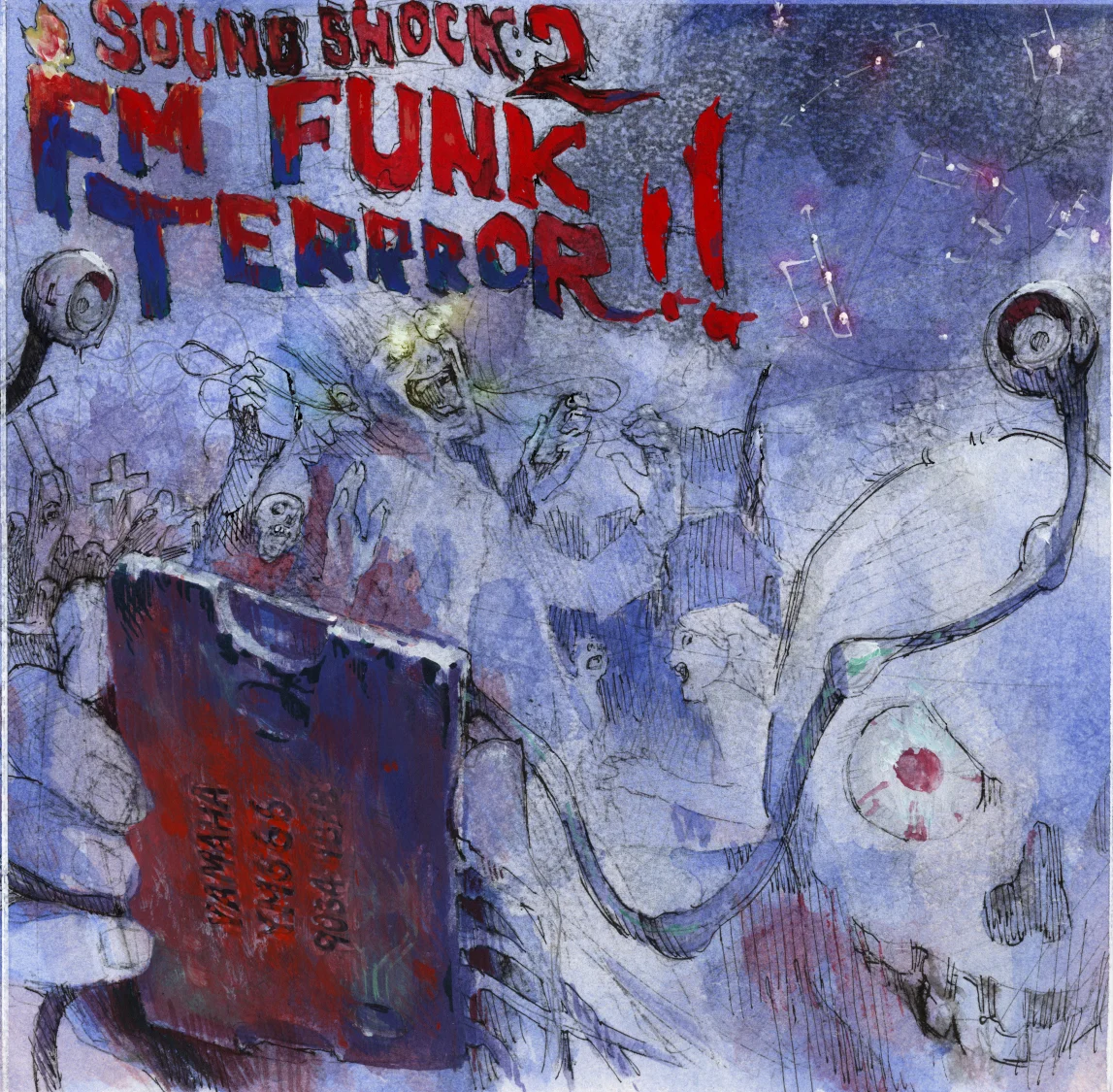
The Genesis of a Visual Identity
The partnership between the SOUNDSHOCK series curator, known in the community as zinger, and Tsuyoshi Shimokura began through an introduction by the artist hex125. While Shimokura was initially brought on to contribute a musical composition to the first volume, FM FUNK MADDNESS!!, his background as a professional artist soon became the focal point of his contribution. Shimokura’s deep-seated passion for vintage computing hardware, FM sound chips, and classic arcade aesthetics provided a unique foundation for the series’ visual language.
Unlike many modern digital illustrations, Shimokura’s work for SOUNDSHOCK utilizes handpainted techniques that evoke the era of 1980s and 1990s Japanese arcade flyers and video game packaging. This stylistic choice serves a dual purpose: it provides a nostalgic link to the era when FM synthesis was the dominant technology in gaming audio, and it elevates the albums to a level of craftsmanship that mirrors the complexity of the music they contain.
FM FUNK MADDNESS!!: The Heroic Power of Synthesis
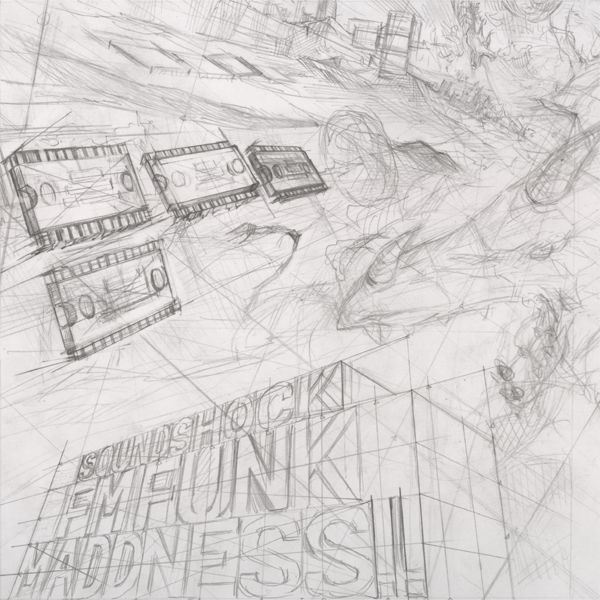
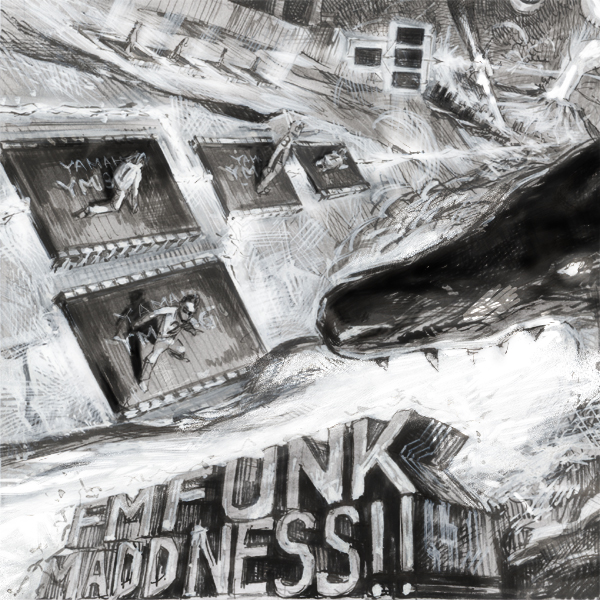
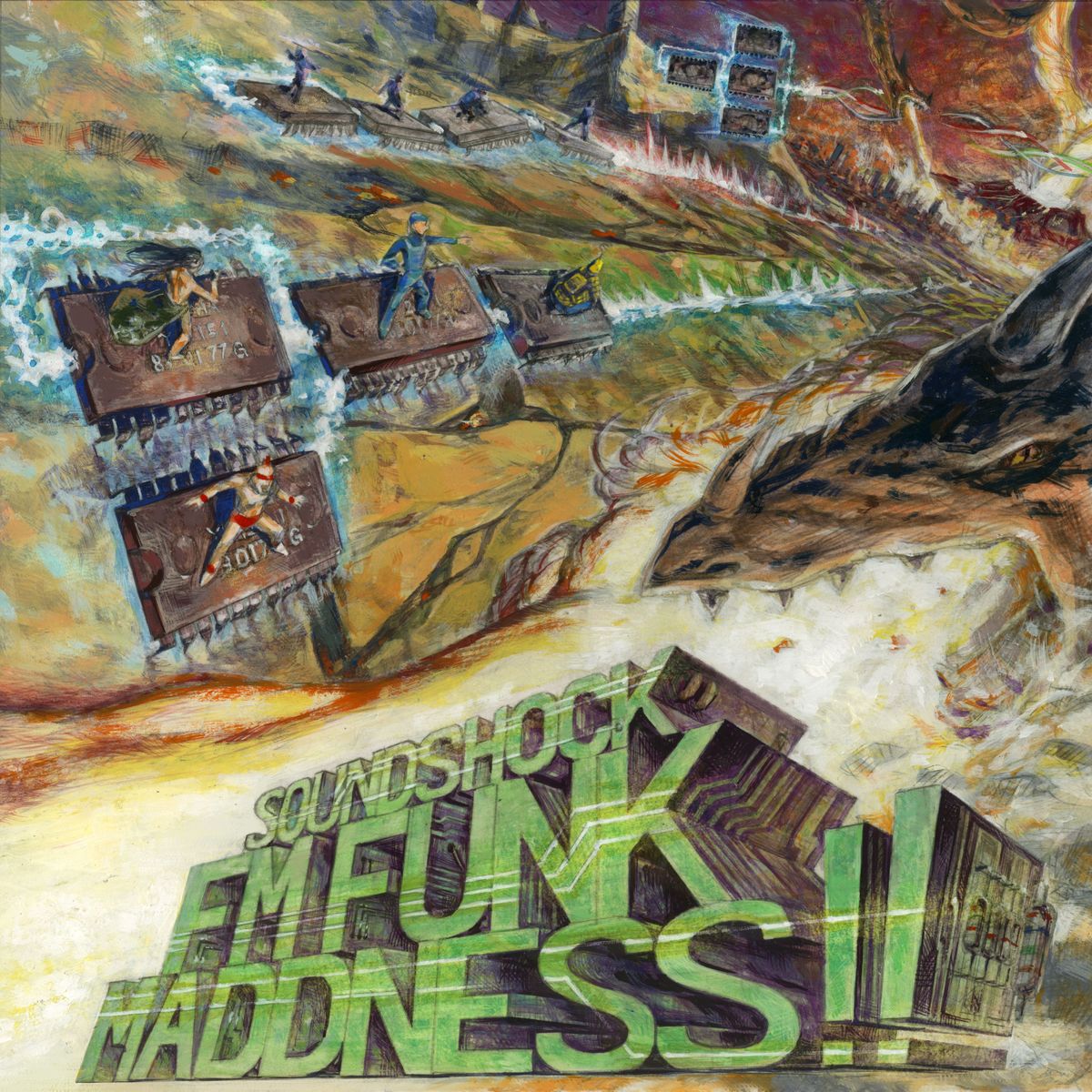
The first installment, SOUNDSHOCK: FM FUNK MADDNESS!!, established the series’ commitment to high-energy, technical compositions. The creative process for the cover art was a collaborative effort between zinger and Shimokura, drawing heavy inspiration from the flyer artwork of Taito classics such as Metal Black and Darius II.
Shimokura’s concept for the first cover was rooted in a narrative of musical heroism. The artwork depicts characters utilizing the "power of FM sound" to repel monstrous entities. A key technical detail in this piece is the alignment of FM chips, which Shimokura rendered in the form of algorithm charts—the mathematical structures used to define how operators interact within an FM synthesizer. By anthropomorphizing these electronic components—giving the chips caterpillar-like legs—Shimokura bridged the gap between abstract technology and character-driven fantasy. This visual metaphor underscored the album’s mission: to take cold, mathematical synthesis and breathe life into it through creative "madness."
FM FUNK TERRROR!!: Horror Tropes and Technical Mythology
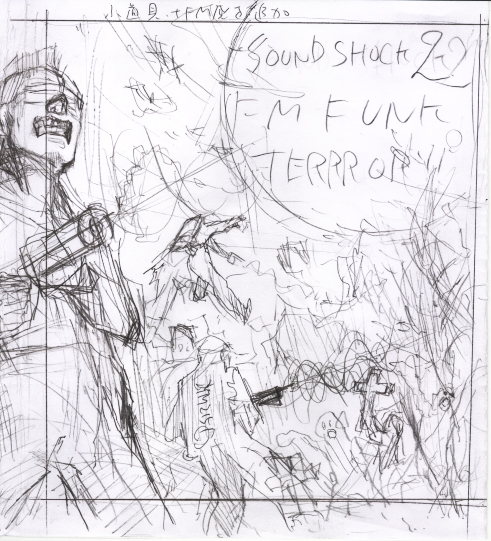
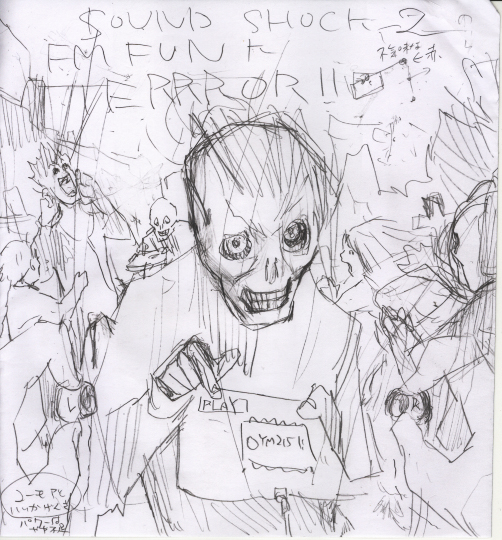
The second volume, SOUNDSHOCK 2: FM FUNK TERRROR!!, shifted the thematic focus toward the horror genre. The development of this cover involved weeks of conceptual discussion, with zinger providing references from 1980s horror cinema—including A Nightmare on Elm Street and The Evil Dead—as well as the cult classic video game series Splatterhouse.
The resulting artwork is a dense, detail-oriented tribute to retro horror. One of the most prominent features is a ghoul in the foreground holding a device labeled "YM666," a play on the Yamaha YM series of sound chips (such as the YM2151 used in arcades or the YM2612 found in the Sega Genesis). The device is styled like a gravestone-themed digital music player, symbolizing the "infectious" nature of the FM sound.
Furthermore, Shimokura expanded the series’ lore by writing a short narrative to accompany the art. In this mythos, the "Algorithm constellations" align on April 5th, prompting a zombie invasion where the victims are not merely killed, but "brain-shocked" into a new state of being. This narrative layer added a sense of world-building to the project, suggesting that the music was not just a product, but a force of nature within a fictional universe.
FM FUNK NIRVANA!!: The Spiritual Culmination
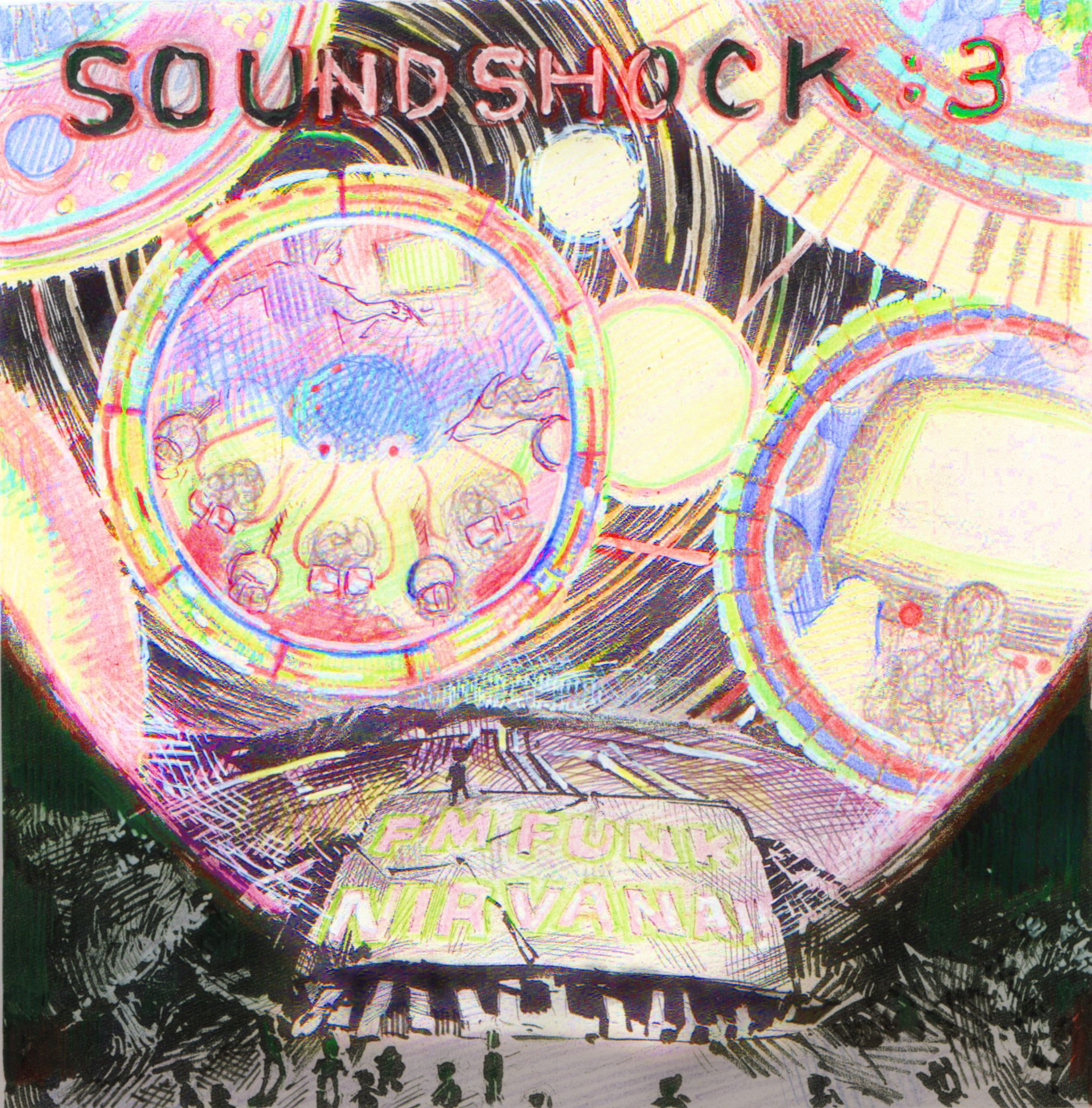
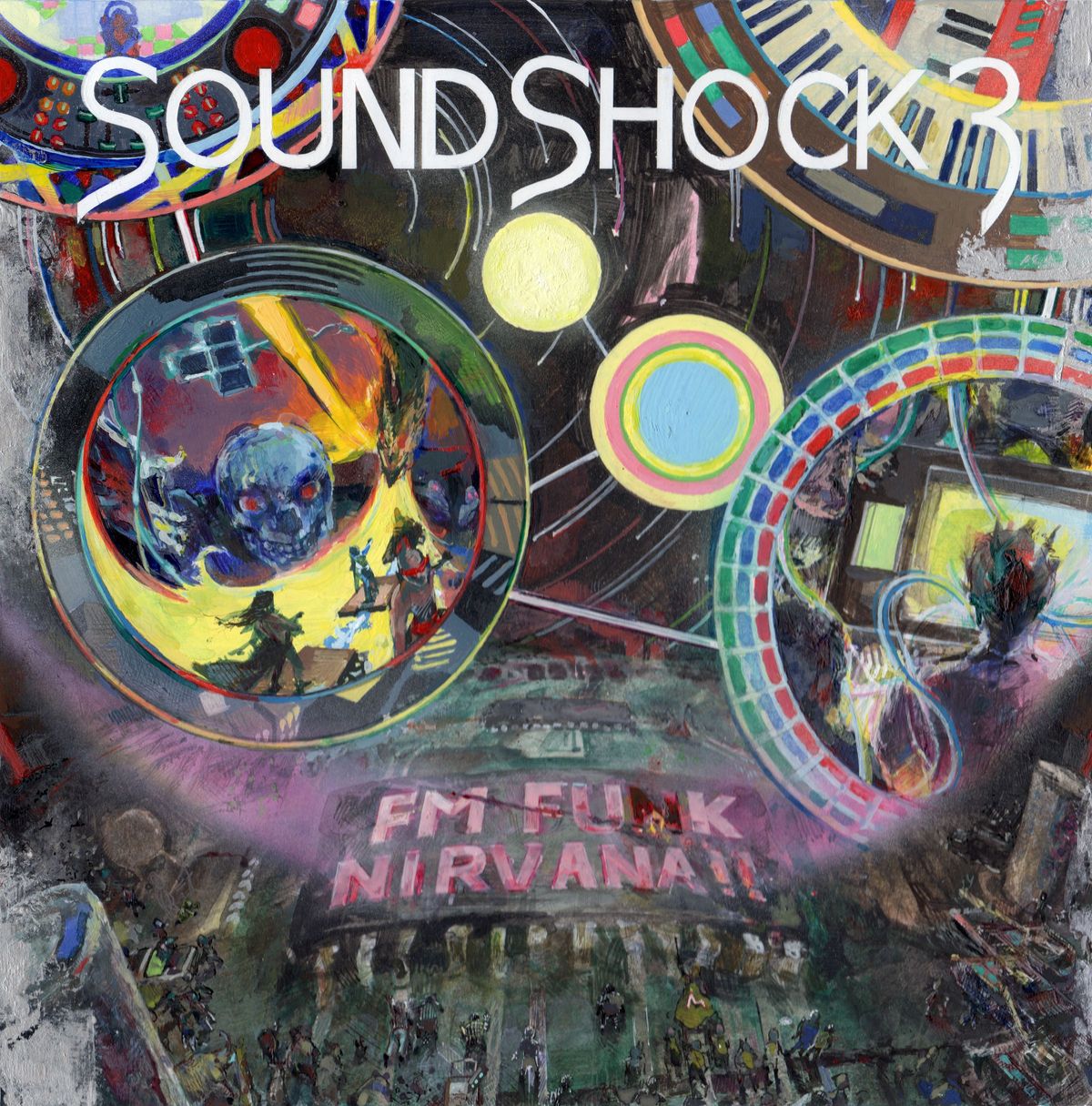
The final chapter, SOUNDSHOCK 3: FM FUNK NIRVANA!!, represents the ultimate evolution of the series. The title itself was inspired by a fan comment years prior, which zinger felt captured the "over-the-top" trajectory of the project. While the previous titles utilized intentional misspellings ("MADDNESS" and "TERRROR") to signify an increase in intensity, "NIRVANA" was left in its standard form. The organizers felt the word already represented a state of perfection and ultimate resolution that could not be further "maxed out."
For the final cover, Shimokura was given greater creative autonomy. He drew inspiration from the soundtrack art of Darius Gaiden and integrated complex Buddhist iconography. The upper portion of the artwork features a "mandala" of spheres, each containing different elemental visions that form a map of the FM universe. Below this celestial vision, a crowd of disciples is shown worshipping a massive FM chip mounted on a circuit board.
This imagery serves as a powerful metaphor for the series’ conclusion. The FM chip is no longer just a tool for heroes or a weapon for monsters; it has become an object of spiritual reverence. This reflects the community’s real-world relationship with retro hardware—a devotion that transcends mere nostalgia and enters the realm of "spiritual guidance," as defined by the traditional use of mandalas.
Technical Context: The Legacy of Yamaha and FM Synthesis
To understand the significance of the SOUNDSHOCK series, one must consider the technical history it celebrates. FM synthesis, popularized by John Chowning and commercialized by Yamaha in the 1980s, defined the soundscape of the decade. The Yamaha DX7 synthesizer and the various YM-series chips found in arcade boards and home consoles (like the Neo Geo and Sega Mega Drive) offered a sharp, metallic, and complex sound that was vastly different from the warmer tones of analog synthesis.
The SOUNDSHOCK series arrived during a period of "FM revival" within the independent music scene. As digital tools made it easier to emulate these classic chips, a new generation of composers began pushing the boundaries of what was possible with 4-operator and 6-operator synthesis. Shimokura’s artwork provided the necessary visual weight to this movement, treating the silicon chips with the same dignity and mythic importance that a classical painter might afford a lyre or a violin.
Analysis of Implications and Broader Impact
The conclusion of the SOUNDSHOCK series marks a transition point for the chiptune and video game music (VGM) communities. In his final message to the fans, Shimokura noted that the end of the series is "not a sad thing," but rather the planting of a "seed for future stars." This sentiment reflects a broader trend in the preservation of digital culture: the idea that the "progeny" of these movements will carry the influence of their predecessors into new, yet-unseen forms.
The series has had a measurable impact on how independent labels approach physical and digital releases. By integrating high-level professional illustration, lore-building, and technical reverence, Ubiktune (the label behind the series) demonstrated that "niche" electronic music can be presented with the same thematic depth as major multimedia franchises.
The collaborative process between zinger and Shimokura also highlights the importance of the "curator-artist" relationship in the digital age. In an era where AI-generated art and stock imagery are increasingly common, the handpainted, concept-heavy approach of the SOUNDSHOCK covers stands as a testament to the value of human intuition and shared cultural history.
Chronology of the SOUNDSHOCK Visual Legacy
- April 2011: FM FUNK MADDNESS!! is released. Shimokura establishes the "Algorithm-hero" visual motif, blending arcade flyer aesthetics with technical diagrams.
- December 2012: FM FUNK TERRROR!! follows, introducing horror elements and the "YM666" mythology. The series gains traction for its unique blend of funk music and aggressive FM programming.
- January 2017: The concept for FM FUNK NIRVANA!! is finalized. Discussions regarding the "mandala" concept and the spiritual end of the series begin.
- April 15, 2017: The final retrospective is published, featuring Shimokura’s concluding message and a look at the prototype sketches that defined the trilogy.
As the "Algorithm constellations" take their final patterns, the SOUNDSHOCK series leaves behind a blueprint for how music, art, and technology can intersect to create a lasting legacy. While the series itself has reached its "Nirvana," the influence of Shimokura’s work and the technical passion of the contributors continue to resonate within the hearts of "believers in FM sound" worldwide.