Jia Lissa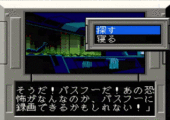
The release of Detonator Orgun on the Mega CD in 1992 marked a significant moment in the intersection of Japanese animation and the burgeoning field of optical media gaming. Developed by Darts and published by Hot-B Co. Ltd., the title served as a direct interactive adaptation of the three-part Original Video Animation (OVA) series of the same name, which had concluded its run earlier that year. Positioned as a graphic adventure, the game sought to capitalize on the technical capabilities of the Mega CD hardware, specifically its ability to play Full Motion Video (FMV) and high-fidelity audio, to bring the high-octane "mecha" aesthetic of director Masami Ōbari to a home audience. However, the transition from the fluid, kinetic animation of the OVA to the static, menu-driven interface of a visual novel presented a series of creative and technical challenges that defined the game’s legacy in the 16-bit era.
Historical Context and the Rise of the OVA Tie-in
The early 1990s represented a "golden age" for the OVA market in Japan. Unlike televised series, OVAs were released directly to home video, allowing for higher production budgets, more detailed animation, and often more mature or complex storylines. Detonator Orgun, which debuted in 1991, was a prime example of this trend. Directed by Masami Ōbari—famed for his work on Fatal Fury: The Motion Picture and Bubblegum Crisis—the series featured intricate mechanical designs and a dark, cyberpunk-inflected narrative.
During this period, Sega’s Mega CD (known as the Sega CD in North America) was positioned as a premium add-on for the Mega Drive console. Its primary selling point was the massive storage capacity of the CD-ROM format, which allowed for 640 megabytes of data—hundreds of times more than the standard cartridges of the day. Publishers like Hot-B recognized that the "Digital Comic" or "Graphic Adventure" genre was the most cost-effective way to utilize this storage. By digitizing frames from the anime and incorporating voice acting, developers could create an experience that felt like "playing" a movie, a novelty that was highly marketable in the Japanese domestic market.
Narrative Structure and Adaptation Accuracy
The story of the Detonator Orgun game closely mirrors the narrative arc of the first two episodes of the OVA, titled "Birth" and "Pursuit," while providing a brief interactive preview of the third installment, "Decisive Battle." The protagonist is Tomoru Shindo, a college student living in the futuristic metropolis of City No. 5 in the year 2292. Tomoru is a young man haunted by recurring dreams of mechanical battles in deep space, a psychological thread that anchors the sci-fi spectacle in a personal coming-of-age story.
The plot is set in motion when Orgun, a "Detonator" or elite warrior of the hostile alien race known as the Evoluders, deserts his kind and flees toward Earth. Following a catastrophic skirmish on the Moon, Orgun establishes a telepathic link with Tomoru. This connection allows Orgun to manifest his consciousness and combat capabilities through a bio-mechanical suit that Tomoru eventually pilots. The narrative explores themes of identity, the morality of war, and the evolutionary destiny of humanity, contrasting the cold, militaristic society of the Evoluders with the vibrant but vulnerable Earth Defense Force (EDF).
The game meticulously recreates these story beats, utilizing extensive dialogue trees to flesh out the world-building. Players interact with a cast of supporting characters, including Professor Michi Kanzaki, an EDF scientist, and the various antagonistic commanders of the Evoluder fleet. Because the game focuses on the first two-thirds of the OVA, the pacing is notably deliberate, prioritizing character development and atmosphere over the rapid-fire action sequences typically associated with the mecha genre.
Chronology of Release and Development
To understand the positioning of Detonator Orgun in the market, one must look at the timeline of its production and the hardware landscape of 1992:
- January 1991: The first episode of the Detonator Orgun OVA is released in Japan, establishing the franchise.
- May 1992: The OVA series concludes with its third episode, solidifying its cult status among mecha enthusiasts.
- July 31, 1992: Hot-B releases the Detonator Orgun game on the Mega CD. This release followed shortly after the launch of the Mega CD hardware in late 1991, making it an early entrant in the system’s library.
- Late 1992: The game remains a Japanese exclusive. Despite the popularity of anime in the West, the high translation costs and the niche appeal of the visual novel genre prevented a North American or European localization.
The development by Darts focused on a "multi-window" system, which was common in Japanese adventures of the era. This allowed the game to display static background art, character portraits, and text boxes simultaneously, creating a layout that mimicked the look of a manga page.
Gameplay Mechanics and Interface
Detonator Orgun eschews the traditional action-oriented gameplay found in other mecha titles, such as Assault Suits Leynos or Mobile Suit Gundam adaptations. Instead, it utilizes a classic point-and-click command interface. The player is presented with a set of contextual verbs:
- Look (Miru): Used to examine the environment for clues or to trigger internal monologues from Tomoru.
- Think (Kangaeru): Allows the player to process information, often serving as a hint system to determine the next necessary action.
- Talk (Hanasu): The primary method of advancing the plot through interrogation and conversation with NPCs.
- Move (Idō): Facilitates travel between various locations within City No. 5, the EDF headquarters, and eventually, space-bound settings.
This mechanical structure places Detonator Orgun in the same category as Hideo Kojima’s Snatcher or the The Space Adventure – Cobra. The challenge for the player lies not in reflexes, but in information gathering and logical progression. However, the game’s strict adherence to the anime’s script means that player agency is somewhat limited; there are few diverging paths, and the "gameplay" largely consists of finding the specific trigger required to move to the next cinematic sequence.
Technical Analysis: Audio and Visual Fidelity
As a Mega CD title, Detonator Orgun was expected to showcase the technical superiority of the format. The results, according to historical analysis, were inconsistent.
Visuals: The game utilizes FMV for its opening sequence and key battle scenes. While these clips were impressive in 1992, the Mega CD’s hardware limitations—specifically its 64-color palette and limited video bandwidth—resulted in heavy graininess and pixelation. The static artwork, however, fared much better. The character designs by Masami Ōbari and the cyberpunk cityscapes were rendered with a high degree of faithfulness to the source material, capturing the neon-lit, high-tech aesthetic of the 23rd century.
Audio: The soundscape of the game is a tale of two technologies. The soundtrack was composed by Kouji Hayama, a celebrated figure in the industry known for his work on the Cho Aniki series. The CD-DA (Compact Disc Digital Audio) tracks provide a powerful, orchestral-synth backdrop that elevates the dramatic tension. However, as the game progresses, the reliance on high-quality Redbook audio diminishes. Much of the mid-game music reverts to the Mega Drive’s internal YM2612 FM synthesis chip. Furthermore, while the game features extensive voice acting from the original anime cast, the quality is often hampered by compression, leading to a "scratchy" output that contrasts sharply with the crystal-clear music of the intro.
Market Reception and Industry Implications
Upon its release, Detonator Orgun received a lukewarm reception from the specialized gaming press in Japan. While critics praised its loyalty to the OVA and the inclusion of professional voice talent, many noted the lack of interactive depth. In an era where players were beginning to expect more from CD-ROM technology—such as the branching narratives of Lunar: The Silver Star or the technical wizardry of Silpheed—a static graphic adventure felt increasingly archaic.
The game’s failure to include any action or "battle" segments was a frequent point of contention. Industry observers noted that for a franchise centered on a powerful mechanized knight, the inability to control the titular Orgun in combat was a missed opportunity. This led to the perception of the game as a "quick cash-in," designed to monetize the existing assets of the OVA with minimal additional development.
Broader Impact and Legacy
The legacy of Detonator Orgun on the Mega CD is inextricably linked to the broader history of anime-to-game adaptations. It stands as a representative of a specific period in the early 90s when developers were still struggling to find the balance between "watching" and "playing" on new multimedia hardware.
The game also highlights the barriers to entry for non-Japanese speakers in the retro gaming community. Because the title is entirely text-heavy and lacks a Western release, it remains an impenetrable artifact for many collectors, accessible only through fan translations or walkthroughs. Its existence, however, paved the way for more sophisticated anime adventures on subsequent platforms like the Sega Saturn and PlayStation, which would eventually perfect the blend of FMV and interactive gameplay.
In summary, Detonator Orgun remains a fascinating, if flawed, piece of Sega history. It captures the ambitious spirit of the Mega CD era, attempting to bring high-end animation into the living room, even if the hardware of the time could not quite match the vision of its creators. For fans of Masami Ōbari and 90s cyberpunk, it serves as a nostalgic window into a time when the boundaries between different forms of media were first beginning to dissolve.