Jia Lissa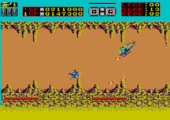
The release of Choplifter on the Sega Master System in 1986 marked a pivotal moment in the evolution of the "rescue-em-up" subgenre, representing a sophisticated bridge between home computer origins and the high-octane demands of the arcade era. Originally conceived by Dan Gorlin and published by Brøderbund for the Apple II in 1982, the title underwent a significant transformation when Sega Enterprises acquired the license for an arcade overhaul in 1985. This arcade version, programmed by the esteemed Rikiya Nakagawa—noted for his work on high-profile titles such as Alien Syndrome and Thunder Blade—served as the direct blueprint for the Master System port. By refining the core mechanics and expanding the environmental variety, Sega successfully transitioned a tactical computer simulation into a fast-paced, visually arresting console experience that remains a cornerstone of the 8-bit era.
Historical Context and Development Evolution
The journey of Choplifter from a 1982 home computer title to a 1986 console flagship is a study in iterative design. Dan Gorlin’s original Apple II version was groundbreaking for its use of physics and its departure from the "destroy everything" philosophy prevalent in early 1980s shooters. In the original version, players were tasked with rescuing 64 hostages from a single, scrolling desert environment, with 16 hostages housed in each of four barracks.
When Sega Enterprises USA released the arcade conversion kit in October 1985, alongside the groundbreaking motorcycle racer Hang-On, the game was fundamentally restructured for a broader audience. Nakagawa’s team reduced the number of hostages per "trip" to eight, which increased the frequency of travel between the battlefield and the home base. This change heightened the tension of the "return flight," a mechanic that forced players to defend a vulnerable, slow-moving craft while laden with precious cargo. The arcade version also introduced new environments beyond the desert, including a naval fleet and a subterranean cave system. These additions were meticulously preserved in the 1986 Master System port, which sought to replicate the arcade’s visual fidelity within the constraints of home hardware.
Core Gameplay Mechanics and Mission Structure
The Master System iteration of Choplifter centers on a six-stage campaign, which effectively consists of three distinct environments—the Desert, the Ocean, and the Caves—looped twice with escalating difficulty. The player assumes the role of a pilot commanding a heavily armed rescue helicopter. Unlike traditional "shmups" (shoot ’em ups) where the primary goal is total annihilation of enemy forces, Choplifter prioritizes precision and resource management.
The mission protocol follows a specific sequence:
- Infiltration: The pilot must navigate past anti-aircraft fire, jet fighters, and tanks to reach the hostage containment areas.
- Extraction: The helicopter must land near the hostages. In a notable display of early AI behavior, the hostages break cover and run toward the craft once it touches down.
- Capacity Management: The helicopter can carry a maximum of eight hostages at a time. This limitation necessitates multiple sorties into enemy territory.
- The Return Flight: Once the cabin is full, the pilot must retreat to the starting base. During this phase, the helicopter’s maneuverability is often tested by pursuing enemy interceptors.
A critical layer of the game’s difficulty is the "friendly fire" mechanic. Players can inadvertently crush hostages with the helicopter’s landing skids or strike them with stray gunfire intended for enemy tanks. This requirement for surgical precision was a radical departure from the "spray and pray" mechanics of contemporaries like Commando or Gradius. To advance to the subsequent stage, the player must successfully return at least 40 hostages to safety, leaving a narrow margin for error across the 48 total captives available per level.
Technical Analysis and Visual Presentation
For 1986, the Master System port of Choplifter was a technical showcase for the console’s superior color palette and scrolling capabilities compared to its primary competitor, the Nintendo Entertainment System (NES). The Master System version utilized a 256×192 resolution and could display 32 colors simultaneously, which Sega leveraged to create vibrant, distinct atmospheres for each of the three biomes.
The desert stages feature multi-layered parallax scrolling, a feature that provides a sense of depth as the sand dunes move at a different rate than the foreground structures. In the ocean stages, the game demonstrates impressive sprite handling as the player’s helicopter hovers over moving naval vessels and submarines. The hostages themselves are animated with surprising detail; they are seen jumping in frustration if the helicopter departs before they can board, or swimming through the water in the naval missions.
A peculiar aspect of the Master System version is the title screen, which depicts the helicopter firing upon the hostages it is meant to save. Historians and enthusiasts have long debated this design choice, with the most likely explanation being a reference to the third stage’s cave environment, where the tight quarters often lead to accidental casualties.
Environmental Hazards and the Difficulty Curve
While Choplifter lacks traditional boss encounters at the end of each level, it compensates with environmental storytelling and escalating hazard density.
- The Desert: Serves as the introductory environment, focusing on tank fire and jet interceptions.
- The Ocean: Introduces verticality and the challenge of landing on moving platforms (submarines and aircraft carriers).
- The Cave: Widely considered the most difficult portion of the game, the cave stage features a "ceiling" of stalactites and a "floor" of volcanic hazards and enemy emplacements. The cramped quarters significantly limit the helicopter’s ability to bank and maneuver, making the rescue of all 48 hostages a feat of extreme skill.
The difficulty curve is notably steep. While the first two stages can be navigated with moderate practice, the cave stage requires memorization of enemy spawn patterns and precise throttle control. This "quarter-muncher" DNA, inherited from the arcade version, meant that many home players faced frequent "Game Over" screens before mastering the physics of the chopper. However, once the mechanics are mastered, a full playthrough of all six stages can be completed in approximately 15 to 20 minutes, reflecting the game’s arcade-centric design philosophy.
Cultural Impact and Legacy
The success of Choplifter on the Master System solidified the franchise’s place in gaming history and influenced the development of future rescue-oriented titles. Most notably, the "Strike" series (Desert Strike, Jungle Strike, etc.) by Electronic Arts in the 1990s owes a significant debt to Choplifter’s objective-based helicopter gameplay.
Sega also included several "Easter eggs" in the Master System port to reward observant players. If a player manages to destroy 16 enemy rockets in a single stage, iconic pop-culture figures such as Superman or E.T. the Extra-Terrestrial appear on the screen. These cameos were a hallmark of 1980s Japanese game development, where programmers often inserted hidden references to Western media.
The game’s impact is also seen in its later iterations. Choplifter II (1991) and Choplifter III (1994) expanded on the formula for the Game Boy and Super NES, respectively, but many fans argue that the 1986 Master System version remains the purest translation of Nakagawa’s arcade vision.
Broader Implications for the 8-Bit Market
The release of Choplifter was a strategic move for Sega as it sought to differentiate the Master System from the NES. By securing high-quality ports of established Western computer hits like Choplifter and Lode Runner, Sega positioned itself as a more "sophisticated" alternative to Nintendo’s platform, catering to players who appreciated the tactical depth of computer gaming combined with the graphical power of the arcade.
Despite its brevity, Choplifter’s high replay value and punishing difficulty ensured its longevity in the rental market and in the collections of early adopters. It proved that a game did not need a complex narrative or dozens of levels to be compelling; rather, a well-tuned physics engine and a clear, high-stakes objective were sufficient to create a "timeless classic."
Conclusion: A Benchmark for Rescue Simulators
Choplifter on the Sega Master System stands as a testament to the era of arcade-to-home transitions. By taking Dan Gorlin’s original concept and infusing it with the technical polish of Sega’s arcade division, the development team created a title that balanced tension, skill, and visual flair. While the lack of boss fights and the relatively short length were criticisms at the time, the game’s focus on precision over destruction offered a refreshing alternative to the standard shooters of the 1980s. Today, it remains an essential piece of the Master System library, representing a moment when gameplay innovation and hardware capability converged to create a unique and enduring challenge. For historians and retro enthusiasts, Choplifter is more than just a shooter; it is a tactical exercise in heroism that defined a generation of rescue-based action games.