Jia Lissa
The release of Shining in the Darkness in 1991 marked a pivotal moment in the history of Sega’s 16-bit hardware, establishing a franchise that would eventually rival industry titans like The Legend of Zelda and Final Fantasy. While Sega’s internal Phantasy Star series had already found a foothold, Shining in the Darkness introduced a distinct flavor of role-playing game (RPG) that combined first-person dungeon crawling with high-production values and a unique aesthetic. The game was the debut project of Climax Entertainment, a studio founded by Hiroyuki Takahashi and Hiroshi (Kan) Naito, two veterans who sought to break away from the established norms of Japanese RPG development. By leveraging the superior processing power of the Motorola 68000 CPU found in the Sega Mega Drive, Climax created a title that not only pushed technical boundaries but also reimagined how players interacted with virtual environments through innovative UI design and a philosophy of "immersive" gameplay.
The Chunsoft Origins and the Quest for Independence
The DNA of the Shining series is ironically rooted in the development of Nintendo’s flagship RPG franchise, Dragon Quest. Hiroyuki Takahashi and Hiroshi Naito met at Chunsoft, the primary developer for Enix’s Dragon Quest titles on the Famicom. Takahashi, who had a background in theater and television production, brought a narrative-driven perspective to the team, while Naito was a self-taught programming prodigy with a fascination for 3D imagery and arcade-style responsiveness. Their collaboration on Dragon Quest III and IV provided them with deep insights into the mechanics of the genre, but it also highlighted the limitations of working within a massive team where individual contributions were often obscured by the brand.
Takahashi’s dissatisfaction grew from a belief that Japanese developers were falling into a trap of imitation, merely iterating on existing successes rather than innovating. During a trip to the United States for focus testing on Dragon Quest III, Takahashi observed American gamers’ skepticism toward Japanese software, which some viewed as derivative of Western computer games like Wizardry or Ultima. This experience solidified his resolve to create something that would earn global respect for its originality. In April 1990, Takahashi and Naito departed Chunsoft to form Climax Entertainment, taking with them several colleagues, including Shinya Nishigaki. Their goal was to elevate the status of game developers in Japan, transforming them into figures as recognizable as professional athletes or film directors.

Selecting the Architecture: Why Climax Chose Sega
When Climax began conceptualizing its first project, the choice of hardware was a critical strategic decision. Although the studio had extensive experience with Nintendo’s 8-bit Famicom, they recognized that the aging hardware could not support the spatial awareness and visual fidelity required for a modern 3D dungeon crawler. While the Super Famicom had recently launched, its complex architecture presented a steep learning curve. In contrast, the Sega Mega Drive (Genesis) had been on the market for two years, and its Motorola 68000 microprocessor was well-documented and powerful.
Sega, desperate to bolster its third-party lineup against Nintendo’s dominant market share, welcomed Climax with open arms. Sega President Hayao Nakayama personally oversaw the initial meetings, recognizing the value of securing talent from the Dragon Quest lineage. However, Climax quickly discovered that Sega’s development tools were insufficient for the level of visual sophistication they envisioned. To rectify this, Climax spent the early months of development building their own proprietary graphics tools and environment. They utilized high-performance Hewlett-Packard workstations provided by Sega R&D head Hisashi Suzuki, which allowed for faster ROM burning and more efficient asset management than the standard tools used at the time.

Technological Innovations: Panorama 3D and Smooth Scrolling
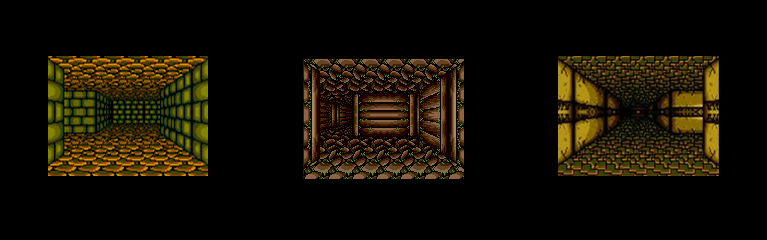
The core technical achievement of Shining in the Darkness was its "Panorama 3D" engine. Unlike many earlier dungeon crawlers that used static, boxy transitions between steps, Climax aimed for a fluid, continuous sense of movement. Naito, who drew the pixel art for the walls himself, insisted on a level of realism that simulated depth through discrete tile-based steps. To achieve this on hardware that lacked built-in 3D scaling or rotation capabilities, Special Effects Programmer Yasuhiro Taguchi employed advanced tile-based tricks.
The engine used a single-point perspective, assembling pre-drawn wall segments that changed patterns based on the player’s distance from them. This created a convincing approximation of movement through a three-dimensional maze. While the Super Famicom’s Mode 7 was the industry standard for pseudo-3D at the time, Climax’s software-driven approach on the Mega Drive allowed for larger, more detailed enemy sprites and elaborate magic effects that would have been difficult to maintain alongside full-screen Mode 7 scaling. By shrinking the playable window slightly, they freed up VRAM to support the "Disney-esque" animations that would become a hallmark of the studio.
Aesthetic Philosophy: Moving Beyond Manga
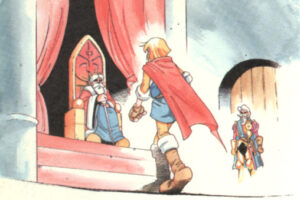
A defining characteristic of Shining in the Darkness was its departure from the traditional manga art style prevalent in 1990s Japanese RPGs. Takahashi and Naito were heavily influenced by classic Western animation, particularly early Disney features like Sleeping Beauty and Alice in Wonderland. They sought a "universal" style that would appeal to both domestic and international audiences. This task fell to Yoshitaka Tamaki, a freelance artist who had won an Enix-sponsored design contest judged by Takahashi.
Tamaki’s character designs focused on "caricature" and personality rather than the typical sharp-edged anime tropes. The hero, Max, and his companions, Milo and Pyra, were designed to feel like actors on a stage. This theatrical influence extended to the town and castle locations, where the camera angles were meticulously crafted to provide a sense of depth. In the tavern, for example, the perspective was angled so that the bar counter appeared to recede into the background, with the tavern owner’s sprite resizing as he moved between rooms. This commitment to visual storytelling ensured that the single town of Thornwood felt alive and reactive to the player’s progress.
Redefining the User Interface: The Icon-Based Menu
Recognizing that RPGs were often bogged down by cumbersome, text-heavy menus, Climax developed a streamlined command system. They implemented a radial icon-based menu that corresponded directly to the directional keys on the Mega Drive controller. This allowed for rapid, intuitive navigation of combat and inventory commands without requiring the player to read through layers of sub-menus.
This system, which was later refined in Shining Force and adopted by other developers in various forms, represented a shift toward user-centric design. Naito’s philosophy was that a player should be able to understand the controls without consulting a manual. The icons—such as a building for "enter" or a wizard for "magic"—flew onto the screen with a distinct sound effect, reinforcing the game’s high-speed, arcade-inspired responsiveness.

The "No-Map" Controversy and Navigation Design
One of the most debated design choices in Shining in the Darkness was the deliberate omission of an auto-mapping system. Despite the complexity of the multi-story labyrinth, Takahashi and Naito believed that a map would undermine the sense of immersion and realism. They wanted players to learn the environment through landmarks—such as puddles, torches, and specific wall decorations—mimicking the way one might navigate a real-world forest or city.
To provide some assistance without "spoon-feeding" the player, Climax included consumable items like Wisdom Seeds and the "View" spell, which provided a temporary glimpse of the player’s surroundings. This philosophy forced players to engage more deeply with the dungeon’s layout, though it significantly increased the game’s difficulty for those unaccustomed to manual mapping.

Market Reception and the Birth of a Legacy
Shining in the Darkness launched in Japan on March 29, 1991, and was a commercial success, selling approximately 300,000 units. This represented a 16% attach rate for the Mega Drive’s installed base at the time, a significant feat for a new IP from a fledgling studio. While the game received some criticism for its high difficulty and memory-saving compromises, it was praised for its production values and fluid gameplay.
In the West, the game arrived with minimal marketing compared to flagship titles like Sonic the Hedgehog. Sega of America marketing head Al Nilsen noted that while it didn’t receive television promotion, it found a dedicated audience through print media and word-of-mouth. Western RPG fans, particularly those who enjoyed the Wizardry series, lauded the game for its polished presentation and "immersive" perspective.
The success of Shining in the Darkness laid the groundwork for the 1992 release of Shining Force, which transitioned the series into the tactical RPG genre. Although Climax would eventually face budgetary and management friction with Sega, their debut title remains a landmark achievement in the 16-bit era. It proved that a small, independent team could innovate within a rigid genre and established the "Shining" brand as a cornerstone of Sega’s identity. The game’s influence can still be seen in modern dungeon crawlers, and its chronology remains a point of fascination for fans who continue to trace the links between the Kingdom of Thornwood and the broader Shining universe.