
 Jia Lissa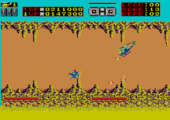
The 1986 release of Choplifter for the Sega Master System represents a pivotal moment in the evolution of the side-scrolling shooter genre, marking the successful transition of a computer-based classic into a refined arcade and home console experience. Originally conceived by Dan Gorlin and released by Brøderbund for the Apple II in 1982, Choplifter introduced a unique "rescue-and-return" mechanic that deviated from the "destroy everything" philosophy common in early 1980s gaming. By the time Sega Enterprises acquired the rights to develop an arcade version in 1985, the title was already a household name. However, it was the 1986 Master System port that solidified the game’s legacy, offering home users a visually superior and mechanically expanded version of the tactical helicopter simulation.
The Evolution from Apple II to the Arcade
To understand the significance of the Sega Master System version, one must examine the iterative improvements made by Sega’s arcade division. In October 1985, Sega Enterprises USA debuted the arcade iteration of Choplifter alongside the groundbreaking racing game Hang-On. This version was programmed by Rikiya Nakagawa, a legendary figure in Sega’s history who would later contribute to iconic titles such as Alien Syndrome and Thunder Blade.
Nakagawa’s team implemented substantial refinements to Dan Gorlin’s original formula. While the Apple II version focused on a singular environment, the arcade version introduced diverse settings, including a naval fleet and a subterranean cave system. Furthermore, the hostage mechanics were adjusted for the faster pace of the arcade; the number of hostages required for a single retrieval trip was reduced to eight, streamlining the gameplay loop while maintaining high stakes. These enhancements provided the foundational architecture for the Master System port, which aimed to replicate the arcade’s intensity within the constraints of home hardware.
Technical Specifications and Hardware Utilization
The Sega Master System version of Choplifter is frequently cited by historians as a showcase for the console’s superior hardware capabilities relative to its primary competitor, the Nintendo Entertainment System (NES). Released in 1986, the port utilized the Master System’s extensive color palette and advanced scrolling capabilities to deliver a visual experience that closely mirrored the arcade original.
One of the most notable technical achievements in this version is the implementation of parallax scrolling in the backgrounds. This technique, which involves moving background layers at different speeds to create an illusion of depth, was relatively rare in early 8-bit home console games. Additionally, the game’s sprites—particularly the helicopter and the individual hostages—featured fluid animations that enhanced the sense of immersion. The Master System’s Zilog Z80 processor allowed for a high density of moving objects on screen, including enemy tanks, jet fighters, and airships, without significant frame rate drops.
Mechanics of the Rescue Mission
The core gameplay of Choplifter revolves around a three-stage cycle that loops with increasing difficulty. Players pilot a rescue helicopter through six total levels (representing three distinct environments: Desert, Ocean, and Cave) with the objective of rescuing 40 hostages per stage to progress.
The rescue process is a multi-tiered tactical challenge. First, the pilot must locate and destroy enemy barracks or structures to free the hostages. Once the hostages emerge, the player must land the helicopter with precision. A careless landing can result in the accidental crushing of the very people the player is tasked with saving—a mechanic that introduced a layer of moral and tactical consequence rarely seen in mid-80s titles. After landing, the pilot must wait for up to eight hostages to board while simultaneously fending off ground-to-air and air-to-air attacks. The return trip to the home base is often the most perilous segment, as the distance from the rescue site increases the likelihood of interception by enemy forces.
Environmental Analysis and Level Design
The Master System port is praised for its environmental variety, which forced players to adapt their flight patterns to different hazards:
- The Desert (Stage 1): This stage serves as an introduction to the game’s mechanics, featuring open spaces and predictable enemy patterns. It introduces the fundamental threat of tanks and anti-aircraft fire. In later loops, this stage transitions into a night-time setting, demonstrating the Master System’s ability to handle color palette swaps effectively.
- The Ocean (Stage 2): In this environment, the helicopter must navigate over a fleet of battleships and submarines. The rescue mechanic is modified here; hostages must swim from a sinking submarine to the helicopter, requiring the player to hover at a precise altitude just above the waterline, leaving them vulnerable to naval artillery.
- The Cave (Stage 3): Historically considered the most difficult segment of the game, the cave environment introduces claustrophobic corridors and natural hazards such as stalactites. The tight quarters limit the helicopter’s mobility, making it an easy target for ground forces. Success in this stage requires a high degree of memorization and mastery of the game’s momentum-based flight controls.
Industry Impact and Comparative Context
During the mid-1980s, the video game industry was defined by the "Console Wars" between Sega and Nintendo. Choplifter was a key asset for Sega in this competition. While a version of Choplifter was eventually released for the NES, the Master System version was widely regarded as the definitive 8-bit port due to its closer adherence to the arcade’s visual fidelity and its inclusion of the additional stages designed by Nakagawa.
The game also featured several "Easter eggs" that were indicative of the era’s pop culture. By destroying a specific number of rockets (typically 16), players could trigger appearances by Superman or E.T. the Extra-Terrestrial. These inclusions, while minor, added a layer of hidden depth that encouraged replayability and community discussion among players.
Tactical Challenges and Historical Critique
Despite its accolades, Choplifter was not without its challenges for the average consumer. The game’s steep difficulty curve, particularly in the subterranean levels, was a direct carryover from its arcade origins, where high difficulty was used to maximize revenue from coin-operated machines. On a home console, where "quarter-munching" was not a factor, this difficulty sometimes bordered on the punitive.
Furthermore, the game’s brevity has been a point of historical critique. A skilled player can complete all three environments in under 15 minutes. To compensate for this, Sega utilized a "looping" system where the stages repeat with increased enemy aggression and faster projectile speeds. While this extended the life of the game, it highlighted the limitations of early cartridge storage, which prevented the inclusion of more diverse levels or complex boss encounters.
Legacy and the Evolution of the Rescue Genre
The success of Choplifter on the Master System had a lasting impact on the development of the "rescue-shmup" sub-genre. Its influence can be seen in later titles such as the Strike series (Desert Strike, Jungle Strike), which expanded upon the tactical helicopter concept by adding resource management and mission-based objectives.
Rikiya Nakagawa’s contributions to the arcade and SMS versions of Choplifter are now viewed as a masterclass in how to port and enhance existing IPs. His ability to take a computer game and inject it with arcade-style adrenaline without losing the soul of the original work set a standard for Sega’s internal development teams for decades to come.
Today, Choplifter on the Master System is remembered as more than just a port; it is viewed as a definitive example of 8-bit excellence. Its blend of tense action, precise controls, and technical sophistication ensured its place in the library of any serious collector of the era. As a bridge between the early computer gaming age and the golden era of home consoles, Choplifter remains a testament to the enduring appeal of well-crafted game mechanics and the importance of tactical depth in interactive entertainment.
The game stands as a reminder of a period when Sega was at the height of its creative powers, successfully translating complex arcade experiences into the living room. For modern audiences, Choplifter offers a window into the design philosophies of the 1980s—a time when gameplay was defined by high stakes, unforgiving difficulty, and the simple, visceral thrill of a successful mission.








