Jia Lissa
In a period of unprecedented growth for the electronic amusement industry, Sega Enterprises, Ltd. has signaled a decisive shift in its corporate trajectory, prioritizing television-based arcade games as the cornerstone of its global operations. Following a fiscal year of record-breaking earnings and the further integration of its American and Japanese subsidiaries, Sega’s Executive Vice President and Representative Director, Hayao Nakayama, has provided a comprehensive overview of the company’s internal restructuring and its aggressive stance against intellectual property infringement. This strategic realignment comes six years after Sega became a primary asset of the Gulf & Western (G&W) Corporation, positioning the manufacturer at the forefront of the "Golden Age" of arcades.
The Gulf & Western Framework and International Synergy
The organizational structure of Sega in 1980 reflects a complex, multi-national web designed to leverage the industrial might of the United States alongside the rapid technological innovation of Japan. Sega of Japan, headquartered in Tokyo, operates as a subsidiary of Sega of America, which is in turn owned by the New York-based conglomerate Gulf & Western Corporation. According to Nakayama, this "grandchild company" status does not diminish Sega of Japan’s autonomy; rather, it integrates the firm into a massive industrial ecosystem.
Gulf & Western currently stands as the 52nd largest corporation in the United States, reporting annual sales of approximately $5.3 billion and a net income of $230 million. While G&W is a diversified giant with interests ranging from automotive parts and energy to the entertainment powerhouse Paramount Pictures, its leisure division has increasingly focused on the interactive sector.
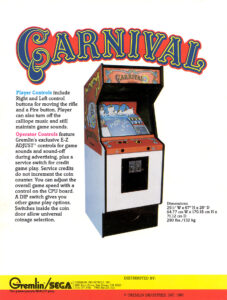
The synergy between Sega’s hubs was further solidified by the 1976 and 1979 acquisitions of Gremlin Industries in the U.S. and Esco Trading in Japan, respectively. This dual-hemisphere approach allows for a unique development cycle: a product may be conceptualized in San Diego by Gremlin and manufactured in Tokyo by Sega, or vice versa. This collaborative pipeline has already yielded significant international successes, with titles like Carnival and Mini Monaco finding massive audiences in the Western market despite varying receptions in their home territories.

Financial Performance and Operational Scale
The fiscal year ending in April 1979 marked a period of significant prosperity for Sega Enterprises, Ltd. The company reported annual sales reaching 24 billion yen (approximately $108 million USD in 1980 values), with a declared income of 5.37 billion yen. This financial health has supported a massive logistical expansion. Sega currently employs 1,200 personnel and maintains a robust domestic infrastructure consisting of three major branch offices in Sapporo, Osaka, and Fukuoka, supplemented by four sales offices and 89 operational centers across Japan.
Nakayama emphasized that Sega’s dual role as both a manufacturer and an operator is a unique hallmark of the Japanese amusement industry. Unlike many Western counterparts that focus strictly on hardware production, Sega maintains a "strong operator mindset." This involves managing a vast network of game centers, ensuring long-term business sustainability through economies of scale. The company’s philosophy centers on a "greatest common denominator" approach, aiming to provide consistent revenue through attentive service and high-quality maintenance across its nationwide locations.
The Strategic Shift to Television Games
The most significant takeaway from Sega’s current policy is the allocation of 70% to 80% of its research and development resources toward television game machines. Nakayama noted that the global market has moved irrevocably toward video-based entertainment, citing the "novelty and entertainment value" that digital screens provide over traditional mechanical or electro-mechanical amusements.
While Sega continues to support pinball and medal games—improving existing units like Blackjack, Faro II, and Punto Banco to reduce waste and lower costs for operators—the focus is clearly on the digital frontier. Nakayama acknowledged the "visual content" criticism often leveled at the industry but argued that the positive engagement of TV games far outweighs the negatives.
The Cabinet Format Debate: Tabletop vs. Upright
A distinct cultural divide has emerged in the hardware preferences of the Japanese and Western markets. In Japan, the "table-type" cabinet has become the industry standard, largely due to its integration into coffee shops and small venues where the machines serve as both furniture and entertainment. Sega’s Head-On was a pioneer in this format, and the company continues to prioritize table models for the domestic market.

Conversely, the Western market remains dominated by "upright" cabinets. Nakayama admitted that Sega is currently engaged in a period of "trial and error" regarding cabinet design. While upright machines offer higher "added value" through ornate cabinet art and presence, the Japanese market’s demand for efficiency and space-saving designs makes the table-type more viable. However, the company has no intention of abandoning upright models, viewing them as essential for the American and European markets where efficiency is balanced against player immersion.
Intellectual Property and the War on "Clones"
Perhaps the most contentious issue addressed by Nakayama is the rampant copying of game software. During the "Invader boom" initiated by Taito’s Space Invaders, the industry saw a surge in unlicensed "clones" or copycat machines. At the time, Japanese law lacked clear copyright protections for software, and manufacturers often struggled to keep up with demand, leading some operators to purchase counterfeit boards out of necessity.
Nakayama signaled that the era of "defiant" copying is coming to an end. Sega has adopted a zero-tolerance policy, utilizing trademarks and unfair competition prevention laws to target counterfeiters. A landmark case in the United States saw Sega/Gremlin successfully sue Exidy over infringements on Head-On, a victory that Nakayama believes has empowered the entire industry.
"Manufacturers should aim for high-quality machines that sell well, even if they are expensive," Nakayama stated, warning that the prevalence of copy products ultimately drives up the cost of legitimate hardware for honest operators. Sega is now actively developing proprietary technology that is increasingly difficult to replicate, effectively using hardware complexity as a shield for its software investments.
Global Expansion and Diversification
Sega’s ambitions extend beyond the arcade floor. Through Sega of America, the company has launched the "Sega Center" game center chain and "PJ Pizzazz," a pizza restaurant concept designed to integrate family dining with electronic entertainment. These divisions, managed by a small coordinating team in the U.S., represent Sega’s attempt to diversify its revenue streams and establish a permanent brand presence in the American leisure sector.
In Europe, which Nakayama describes as a "buyer’s market," Sega has found success by licensing technologies and games from other Japanese firms for international distribution. The licensing of Astro Fighter is a prime example of Sega acting as a global conduit for Japanese innovation, ensuring that even games not developed in-house contribute to the group’s global footprint.
Chronology of Key Sega Milestones (1974–1980)
- 1974: Sega Enterprises, Ltd. is acquired by Gulf & Western Corporation, becoming part of a major U.S. conglomerate.
- 1976: Sega of America acquires Gremlin Industries, establishing a dedicated R&D and manufacturing hub in San Diego, California.
- 1978: The release of Head-On marks a major success in the "maze game" genre and popularizes the tabletop cabinet format in Japan.
- 1979: Sega acquires Esco Trading in Japan to bolster its distribution and sales network.
- 1979 (April): Fiscal year ends with record 24 billion yen in sales.
- 1980: Sega/Gremlin wins a pivotal legal battle against Exidy regarding Head-On, setting a precedent for software protection.
- 1980 (August): Executive VP Hayao Nakayama confirms an 80% focus on TV games, signaling the end of the electro-mechanical era as the primary driver of the company.
Broader Impact and Industry Implications
The strategies outlined by Nakayama reflect a maturing industry moving away from its "Wild West" roots toward a structured, corporate-driven future. By aligning with a conglomerate like Gulf & Western, Sega has secured the capital necessary to withstand the volatile cycles of the amusement market.
The focus on TV games suggests that the industry is no longer satisfied with simple mechanical novelties; instead, it is chasing the infinite possibilities of software-defined entertainment. This shift is expected to trigger a technological arms race, as manufacturers like Sega, Atari, and Midway compete to produce more sophisticated graphics and more complex gameplay to deter counterfeiters and attract a more discerning public.
Furthermore, Nakayama’s emphasis on the "operator mindset" suggests that the future of the arcade lies not just in the machines, but in the environment. The expansion into "PJ Pizzazz" and "Sega Centers" hints at a move toward "location-based entertainment" centers, where the social experience of gaming is as important as the game itself.
As 1980 progresses, Sega stands as a bridge between the industrial manufacturing of the mid-20th century and the digital entertainment revolution of the 21st. With a robust global pipeline, a firm legal stance on intellectual property, and a clear focus on video technology, the company is positioned to remain a dominant force in the global leisure market for the foreseeable future.