Farhan hamdan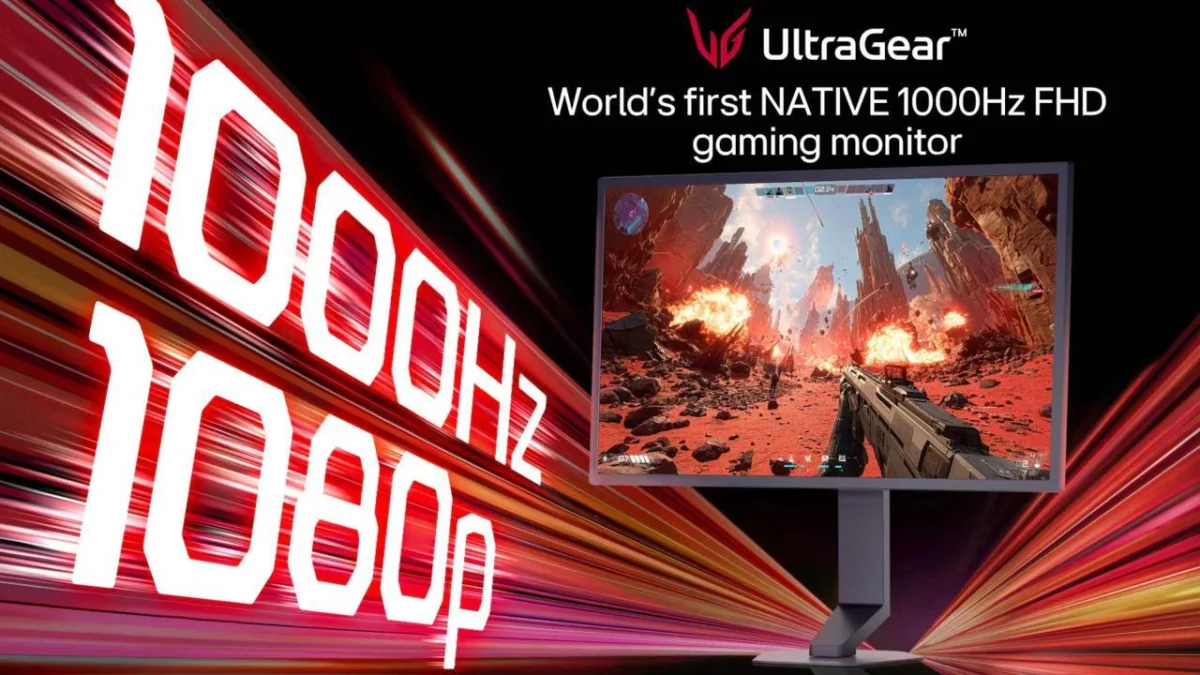
LG Electronics has officially announced the UltraGear 25GR590B, a groundbreaking 24.5-inch native 1080p IPS display capable of an unprecedented 1000Hz refresh rate, with commercial availability anticipated by the end of the current year. This innovative monitor is poised to set a new benchmark in the competitive gaming display market, introducing features designed to dramatically enhance motion clarity. A pivotal element of its advanced capabilities is the inclusion of LG’s proprietary “Motion Blur Reduction Pro” technology, which leverages sophisticated Black Frame Insertion (BFI) techniques to combat ghosting and blur, promising a visual experience traditionally associated with cathode-ray tube (CRT) displays. The introduction of such a high refresh rate, coupled with advanced motion blur reduction, signals a significant leap forward for gamers, particularly those in esports, where every millisecond of visual precision can translate into a competitive advantage.
The Pursuit of Perfect Motion: A Historical Context
The evolution of display technology for gaming has been a relentless pursuit of speed and clarity. For decades, the gold standard for motion clarity was the CRT monitor, renowned for its instantaneous pixel response and inherent ability to produce images with virtually no motion blur. This was largely due to their operating principle, where an electron beam rapidly scanned and illuminated phosphors, followed by a brief period of darkness, effectively mimicking Black Frame Insertion. However, the bulky nature, lower resolutions, and energy inefficiency of CRTs led to their gradual replacement by flat-panel displays, primarily Liquid Crystal Displays (LCDs).
Early LCDs, while offering superior resolution, slim profiles, and energy efficiency, struggled with inherent limitations in pixel response times, leading to noticeable motion blur, ghosting, and input lag. The industry responded by incrementally increasing refresh rates, moving from standard 60Hz to 120Hz, 144Hz, 240Hz, and more recently, beyond 360Hz and even 500Hz with models like the ASUS ROG Swift Pro PG248QP (540Hz) and Alienware AW2524H (500Hz). Each increase aimed to provide smoother visuals and reduce perceived input lag, catering to the demands of professional esports players who require the quickest possible visual feedback.
Alongside refresh rate advancements, technologies like BFI emerged as a software or hardware-level solution to mitigate motion blur. BFI works by inserting a black frame between each displayed image frame, effectively resetting the persistence of vision and reducing the time pixels are illuminated. While effective, earlier BFI implementations often came with trade-offs, such as reduced overall brightness and noticeable flicker, especially at lower refresh rates. The challenge for display manufacturers has been to integrate BFI seamlessly, minimizing these drawbacks while maximizing its benefits. LG’s UltraGear 25GR590B, with its 1000Hz refresh rate, represents a pivotal moment in this ongoing quest, potentially overcoming historical limitations of BFI.
LG UltraGear 25GR590B: Specifications and Core Innovations
The LG UltraGear 25GR590B is engineered with a 24.5-inch In-Plane Switching (IPS) panel, a technology known for its excellent color accuracy and wide viewing angles. The choice of 1080p resolution for such a high refresh rate monitor is strategic, targeting the competitive gaming segment where maximizing frame rates (FPS) is often prioritized over pixel density. Achieving 1000 frames per second (fps) in modern games requires exceptionally powerful hardware, and 1080p provides a more attainable target resolution for such demanding performance.
The headline feature, undoubtedly, is the native 1000Hz refresh rate. This represents a significant leap from the current commercial high-refresh-rate monitors, effectively doubling or even tripling the speeds of many premium offerings. A higher refresh rate means more frames are displayed per second, resulting in significantly smoother motion, reduced input lag, and a more responsive feel for the user. For competitive gamers, this translates to faster target acquisition and more precise movements.
However, the true innovation potentially lies in the integration of "Motion Blur Reduction Pro." While LG’s official designation, this technology is understood to be an advanced implementation of Black Frame Insertion. The crucial distinction here is not just the presence of BFI, but its application on a 1000Hz panel. This incredibly high refresh rate provides an unprecedented canvas for BFI to operate, mitigating its historical drawbacks.
The Synergy of 1000Hz and Advanced Black Frame Insertion
The efficacy of Black Frame Insertion is directly proportional to the display’s refresh rate. At lower refresh rates (e.g., 60Hz or 120Hz), inserting black frames can lead to noticeable flicker, as the eye perceives the rapid on-off cycling of the backlight. This flicker can cause eye strain and detract from the viewing experience. However, as the refresh rate increases, the frequency of the black frame insertion also rises, pushing the flicker beyond the perceptible threshold for the human eye.
Industry research and development, notably seen in technologies like NVIDIA’s "Pulsar" (a precursor to advanced BFI techniques), demonstrated that BFI becomes significantly less noticeable in terms of flicker at refresh rates of 120Hz and above. The LG UltraGear 25GR590B, operating at 1000Hz, pushes this concept to an extreme. At this refresh rate, the flicker associated with BFI is expected to be virtually imperceptible, allowing users to experience the full benefits of motion blur reduction without the common trade-offs.

Furthermore, the 1000Hz refresh rate opens the door for highly sophisticated BFI techniques. One such technique, explored by display experts like Blur Busters, involves "CRT Beam Emulation." This method aims to replicate the scanline rendering of CRTs by breaking down a single source frame into multiple sub-frames, each displayed for a very brief period. For instance, a 60Hz source signal could be divided into 16 parts, each displayed sequentially within the 1000Hz refresh cycle, with black frames or extremely brief illumination periods in between. This advanced method could potentially achieve motion clarity levels previously thought impossible on LCDs, nearing the "zero motion blur" characteristic of CRTs.
Consider a scenario where a game outputs at 240Hz. With the UltraGear 25GR590B, LG’s Motion Blur Reduction Pro could theoretically interleave multiple black frames or apply advanced scanout techniques within the 1000Hz cycle, significantly sharpening the perception of moving objects. Even for games or consoles capped at 120Hz, the monitor’s high refresh rate combined with BFI could yield substantial benefits. Moreover, if a scaler is used to upsample a 60Hz game to 120Hz, the monitor would then treat it as a native 120Hz signal, allowing it to leverage its 1000Hz capability for advanced BFI, potentially operating at 960Hz. This could result in dramatically reduced motion blur with minimal flicker, as demonstrated by previous experiments converting lower frame rates (e.g., 24p movies to 96p, then displayed at 384Hz with BFI for significant blur reduction and reduced flicker).
Impact on Gaming Experience: Input Lag vs. Perceived Latency
While the UltraGear 25GR590B’s primary contribution is motion clarity, its impact on the perception of input lag is also noteworthy. It is crucial to distinguish between actual input lag (the time it takes for a display to process and present a signal) and perceived latency. While upscaling a 60Hz signal to 120Hz before sending it to the 1000Hz monitor might introduce a minor processing buffer, the dramatic reduction in motion blur can create an illusion of lower lag.
This phenomenon is well-documented in display research. An HD CRT, despite potentially having two frames of actual input lag, often feels more responsive than a 60Hz LCD with only a few milliseconds of lag. The reason lies in the clarity of motion. When motion blur is significantly reduced, objects on screen appear sharper and movements feel more "snappy" and immediate. The brain interprets this visual crispness as a direct response to input, even if the raw latency numbers haven’t changed drastically. For competitive gamers, this perceived responsiveness can be as critical as raw input lag figures, enhancing decision-making and reaction times.
Market Positioning and Broader Implications
The LG UltraGear 25GR590B is strategically positioned at the apex of the competitive gaming monitor market. Its 1000Hz refresh rate directly targets esports professionals and enthusiasts who demand the absolute best in performance. The monitor’s 1080p resolution aligns with the typical setup for professional tournaments, where maximizing frame rates is paramount for maintaining a competitive edge. The use of an IPS panel, rather than OLED, for such an extreme refresh rate is a practical choice, as IPS technology has traditionally been more amenable to ultra-high refresh rates at lower costs and with less risk of burn-in, though OLED technology is rapidly advancing in this area.
The announcement of this monitor could spur further innovation across the display industry. Competitors are likely to accelerate their research and development efforts in high-refresh-rate panels and advanced motion blur reduction techniques. The success of LG’s "Motion Blur Reduction Pro" will largely depend on its implementation details. If LG has truly leveraged the 1000Hz capability to deliver a BFI experience that minimizes flicker while maximizing clarity, it could set a new standard for gaming displays.
However, the full potential of the UltraGear 25GR590B will only be realized by users with computing hardware capable of consistently rendering games at extremely high frame rates. Driving a game at 1000 fps in a visually demanding title requires top-tier graphics cards and processors. For those who cannot consistently hit such frame rates, the benefits of the 1000Hz native refresh might be limited to specific scenarios or older, less demanding titles. Nonetheless, the advanced BFI capabilities will still offer significant improvements even for lower refresh rate sources (e.g., 120Hz, 240Hz), providing a tangible upgrade for a broader range of gamers.
Conclusion: A Potential Game-Changer
The LG UltraGear 25GR590B, with its world-first 1000Hz native refresh rate and advanced "Motion Blur Reduction Pro" technology, represents a significant milestone in gaming display innovation. While the core specifications are impressive, the real excitement lies in the synergistic potential of an ultra-high refresh rate combined with sophisticated Black Frame Insertion. If LG’s implementation effectively minimizes flicker while delivering near-CRT levels of motion clarity, this monitor has the potential to be a genuine game-changer, redefining expectations for visual responsiveness and precision in competitive gaming.
As the monitor approaches its anticipated shipping date later this year, the industry awaits independent reviews and detailed technical analyses to validate LG’s claims. The performance of "Motion Blur Reduction Pro" across various refresh rates, from 60Hz (upscaled) to native 1000Hz, will be critical in determining its broader impact. Regardless of the precise technical validation, LG’s bold step in pushing the boundaries of refresh rate technology underscores the relentless drive for innovation in the gaming hardware sector, ultimately benefiting gamers with an ever-improving visual experience.