
 Farhan hamdan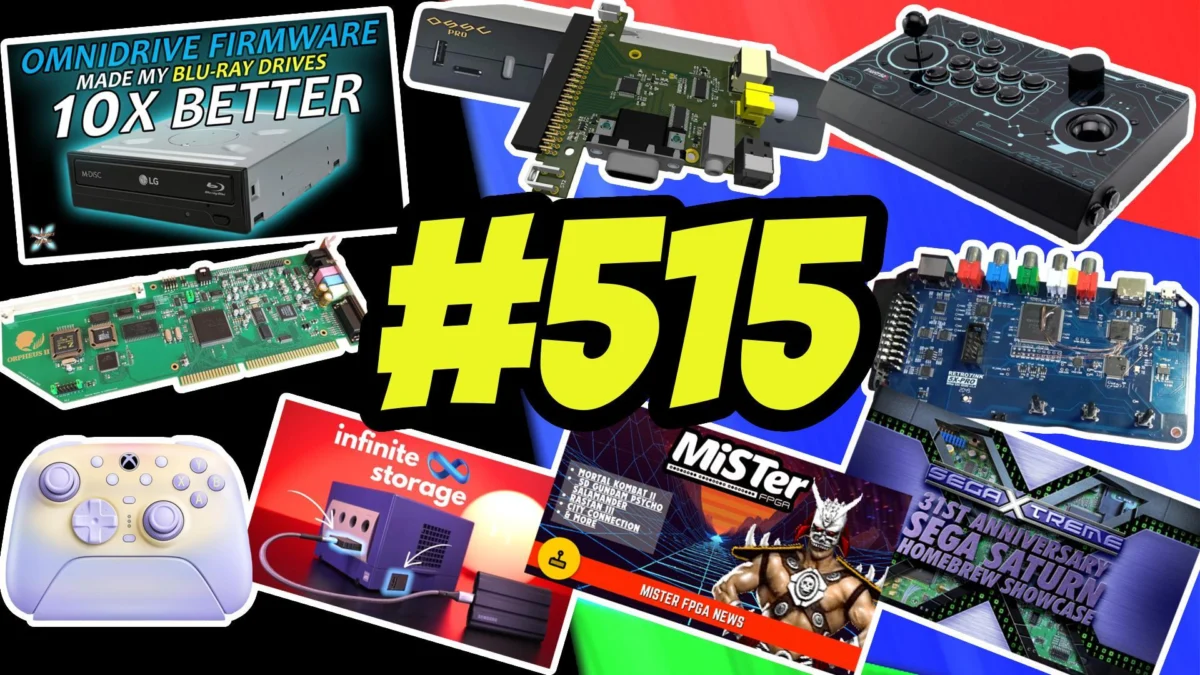
The latest installment of the Weekly Roundup, published on May 27th, 2026, has highlighted a significant array of advancements and updates across the retro gaming landscape, spanning innovations in hardware, software, preservation tools, and community initiatives. This week’s discussion featured pivotal developments ranging from advanced disc ripping firmware and high refresh rate displays to sophisticated controller technologies and crucial updates for FPGA-based emulation platforms. These revelations collectively underscore a vibrant and continuously evolving ecosystem dedicated to the preservation, enhancement, and enjoyment of classic video games.
Innovations in Console Preservation and Digital Access
A key highlight in the realm of game preservation is the new OmniDrive Disc Ripping Firmware, now enabling users to rip discs from a variety of consoles, including the original Xbox, GameCube, and Wii, directly onto their personal computers. This firmware represents a significant leap forward for digital archiving, offering enthusiasts a streamlined method to create personal backups of their physical game collections. The increasing fragility of optical media and the obsolescence of disc drives in modern computing environments make tools like OmniDrive indispensable. Historically, disc ripping has often involved complex setups or console-specific modifications, but this new firmware aims to simplify the process, making game data more accessible for preservation and use with emulators or flashcart solutions. The legal implications of disc ripping for personal backups remain a nuanced topic, generally permitted for personal use in many jurisdictions, provided the user owns the original physical media. This development aligns with broader efforts within the retro gaming community to ensure that digital copies of games remain accessible for future generations, mitigating the risks of physical media degradation and console hardware failures.
Further enhancing digital access and convenience, the USB Dolphin HDD Demo showcased the practical application of external hard drive integration for GameCube and Wii systems (often referred to collectively as "Dolphin" hardware). This demonstration illustrated the ease and speed with which games can be loaded directly from a USB-connected HDD, bypassing the slower optical drive. For many enthusiasts, replacing disc loading with HDD access dramatically improves quality of life, reducing load times, minimizing wear and tear on original console components, and centralizing large game libraries. The GameCube and Wii, despite their age, possess a robust library of titles, and modernizing their storage solutions ensures these games can be enjoyed with contemporary convenience. This trend reflects a broader movement within retro gaming to blend the authenticity of original hardware with the practical benefits of modern storage technology, providing a seamless bridge between past and present gaming experiences.
Advancements in Display and Control Technologies
The discussion around a 1000Hz 1080p Display captured significant attention, probing the implications of such ultra-high refresh rates for both modern and retro gaming. While retro consoles typically output at 60Hz or less, the advent of displays capable of 1000Hz (1000 frames per second) signifies a pursuit of ultimate motion clarity and minimal input latency. For retro gaming, while the source material won’t directly benefit from the raw frame rate, these displays often feature advanced scaling algorithms and extremely low response times that can reduce input lag and improve overall visual smoothness when coupled with high-quality upscalers. The technical challenges in achieving 1000Hz at 1080p are substantial, requiring cutting-edge panel technology and interface bandwidth. Analysts suggest that while immediate direct benefits for native retro signals might be limited, the peripheral advantages in terms of response time and processing capabilities make such displays interesting for the discerning enthusiast seeking the purest signal path and most responsive experience possible, even if it means displaying each 60Hz frame multiple times with extreme precision.
In controller technology, the 8BitDo Ultimate 3 with Force Ring Adjustable TMR Joysticks presented a compelling upgrade for gaming peripherals. 8BitDo has established itself as a leader in retro-inspired, high-quality modern controllers, and this latest iteration addresses one of the most persistent issues in gaming: analog stick drift. By incorporating Tunnel Magnetoresistance (TMR) joysticks, which operate on magnetic principles rather than physical contact, the controller significantly reduces wear and tear, promising superior longevity and precision compared to traditional potentiometer-based sticks. The "Force Ring" and adjustable nature of these joysticks further allow users to fine-tune the stick’s resistance and dead zones, catering to individual preferences across various game genres. This innovation reflects a growing demand for durable, high-performance controllers that can withstand extensive use, benefiting not only retro titles requiring precise analog input but also modern games.
For arcade enthusiasts, the introduction of FightBox Arcade Sticks with Spinner & Trackball Options was a welcome development. Arcade sticks are crucial for faithfully recreating the arcade experience, but the inclusion of specialized inputs like spinners and trackballs opens up a wider array of classic arcade genres. Spinners are essential for games like Tempest, Arkanoid, and Pong, requiring rapid rotational input, while trackballs are vital for titles such as Marble Madness, Centipede, and Golden Tee, demanding smooth, multi-directional rolling input. FightBox’s offering caters to a dedicated niche within the retro gaming community that values authenticity and accuracy in control schemes. These specialized controllers ensure that the unique gameplay mechanics of these classic titles can be experienced as originally intended, preserving the distinct feel of vintage arcade cabinets for home use.
Refining the Retro Gaming Signal Chain

The OSSC Pro Firmware & New Extra A/V Module update brought significant enhancements to one of the most respected video scalers in the retro gaming community. The OSSC (Open Source Scan Converter) Pro is lauded for its ability to convert low-resolution, interlaced analog video signals from classic consoles into high-definition, progressive scan outputs suitable for modern flat-panel displays, all with extremely low latency. The new firmware, coupled with an extra A/V output module, specifically adds support for Composite and S-Video output. While the OSSC Pro is primarily known for its pristine component and RGB signal handling, the inclusion of Composite and S-Video capabilities broadens its compatibility, allowing users with a wider array of older consoles or specific display setups to benefit from its advanced processing. This update underscores a commitment to comprehensive signal handling, ensuring that even the most challenging legacy video formats can be integrated into high-quality retro gaming setups.
Similarly focused on video fidelity, the RetroTINK 5x Launch Edition Mod Testing delved into the intricacies of a "4:4:4 mod" for the popular RetroTINK 5x Pro scaler. The RetroTINK 5x Pro is another flagship device in the retro video scaling market, known for its excellent image quality and ease of use. The 4:4:4 mod refers to achieving full 4:4:4 chroma subsampling, which means that for every pixel, the luminance (brightness) and chrominance (color) information are fully sampled, without compression. In contrast, 4:2:2 or 4:2:0 subsampling reduces color information to save bandwidth, which can lead to a slight loss of color detail, particularly noticeable with sharp color transitions or fine pixel art. For discerning retro gamers and pixel artists, maintaining 4:4:4 chroma is paramount to ensuring that the original color palette and pixel integrity of classic games are reproduced with utmost accuracy on modern displays. This mod highlights the community’s relentless pursuit of pixel-perfect video output, pushing the boundaries of what is achievable in retro video signal processing.
Community-Driven Preservation and Development
The SegaXtreme Saturn 31st Anniversary Showcase, featuring 31 entrants, was a vibrant celebration of one of Sega’s most beloved, albeit commercially challenging, consoles. The Sega Saturn, released in 1994 in Japan and 1995 in North America and Europe, developed a fervent cult following despite being overshadowed by the PlayStation. Its complex hardware architecture made development challenging, but it also fostered a unique library of games, particularly in Japan. The SegaXtreme community has been instrumental in keeping the Saturn’s legacy alive through homebrew development, game translations, hardware modifications, and detailed historical archiving. A 31st-anniversary showcase with 31 entrants signifies a robust and active community, demonstrating ongoing creativity and passion for the console. Such events are crucial for highlighting new fan-made games, unreleased prototypes, and quality-of-life enhancements, ensuring the Saturn’s rich history and potential continue to be explored and celebrated.
Further illustrating the power of community development, Lu’s MiSTer FPGA Updates brought news of significant progress on the MiSTer FPGA platform. MiSTer FPGA (Field-Programmable Gate Array) is a revolutionary open-source project that utilizes FPGA technology to accurately replicate the hardware of classic video game consoles and arcade machines at a transistor level. This approach offers unparalleled accuracy compared to software emulation, effectively creating a "new" piece of hardware that behaves identically to the original. The latest updates included new cores for iconic titles such as Mortal Kombat 2 and Rastan Saga III, along with continued progress on the highly anticipated Sega Saturn core. The development of MiSTer cores is a painstaking process, often requiring reverse engineering and meticulous programming. The continuous expansion of its game library, particularly with complex systems like the Sega Saturn, solidifies MiSTer’s position as a premier platform for experiencing retro games with hardware-level authenticity, providing a powerful tool for both casual play and academic preservation.
Vintage PC Audio Revival: The Orpheus II ISA Sound Card
For enthusiasts of vintage PC gaming, the Orpheus II ISA Sound Card returning for a new batch of preorders was significant. ISA (Industry Standard Architecture) slots were standard in PCs from the 1980s and early 1990s, and sound cards for this era, such as the AdLib and Sound Blaster, were pivotal for bringing audio to PC games. The Orpheus II is a modern reproduction or enhancement of classic ISA sound cards, designed to provide high-quality, authentic audio for DOS-era games on vintage PC hardware. Many retro PC gamers face challenges with original sound cards, which can be prone to failure or difficult to configure with modern systems. The Orpheus II aims to solve this by offering a reliable, high-fidelity solution that perfectly recreates the soundscapes of classic PC titles. Its availability ensures that the rich auditory experiences of games from the golden age of PC gaming can be accurately enjoyed, catering to a dedicated segment of the retro computing community committed to authentic hardware experiences.
The Broader Implications for Retro Gaming
Collectively, the developments featured in Weekly Roundup #515 paint a picture of a retro gaming community that is not merely nostalgic but actively engaged in innovation, preservation, and enhancement. The advancements in disc ripping and HDD integration highlight a strong drive towards accessibility and digital archiving, ensuring that classic games remain playable for future generations. The push for ultra-high refresh rates and precise, durable controllers signifies a relentless pursuit of optimal performance and user experience, blending the best of modern technology with classic gameplay. Furthermore, the ongoing efforts in video scaling (OSSC Pro, RetroTINK 5x) demonstrate a commitment to visual fidelity, making retro games look better than ever on contemporary displays. Finally, the vibrant community events like the SegaXtreme showcase and the continuous development on platforms like MiSTer FPGA underscore the collaborative spirit and enduring passion that fuels the entire retro gaming ecosystem. These initiatives are not just about playing old games; they are about understanding, preserving, and celebrating the history of interactive entertainment while simultaneously pushing its boundaries. The continued support for content creators and developers, as highlighted by the call for Patreon support and affiliate link usage, remains critical for sustaining this dynamic and innovative landscape.








