Jia Lissa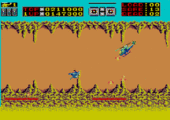
The 1986 release of Choplifter on the Sega Master System represents a pivotal moment in the evolution of the "shmup" (shoot ’em up) genre, marking a successful cross-continental transition from American home computer software to Japanese arcade and console dominance. Originally conceived by Dan Gorlin and published by Brøderbund for the Apple II in 1982, Choplifter fundamentally altered the landscape of action gaming by introducing a rescue-based objective rather than a purely destructive one. When Sega Enterprises acquired the rights to adapt the title for arcades in 1985, the company tasked legendary programmer Rikiya Nakagawa with refining the experience. The subsequent 1986 port to the Sega Master System serves as a definitive version of this vision, blending the tactical depth of the original computer game with the polished aesthetics and increased difficulty of the mid-80s arcade era.
Historical Development and the Sega Partnership
The journey of Choplifter is unique in the annals of video game history. While most successful titles of the era originated in Japanese arcades before being ported to home consoles, Choplifter followed an inverted trajectory. Following its massive success on the Apple II, Atari 8-bit, and Commodore 64 platforms, Sega Enterprises USA recognized the game’s potential for the coin-operated market. In October 1985, Sega released Choplifter as an arcade conversion kit alongside the seminal motorcycle racer Hang-On.
The arcade version was not a mere visual upgrade but a mechanical overhaul led by Rikiya Nakagawa, who would later gain fame for his work on Alien Syndrome and Thunder Blade. Nakagawa’s team implemented significant changes to the core loop, reducing the number of hostages required for rescue from 16 to eight per trip to increase the frequency of high-tension landings. They also introduced entirely new environments, including a naval fleet and a subterranean cavern. When Sega brought the game to its 8-bit home console, the Master System (known as the Mark III in Japan), in 1986, it aimed to replicate this enhanced arcade experience faithfully, leveraging the console’s superior color palette and scrolling capabilities compared to its primary rival, the Nintendo Entertainment System.
Core Gameplay Mechanics and Mission Structure
At its heart, Choplifter on the Master System is a test of precision and situational awareness. Players pilot a rescue helicopter through six distinct stages, which consist of three unique environments—the desert, the ocean, and the cave—looped twice with increased difficulty. The primary objective is to rescue a minimum of 40 hostages to progress to the next level.
The gameplay loop is divided into three critical phases:
- Infiltration: Navigating enemy airspace to locate the barracks or prisons holding the hostages.
- Extraction: Landing the helicopter with pinpoint accuracy. This phase is fraught with peril, as a landing that is too fast or poorly positioned can inadvertently crush the very hostages the player is trying to save.
- Evacuation: Once the helicopter is grounded, hostages must run toward the craft and board. During this time, the pilot is vulnerable to ground-to-air fire and aerial assaults. The helicopter has a limited capacity, forcing the player to make multiple dangerous trips back to the home base.
The tension of the game is derived from the "long-tail" risk. The further a player ventures into enemy territory to collect hostages, the longer and more hazardous the return flight becomes. This creates a psychological pressure where the player must decide whether to fill the chopper to capacity or return early with a smaller group to ensure survival.
Technical Specifications and Visual Presentation
For 1986, the Master System port of Choplifter was a technical showcase. While the Apple II original was monochromatic and lacked fluid scrolling, the Sega version utilized the Master System’s VDP (Video Display Processor) to deliver vibrant colors and smooth parallax scrolling. The parallax effect, which allows the background to move at a different speed than the foreground, provided a sense of depth that was rare in 8-bit home gaming at the time.
The color palette was used effectively to distinguish between the three environments. The desert stages featured warm oranges and yellows, while the naval stages utilized the Master System’s deep blues to depict the ocean and the gray steel of enemy battleships. The subterranean "cave" level utilized darker tones to emphasize the claustrophobic nature of the environment. Furthermore, Sega’s version added charming animations that enhanced the game’s personality, such as hostages jumping in frustration if the helicopter took off before they could board, or swimming toward the rescue craft during the sea-based missions.
The Difficulty Curve and Design Philosophy
The Master System version of Choplifter is noted for its steep difficulty curve, a direct legacy of its arcade origins. In the mid-1980s, arcade games were designed to be "quarter-munchers," utilizing high difficulty to ensure a high turnover of players. While the Master System version was a home release, Sega maintained this unforgiving philosophy.
The third stage, the Cave, is frequently cited by players and critics as the game’s primary "choke point." Unlike the open skies of the desert or the sea, the cave environment introduces physical hazards in the form of stalactites and narrow passageways. Players must maintain a low altitude to avoid ceiling collisions, which simultaneously makes them easier targets for ground-based anti-aircraft tanks. The absence of traditional boss encounters is compensated for by the introduction of "super-enemies" in later stages, such as massive airships and high-speed interceptor jets that require specific patterns to defeat.
Chronology of the Choplifter Franchise
To understand the impact of the Master System release, it is essential to view it within the broader timeline of the franchise:
- 1982: Dan Gorlin releases the original Choplifter on Apple II via Brøderbund.
- 1984: The game is ported to the Commodore 64 and Atari 5200.
- 1985: Sega Enterprises releases the arcade version, introducing new levels and refined mechanics.
- 1986 (September): Choplifter is released for the Sega Master System in North America and Japan.
- 1986 (November): A version is released for the Nintendo Famicom/NES, though it is generally considered graphically inferior to the Sega version.
- 1991: Sega releases Choplifter II for the Game Boy.
- 1994: Choplifter III is released for the Super NES and Game Boy, further evolving the graphics and adding more complex weaponry.
- 2012: Choplifter HD is released on modern platforms, serving as a spiritual and mechanical homage to the 1986 Sega version.
Cultural Context and Hidden Secrets
The 1980s was an era defined by action-hero cinema, with films like Rambo: First Blood Part II and Missing in Action popularizing the trope of the lone pilot or soldier venturing behind enemy lines to rescue prisoners of war. Choplifter tapped into this zeitgeist, allowing players to live out those cinematic fantasies.
Sega also included several "Easter eggs" in the Master System port to reward dedicated players. If a player managed to destroy 16 rockets in specific sequences, iconic pop-culture figures like Superman or E.T. the Extra-Terrestrial would briefly appear on screen. These additions were not present in the original computer versions and served to demonstrate Sega’s more playful and "cool" brand identity during the 8-bit console wars.
Critical Analysis and Market Impact
Upon its release, Choplifter was a critical and commercial success for Sega. It helped establish the Master System as a powerhouse for arcade-perfect (or near-perfect) ports, a key selling point in its competition against the Nintendo Entertainment System. Reviewers at the time praised the game for its unique "rescue-first" mechanics, which offered a cerebral alternative to the mindless destruction found in contemporary titles like TwinBee or 1942.
However, the game was not without its detractors. The brevity of the experience—a skilled player can complete all six loops in under 20 minutes—was a point of contention. While the difficulty provided longevity through the need for practice and memorization, the actual content was thin by modern standards. The decision to loop the three main stages rather than creating six unique environments was a limitation likely dictated by the storage capacity of early Master System cartridges.
Legacy and Modern Significance
Today, Choplifter on the Master System is regarded as a quintessential 8-bit classic. It served as the blueprint for later "rescue shmups," most notably Electronic Arts’ Strike series (Desert Strike, Jungle Strike), which expanded upon the helicopter rescue mechanics with more complex mission objectives and 16-bit graphics.
The game’s score of 8 out of 10 reflects its status as a high-tier title in the Master System library. Its combination of tight controls, impressive visual effects, and a high-stakes gameplay loop ensures that it remains playable and engaging decades after its release. For historians of the medium, it stands as a testament to the era when Sega was at the height of its creative powers, successfully bridging the gap between the living room and the arcade.
Whether viewed as a nostalgic relic or a masterclass in 8-bit game design, Choplifter remains a mandatory experience for those seeking to understand the foundations of the action genre. Its message—that saving lives can be just as thrilling as taking them—remains a unique and enduring legacy in the world of video games.