
 Jia Lissa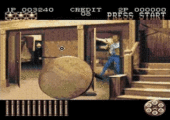
Historical Context and the Regulatory Environment
The release of Lethal Enforcers II: Gun Fighters occurred during a transformative period for the video game industry. Its predecessor, the original Lethal Enforcers, had been a focal point of the 1993 United States Senate hearings on video game violence, led by Senators Joe Lieberman and Herb Kohl. Alongside titles such as Mortal Kombat and Night Trap, Lethal Enforcers was scrutinized for its use of digitized photographic sprites and realistic depictions of gun violence.
In response to the growing pressure from lawmakers and the public, the industry moved toward a formalized ratings system. While the first game carried a restrictive MA-17 rating under the Sega Videogame Rating Council (VRC), Lethal Enforcers II was assigned an MA-13 rating. This shift was attributed to the change in setting; the move to 1873 provided a level of historical abstraction that mitigated the perceived intensity of the violence compared to the contemporary police setting of the first title. Despite the lower rating, Konami maintained the series’ signature digitized aesthetic, which continued to push the boundaries of realism available on 16-bit hardware.
Technical Specifications and Hardware Integration
The Sega CD version of Lethal Enforcers II: Gun Fighters was developed to leverage the hardware’s unique capabilities, specifically regarding storage and audio fidelity. While the visual assets were shared with the standard Sega Genesis (Mega Drive) cartridge version, the CD-ROM format allowed for a vastly superior auditory experience.
Audio and Visual Performance
The game utilizes Redbook audio, providing CD-quality music and voice samples that significantly outclassed the synthesized sound of the cartridge version. The orchestral and western-themed score, combined with clear vocal cues from both enemies and innocent civilians, created a more immersive arcade-like atmosphere.
Visually, the game faced the inherent limitations of the Sega CD’s hardware, specifically the 64-color palette. This resulted in a somewhat grainy and desaturated look compared to the high-resolution arcade original. However, the digitized sprites—a hallmark of early 90s Konami titles—remained recognizable, and the frame rate was optimized to ensure that the fast-paced action required for a light gun shooter was not compromised by hardware lag.
The Justifier Light Gun
Lethal Enforcers II was designed primarily for use with the Konami Justifier, a proprietary light gun peripheral. The Justifier used the timing of the electron beam in Cathode Ray Tube (CRT) televisions to determine where the player was aiming.
- Accuracy: The peripheral offered high levels of precision, which was necessary given the game’s increased difficulty.
- Compatibility: Due to the nature of the light-sensing technology, the Justifier is incompatible with modern Liquid Crystal Display (LCD), Light Emitting Diode (LED), or Plasma screens. Collectors and enthusiasts must maintain functional CRT hardware to experience the game as intended.
- Alternative Controls: While the game supports the standard Genesis three-button or six-button controllers, this method is widely considered suboptimal. Moving a cursor with a D-pad lacks the speed required to react to enemies that appear simultaneously on opposite sides of the screen.
Chronological Stage Analysis
The narrative and gameplay progression of Lethal Enforcers II: Gun Fighters is divided into five distinct stages, each culminating in a complex boss encounter. The game demands not only quick reflexes but also tactical prioritization of targets.
Stage 1: The Bank Robbery
The game opens in a frontier town where a gang of outlaws has initiated a bank heist. Players must navigate the town square and the interior of the bank, neutralizing bandits while avoiding bank tellers and townspeople. The stage concludes with a confrontation against a boss positioned in a fortified covered wagon. This boss utilizes three cannons, requiring the player to balance defensive fire (shooting incoming cannonballs) with offensive fire directed at the antagonist.
Stage 2: The Stagecoach Pursuit
The second stage shifts the action to a high-speed chase involving a stagecoach and a covered wagon. This level introduces mounted combatants, increasing the movement speed of targets. The boss encounter involves an enemy who hurls barrels at the player. Defeating this boss triggers an explosion that leads into the game’s first bonus round—a saloon-based accuracy challenge where players must shoot bottles and sliding glasses within a 15-second window.
Stage 3: The Saloon Shootout
Returning to a more static environment, Stage 3 takes place inside a bustling saloon. The primary challenge here is the density of "non-combatant" sprites, including "ladies of the evening" who frequently cross the line of fire. Enemies are equipped with a variety of weapons, including revolvers, knives, and hatchets. The stage ends with a classic "Quick Draw" duel against three gunmen in the street, testing the player’s reaction time to its limit.
Stage 4: The Train Robbery
This stage takes the player onto the rails, beginning at the caboose and moving toward the locomotive of a steam train. The environment is narrow, forcing tight clusters of enemies. The boss is a locomotive engineer who utilizes dynamite as a projectile weapon. Players must intercept the dynamite in mid-air to prevent damage, a mechanic that requires higher precision than standard gunfights. A second bonus stage follows, involving a bottle-shooting challenge hosted by a civilian character.
Stage 5: The OK Mine Company
The final stage descends into the depths of a gold mine. The environment is darker and more claustrophobic. The final encounter takes a supernatural turn, as the main antagonist summons skeletal warriors. In a unique mechanical twist, players must focus their fire exclusively on the boss, as the skeletons are impervious to standard fire. Upon the boss’s defeat, a concluding animation depicts his transformation into a skeleton, followed by the game’s credits.
Gameplay Mechanics and Scoring Data
Konami implemented several changes to the difficulty curve in the sequel. While the first game required a minimum accuracy percentage to progress between stages, Lethal Enforcers II removed this barrier. To compensate, the enemy AI was made significantly more aggressive.
Enemy Behavior and Weaponry
Enemies in the sequel draw their weapons faster and fire more frequently. Furthermore, certain "elite" enemies require multiple hits to be neutralized, necessitating a "double-tap" strategy. To assist the player, various power-ups can be found by shooting environmental objects like signs or crates. These include:
- Dual Pistols: Increased fire rate.
- Shotguns: Wider hit area.
- Gatling Guns: Rapid continuous fire.
- Cannons: High-damage area-of-effect shots.
The Ranking System
Performance is evaluated at the end of each stage based on accuracy and the number of "innocent" casualties. High accuracy is required to achieve the top ranks, which are categorized as follows:
- 90% and above: U.S. Marshal
- 80-89%: Deputy Marshal
- 70-79%: Sheriff
- 60-69%: Deputy
- 59% and under: Posse
To aid in the completion of the more difficult stages, Konami increased the number of "continues" (credits) from five in the original game to nine in the sequel, allowing for a more forgiving experience for casual players while maintaining a high skill ceiling for enthusiasts.
Impact and Legacy
Lethal Enforcers II: Gun Fighters remains a definitive example of the light gun genre’s peak in the mid-90s. By moving the setting to the Old West, Konami successfully refreshed the brand while navigating the complex regulatory environment of the time. The Sega CD version, in particular, is often cited as the superior home port due to its high-fidelity audio, which bridged the gap between the 16-bit home console and the arcade cabinet.
The game’s legacy is tied to the era of "interactive cinema" and digitized sprites, a trend that eventually gave way to the fully 3D rendered environments of the 32-bit era (such as Time Crisis and Virtua Cop). However, for historians of the Sega CD and fans of arcade shooters, Lethal Enforcers II represents a high-water mark for the platform, offering a challenging, technically impressive, and historically significant piece of software that utilized the CD-ROM medium to its fullest potential in 1994.








