
 Jia Lissa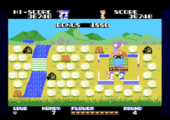
The Technical Innovation and Historical Legacy of Girls Garden on the Sega SG-1000 represents a pivotal moment in the early history of Sega Enterprises and the professional debut of one of the most influential figures in the video game industry, Yuji Naka. Released in early 1985 for Sega’s first home console, the SG-1000, this action-puzzle title stands as a testament to the technical ingenuity required to overcome the hardware limitations of the early 8-bit era. While often categorized as a simple "girl-oriented" game, a contemporary analysis reveals a work of significant complexity, featuring advanced programming techniques and a nuanced approach to game design that would later become hallmarks of the Sega development philosophy.
Historical Context and Development Origins
The development of Girls Garden began in 1984, shortly after Yuji Naka joined Sega at the age of 19. At the time, the video game market was heavily skewed toward male demographics, with a library dominated by space shooters, sports simulations, and arcade ports. Sega management, recognizing an untapped market, tasked Naka and his colleague Hiroshi Kawaguchi—who would later become a legendary composer for titles like Out Run and Space Harrier—with creating a game that would appeal specifically to female players.
The project was initially conceived as a training exercise for the new recruits. However, the quality of the prototype was so high that Sega opted for a full commercial release. Girls Garden was developed in approximately five months, a timeline that required Naka to master the Zilog Z80 processor and the Texas Instruments TMS9918A video display processor (VDP) under significant pressure. The game’s release in February 1985 marked the beginning of a shift in Sega’s internal culture, moving from simple arcade conversions to more sophisticated, original home console experiences.
Core Gameplay Mechanics and Narrative Structure
The narrative premise of Girls Garden is centered on a young protagonist named Papri. The objective is to collect flowers to win the affection of a boy named Minto. The game introduces a romantic rival, Cocco, who serves as the primary driver of the game’s difficulty and time management system. Unlike many contemporary titles that utilized a standard numerical countdown, Girls Garden employed a visual representation of time: a meter at the top of the screen shows Minto moving toward Cocco. If Minto reaches Cocco before Papri delivers her bouquet, the round is lost.
To succeed, Papri must navigate a garden infested with hostile bears. The primary gameplay loop involves gathering exactly ten flowers in full bloom. The flowers cycle through six distinct stages of growth. If the player collects a flower that has not yet bloomed or one that has started to wilt, the bouquet is penalized, often resulting in the loss of half the collected items. This mechanic introduces a high-stakes "risk versus reward" element, requiring players to memorize timing patterns rather than simply reacting to on-screen prompts.
To mitigate the threat of the bears, Papri can deploy honey pots. When a honey pot is placed, the bears are distracted for several seconds, allowing the player to safely harvest flowers or navigate tight corridors. This early example of "crowd control" mechanics demonstrates Naka’s early aptitude for creating layered gameplay systems within limited hardware constraints.
Technical Milestones on the SG-1000 Hardware
The SG-1000 hardware was notoriously difficult to program for, particularly regarding its sprite handling and scrolling capabilities. The TMS9918A VDP supported only 16 colors and had a strict limit on the number of sprites that could appear on a single horizontal line before flickering occurred. Despite these limitations, Girls Garden introduced technical features that were rarely seen on the platform.
Pseudo-Parallax Scrolling
One of the most notable achievements in Girls Garden is the implementation of multi-layered scrolling. While the SG-1000 did not natively support parallax scrolling, Naka utilized a technique that involved shifting background tiles at different rates. The clouds in the background move independently of the mountains and the foreground foliage, creating a sense of depth that was revolutionary for a 1985 home console title. Although the scrolling appears somewhat "choppy" by modern standards due to the tile-based nature of the movement, it represented a significant leap over the static or single-plane screens common in other SG-1000 games.
Magnified Sprites and Challenging Stages
Every two rounds, the game transitions to a "Challenging Stage." In this mode, the game utilizes a specific feature of the TMS9918A chip that allows for "magnified" sprites. The character models of Papri and the bears are rendered at four times their standard size. This visual shift was a deliberate attempt to showcase the versatility of the hardware. The gameplay in these stages shifts to a side-scrolling perspective where Papri must jump over waves of charging bears. This mode is recognized for its high difficulty, as the large hitboxes and fixed jump arcs require frame-perfect timing.
Visual Detail and Artistry
The game’s aesthetic was unusually detailed for its era. The house where Minto resides features vibrant colors and a "welcome" mat, while the environments transition from lush gardens to more treacherous terrain featuring lakes and rock formations. The character animations also conveyed personality; when Papri is caught by a bear, she is shown crying, a departure from the generic explosion or disappearance animations found in most 1980s titles.
Musical Composition and Sound Design
While Hiroshi Kawaguchi is credited as a programmer on Girls Garden, the game’s audio landscape was shaped by Tohru Nakabayashi and Katsuhiro Hayashi. The soundtrack is remarkably varied, featuring upbeat melodies for the main levels and a tense, faster-paced theme for the Challenging Stages.
A notable inclusion in the sound design is the use of classical music. Upon successfully completing a level and delivering the flowers to Minto, the game plays a digital rendition of Felix Mendelssohn’s "Wedding March." This use of recognizable motifs helped elevate the game’s production value, making it feel more like a complete "experience" rather than a simple arcade diversion.
Comparative Analysis: Girls Garden vs. Contemporary Titles
To understand the impact of Girls Garden, it is useful to compare it to other prominent titles of the era, such as Smurf: Rescue in Gargamel’s Castle on the ColecoVision. While both games focused on navigating a hazardous environment to reach a goal, Girls Garden offered a more sophisticated internal logic.
The "energy" meter in Smurf was a simple linear drain, whereas the "Minto-Cocco" meter in Girls Garden provided a narrative-driven urgency. Furthermore, the AI of the bears in Girls Garden was more proactive than the static or predictable enemies found in many early 1980s platformers. The bears would actively track the player’s position, necessitating the strategic use of honey pots and terrain navigation.
Chronology of Influence and Legacy
The release of Girls Garden was the first step in a career that would eventually lead Yuji Naka to create Sonic the Hedgehog. The technical tricks learned during the development of this SG-1000 title—specifically regarding high-speed scrolling and sprite management—served as the foundation for Naka’s later work on the Sega Genesis.
- 1984: Yuji Naka joins Sega and begins development on Girls Garden as a training project.
- 1985: Girls Garden is released in Japan. It becomes one of the final major successes for the SG-1000 before Sega shifted focus to the Mark III (Master System).
- 1991: Naka applies the lessons of hardware optimization to release Sonic the Hedgehog, revolutionizing the platformer genre.
- 2016: Girls Garden receives a wider international audience via its inclusion in the Sega 3D Classics Collection for the Nintendo 3DS, featuring enhanced 3D effects that further highlight the original game’s parallax techniques.
Market Impact and Modern Availability
While the SG-1000 never achieved the global market dominance of the Nintendo Entertainment System (NES), Girls Garden remains a highly sought-after title for collectors. Original cartridges are considered rare, often fetching high prices in the secondary market.
For modern players, the game is most accessible through the Sega 3D Reprint Archives 3: Final Stage (released in Japan) or the Sega 3D Classics Collection (released internationally). These versions offer a "pixel-perfect" emulation, allowing players to experience the game exactly as it appeared in 1985, but with the added stability of modern hardware.
Conclusion: A Foundation for the Future of Sega
Girls Garden is more than a historical curiosity; it is a sophisticated piece of software that pushed the boundaries of what was thought possible on the SG-1000. It demonstrated that even "simple" concepts could be elevated through technical excellence and thoughtful design. By prioritizing visual storytelling, technical innovation, and a unique thematic approach, Yuji Naka and his team created a blueprint for the "Sega style"—a blend of arcade-quality action and technical wizardry that would define the company for decades to come. As the debut of several industry legends, Girls Garden holds a permanent place in the annals of video game history, serving as the first bloom in what would become a massive garden of Sega’s creative achievements.








