Jia Lissa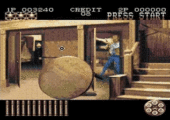
Released in 1994 by Konami, Lethal Enforcers II: Gun Fighters represents a significant moment in the evolution of the light gun genre, serving as both a prequel and a technical expansion of its 1993 predecessor. While the original title focused on a contemporary urban setting, this installment transports players to the American Old West of 1873. The transition to the Sega CD platform allowed Konami to leverage the storage capacity of optical media to deliver a more authentic arcade experience than was possible on standard cartridge-based hardware. This report examines the technical specifications, gameplay mechanics, historical context, and the broader industry impact of this mid-90s interactive shooting title.
Technical Specifications and Hardware Requirements
Lethal Enforcers II: Gun Fighters was designed to bridge the gap between arcade-level performance and home console limitations. On the Sega CD, the game benefits significantly from the hardware’s ability to stream high-fidelity audio and store larger amounts of digitized data. While the visual assets are largely shared with the Sega Genesis version—resulting in a somewhat restricted color palette—the Sega CD iteration distinguishes itself through its sound design. By utilizing Redbook Audio, the game provides CD-quality music and clear voice samples, which were a primary selling point for the Sega CD peripheral in an era dominated by FM synthesis.
A critical component of the user experience is the hardware interface. The game supports the standard Sega Genesis controller, but it was optimized for the Konami Justifier, a proprietary light gun peripheral. Due to the nature of light gun technology in 1994, the Justifier requires a Cathode Ray Tube (CRT) television to function. Modern liquid crystal displays (LCD) and light-emitting diode (LED) screens do not have the refresh rates or scanning characteristics necessary for the Justifier’s light-sensing diode to register hits. For two-player functionality, the game utilizes a unique daisy-chain system where a second, pink-colored Justifier must be plugged into the bottom of the primary blue Justifier.
A Chronological Progression of Stages
The game is structured into five distinct stages, each culminating in a boss encounter that requires specific tactical approaches. The progression follows a narrative arc centered on law enforcement in a frontier setting.
Stage One: The Bank Robbery
The narrative begins with an immediate crisis: a bank heist in progress. Players must navigate the interior of a frontier bank, distinguishing between armed bandits and innocent civilians. The stage concludes with a confrontation against a boss positioned in a fortified covered wagon equipped with three cannons. This encounter introduces a dual-task mechanic, requiring players to neutralize incoming projectiles while simultaneously depleting the boss’s health meter.
Stage Two: The Stagecoach Pursuit
The second stage shifts the environment to an open-road pursuit. This level emphasizes moving targets, as most enemies appear on horseback. The boss encounter involves a villain who hurls barrels from the back of a wagon. Upon the boss’s defeat, a cinematic explosion occurs, leading into the game’s first bonus round. This intermission takes place in a saloon, challenging players to destroy glassware and sliding drinks within a 15-second window to earn points and extra lives.
Stage Three: Saloon Confrontation
Stage three moves the action into the heart of a local saloon. This environment is characterized by high-density enemy spawns and frequent "no-shoot" civilian targets, specifically the saloon’s female employees. Enemies in this stage utilize a variety of weapons, including knives and hatchets, alongside standard firearms. The stage ends with a "quick draw" duel in the street against three specialized gunfighters clad in black.
Stage Four: The Great Train Robbery
The fourth stage takes place on a moving locomotive, beginning at the caboose and progressing toward the engine. The verticality and horizontal movement of the train add a layer of complexity to the shooting gallery mechanics. The boss is a locomotive engineer who utilizes dynamite as a primary weapon. Success in this stage requires high-precision shooting to detonate the dynamite in mid-air before it reaches the player. A second bonus stage follows, involving a bottle-shooting challenge hosted by a civilian character.
Stage Five: The OK Mine Company
The final stage leads players into a deep-earth mining operation. As the player descends into the mine, the game takes a turn toward the supernatural. The final antagonist summons skeletal warriors who attack by throwing knives and their own severed heads. Notably, the skeletal minions are invincible; the player must focus fire exclusively on the main boss while dodging or shooting down incoming projectiles. The game concludes with the boss’s transformation into a skeleton, followed by the credits sequence.
Gameplay Mechanics and Scoring Systems
Lethal Enforcers II: Gun Fighters maintains the core "aim and fire" mechanics of its predecessor but introduces several refinements. Players begin with a standard six-shooter that requires manual reloading—achieved by aiming the light gun away from the screen and pulling the trigger.
Strategic depth is added through weapon upgrades hidden within the environment. By shooting specific background objects such as signs or vases, players can unlock:
- Dual Pistols: Increasing the rate of fire.
- 50-Caliber Sharps Rifles: Providing high-damage single shots.
- Shotguns: Offering a wider spread to hit multiple targets.
- Gatling Guns and Cannons: Providing rapid-fire or high-impact capabilities for limited durations.
The difficulty curve in the sequel is notably steeper than in the original title. Enemies exhibit faster reaction times and often require multiple shots to neutralize. However, Konami balanced this by removing the minimum accuracy requirement for stage progression. Instead of being "fired" for poor performance, players are now ranked based on their accuracy at the end of each level. The ranking system is as follows:
- 90% or above: U.S. Marshal
- 80-89%: Deputy Marshal
- 70-79%: Sheriff
- 60-69%: Deputy
- 59% and under: Posse
Historical Context: Ratings and Regulation
The release of Lethal Enforcers II: Gun Fighters occurred during a period of intense scrutiny for the video game industry. In 1993, the original Lethal Enforcers, along with titles like Mortal Kombat and Night Trap, was a focal point of U.S. Senate hearings led by Senators Joe Lieberman and Herb Kohl. These hearings focused on the impact of violent video games on children and eventually led to the creation of the Entertainment Software Rating Board (ESRB).
Interestingly, while the first Lethal Enforcers was often cited for its realistic digitized violence and received an MA-17 rating under Sega’s internal Videogame Rating Council (VRC), Lethal Enforcers II was granted an MA-13 rating. This shift is attributed to the change in setting; industry analysts at the time suggested that the historical Western context made the violence feel more like a "period piece" rather than a depiction of modern-day crime, which was perceived as more threatening to social order.
Comparative Analysis: Sega CD vs. Standard Genesis
While both the Genesis and Sega CD versions of the game were released in 1994, the Sega CD version is widely considered the definitive home port. The primary differentiator is the audio. The Genesis cartridge was limited by the storage capacity of the era, resulting in compressed, scratchy voice samples and MIDI-based music. The Sega CD version utilized the extra 600MB of space on the disc to include the full arcade soundtrack and uncompressed vocal cues, such as the iconic "Draw!" and "Reload!" commands.
From a visual standpoint, both versions suffered from the Genesis hardware’s 64-color on-screen limit. This resulted in a "dithering" effect where colors appear grainy or blurry compared to the vibrant 256-color palette of the original arcade cabinet. Despite these visual compromises, the Sega CD version’s inclusion of nine continues—as opposed to the five offered in the original game—made the increased difficulty more manageable for home players.
Legacy and Industry Impact
Lethal Enforcers II: Gun Fighters stands as one of the final major successes for the 2D digitized sprite-based light gun genre. Shortly after its release, the industry began a rapid transition toward 3D polygonal graphics, exemplified by titles like Sega’s Virtua Cop and Namco’s Time Crisis. These later games allowed for dynamic camera movements and more complex hit detection, which eventually made the static shooting galleries of the Lethal Enforcers series feel like relics of a previous era.
However, the game remains a benchmark for the Sega CD library. It showcased the potential of the "Multimedia" age of the early 90s, where CD-ROM technology was used to bring arcade-quality audio into the living room. For collectors and retro-gaming enthusiasts, the title serves as a reminder of a specific moment in gaming history when the industry was caught between the controversy of realistic violence and the technical limitations of 16-bit hardware.
In summary, Lethal Enforcers II: Gun Fighters offered a more challenging, aurally superior, and historically themed follow-up to a controversial classic. By refining the light gun mechanics and embracing the storage advantages of the Sega CD, Konami delivered a product that successfully replicated the arcade experience for the home market, cementing its place in the annals of mid-90s gaming history.