
 Jia Lissa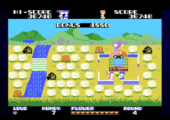
Released in 1985 for the SG-1000, Girl’s Garden stands as a significant milestone in the early history of Sega Enterprises, representing both a technical triumph over restrictive hardware and the professional debut of Yuji Naka, the renowned programmer who would later create Sonic the Hedgehog. While the SG-1000 is often overshadowed by the global success of the Nintendo Entertainment System (Famicom), Girl’s Garden serves as a testament to the creative ingenuity that defined Sega’s internal development teams during the mid-1980s. The game, categorized as an action-collectible title, tasked players with navigating a vibrant but hazardous environment to secure the affection of a romantic interest, a premise that was intentionally designed to expand the traditional male-centric gaming demographic of the era.
The Genesis of a Legend: Yuji Naka’s Directorial Debut
The development of Girl’s Garden began under a specific mandate from Sega’s executive leadership. During the early 1980s, the burgeoning home console market was dominated by arcade ports and high-action shooters. Sega, seeking to diversify its portfolio and appeal to a broader audience, specifically instructed its development staff to create a title that would resonate with female players. Yuji Naka, then a young trainee at Sega, took on the challenge alongside a small team that included Hiroshi Kawaguchi, who would eventually become one of the most celebrated composers in the industry for his work on Space Harrier and Out Run.
Naka’s approach to the project was twofold: he sought to create a visually charming experience while simultaneously pushing the SG-1000’s hardware to its absolute limits. In various retrospective interviews, Naka has noted that the project was a formative experience, teaching him the importance of visual feedback and character personality. The result was a game that felt significantly more "alive" than many of its contemporaries. While many SG-1000 titles felt like static, flickering approximations of arcade hits, Girl’s Garden introduced a level of environmental storytelling and animation fluidity that was rare for the 1984-1985 period.
Gameplay Mechanics and Narrative Structure
In Girl’s Garden, players assume the role of Papri, a young girl with pink hair who is deeply infatuated with a boy named Minto. The narrative goal is simple yet high-stakes: Papri must collect ten fully bloomed flowers to create a bouquet for Minto before he reaches the house of a rival girl named Cocco. This "timer" system is one of the game’s most innovative features. Instead of a standard numerical countdown or a depleting energy bar, the game uses a visual progress tracker at the top of the screen. This tracker depicts Minto walking toward Cocco; if he reaches her before Papri delivers the flowers, the round is lost.
The gameplay loop involves navigating a series of increasingly complex outdoor environments filled with flowers in various stages of growth. The growth cycle is represented through six distinct animation frames. Players must wait for the flowers to reach the fourth frame—full bloom—to collect them. Harvesting a flower too early or too late (when it has wilted) results in a penalty, typically the loss of half of the currently held flowers.
The environment is further complicated by the presence of antagonistic bears. These bears patrol the garden and will pursue Papri upon detection. To survive, players can utilize honey pots, which serve as a distraction, drawing the bears away from Papri’s path. The inclusion of these hazards, combined with environmental obstacles like lakes and rocks, transforms a seemingly simple collection game into a strategic exercise in pathfinding and timing.
Technical Innovations: Parallax Scrolling and Sprite Manipulation
From a technical standpoint, Girl’s Garden is often cited by retro-gaming historians as one of the most advanced titles for the SG-1000. The console utilized the Texas Instruments TMS9918A Video Display Processor (VDP), a chip known for its strict limitations, including a "single color per sprite" rule and a lack of hardware-based scrolling. Despite these hurdles, Naka and his team implemented a form of parallax scrolling—a technique where background elements move at different speeds to create an illusion of depth.
In Girl’s Garden, the clouds in the sky, the distant mountains, and the grass in the foreground shift at varying rates. Because the hardware did not support this natively, the effect was achieved through sophisticated background tile manipulation. While the scrolling appears slightly "choppy" by modern standards, it was a revolutionary feat for a home console in 1985, providing a sense of scale and atmosphere that few other games on the system could match.
Furthermore, the game utilizes a special "double-size" sprite mode for its "Challenging Stages." After every two successful rounds, the game transitions to a bonus level where Papri and the bears appear four times their normal size. This mode utilizes a specific feature of the VDP that allows for larger sprite rendering, albeit at the cost of resolution. These stages require the player to jump over waves of charging bears, testing reflexes and demonstrating the team’s ability to utilize every obscure feature of the hardware.
Audio-Visual Presentation and Artistry
The aesthetic of Girl’s Garden is characterized by its "Kawaii" (cute) art style, which was a deliberate choice to align with the game’s target demographic. The use of color is particularly noteworthy; despite the SG-1000’s limited palette, the game features vibrant greens for the foliage, deep blues for the water, and a distinct pink for the protagonist. The character of Papri is expressive; notably, when she loses a life, she is shown crying—a small but significant detail that added emotional weight to the gameplay, contrasting with the generic "death" animations of the era.
The soundtrack, while limited by the system’s three-channel programmable sound generator (PSG), is remarkably varied. The main theme is upbeat and catchy, maintaining the game’s lighthearted tone. Upon a successful delivery of the flowers, the game plays a rendition of Felix Mendelssohn’s "Wedding March," providing a satisfying auditory reward for the player’s efforts. The collaboration between Naka and the programming team, which included Hiroshi Kawaguchi in a non-musical role, ensured that the audio and visual elements were tightly integrated, resulting in a polished product that felt ahead of its time.
Chronology and Market Context
To understand the impact of Girl’s Garden, one must look at the timeline of the 8-bit console wars.
- July 1983: Sega releases the SG-1000 in Japan on the same day Nintendo releases the Famicom.
- Late 1984: Development of Girl’s Garden begins as part of an effort to diversify the SG-1000 library.
- February 1985: Girl’s Garden is officially released.
- 1985-1986: Sega transitions focus to the Mark III (the predecessor to the Master System), but Girl’s Garden remains a cult favorite among early adopters.
- 2010s-Present: The game is rediscovered by international audiences through emulation and official retro collections, such as the Sega 3D Reprint Archives 3: Final Stage for the Nintendo 3DS.
At the time of its release, the SG-1000 was struggling to maintain market share against the Famicom’s superior hardware and third-party support. Girl’s Garden was a crucial title because it proved that Sega’s internal talent could produce high-quality, original content that wasn’t just a port of an arcade game. It demonstrated a "Sega identity"—one rooted in technical excellence and quirky, stylish presentation.
Legacy and Broader Impact on the Industry
The legacy of Girl’s Garden is inextricably linked to the career of Yuji Naka. Many of the design philosophies found in this early work—speed, fluid animation, and a focus on visual flair—would eventually culminate in the development of Sonic the Hedgehog in 1991. The success of Girl’s Garden gave Naka the leverage within Sega to pursue more ambitious projects, eventually leading to his role as the head of Sonic Team.
Furthermore, Girl’s Garden is an early example of "target marketing" in the video game industry. By creating a game specifically for girls, Sega acknowledged an underserved segment of the market decades before "casual gaming" became a mainstream industry term. While the gendered tropes of the game (collecting flowers for a boy) reflect the cultural context of 1980s Japan, the core mechanics of risk versus reward and environmental management remain universally engaging.
Today, Girl’s Garden is viewed not just as a relic of the past, but as a masterpiece of 8-bit programming. It serves as a reminder of a period when developers had to be magicians, using clever code and artistic shortcuts to overcome the physical limitations of the silicon they were working with. For collectors and historians, the game is a "must-play," representing the humble beginnings of a corporate giant and the first spark of genius from one of gaming’s most influential creators. Whether played on original hardware or through modern ports, the charm of Papri’s quest for flowers continues to bloom, nearly four decades after its debut.








