
 Jia Lissa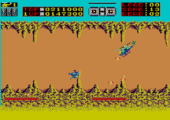
Historical Context and Development Chronology
The journey of Choplifter from a home computer curiosity to an arcade powerhouse and finally to a flagship console title is a narrative of iterative refinement. When Dan Gorlin first developed the game for the Apple II, it was lauded for its innovative use of physics and its departure from the standard "destroy everything" philosophy of early 1980s shooters. In Gorlin’s original vision, the player was tasked with rescuing 64 hostages from behind enemy lines, a mission inspired by the real-world tension of the 1979 Iran Hostage Crisis.
In October 1985, Sega Enterprises USA released the arcade version of Choplifter as a conversion kit, launching it alongside the groundbreaking racing title Hang-On. The arcade project was spearheaded by Rikiya Nakagawa, a developer who would later become a legendary figure at Sega and Technosoft, contributing to titles such as Alien Syndrome and Thunder Blade. Nakagawa’s team re-engineered the game to suit the fast-paced, "quarter-munching" environment of the 1980s arcade scene. This version introduced more vibrant colors, more aggressive enemy AI, and new environments beyond the traditional desert setting.
By 1986, the Sega Master System (SMS) was in its infancy, struggling to gain a foothold in a market dominated by the Nintendo Entertainment System (NES). Sega utilized Choplifter as a key software asset to demonstrate the SMS’s hardware advantages, specifically its larger color palette and its ability to handle complex background scrolling. The port was not merely a reduction of the arcade game but a carefully optimized translation that retained the sophisticated gameplay mechanics introduced by Nakagawa.
Technical Analysis of Gameplay Mechanics
The Sega Master System version of Choplifter maintains a complex set of mechanics that distinguish it from standard arcade shooters of the era. The player controls a rescue helicopter with a multi-directional flight model. Unlike the auto-scrolling shooters common in 1986, Choplifter allows for free movement across a horizontal plane, requiring the player to manage momentum and orientation.
The primary objective is the extraction of hostages held in barracks across three distinct environments: the desert, the ocean, and a subterranean cave system. The mission structure is divided into six stages, which are essentially three unique environments looped twice with increased difficulty. To progress to a subsequent stage, the player must successfully return at least 40 hostages to the home base.
The rescue process involves several high-stakes steps:
- Infiltration: Navigating through anti-aircraft fire and enemy jets to reach the barracks.
- Extraction: Landing the helicopter near the barracks to allow hostages to board. This phase is particularly dangerous, as the helicopter is stationary and vulnerable to ground fire.
- Hostage Management: The helicopter has a limited capacity, carrying only 16 hostages at a time. This necessitates multiple trips across the battlefield.
- Return Flight: Navigating the laden, slower craft back to the safety of the American flag at the starting point.
A critical technical feature of the Master System port is the "hostage AI." The sprites for the hostages exhibit reactive behaviors; they run toward the helicopter when it lands, but they can also be inadvertently crushed by the player’s craft or killed by enemy fire. This added a layer of tactical depth and "moral" stakes rarely seen in 1980s gaming.
Hardware Utilization and Visual Fidelity
On a technical level, the Sega Master System port of Choplifter was a significant achievement for 1986. The console, powered by a Zilog Z80 CPU running at 3.58 MHz and a Video Display Processor (VDP) based on the Texas Instruments TMS9918, was capable of displaying 32 simultaneous colors from a palette of 64. This was a marked improvement over the NES, which had a more restrictive color system.
Sega’s developers utilized the VDP to implement parallax scrolling, a technique where background layers move slower than foreground layers to create an illusion of depth. In Choplifter, this is most evident in the desert and ocean stages, where the distant horizons move independently of the immediate terrain.
The game’s environmental design also pushed the hardware. The second stage, set over an ocean fleet, required the system to render large moving sprites (battleships and submarines) while maintaining a stable frame rate. The third stage, the cave system, challenged the player’s precision with narrow corridors and stalactites, utilizing the SMS’s collision detection to punish even the slightest pilot error.
Comparative Data: Arcade vs. Master System Port
While the Master System version was a "port," it featured several deviations from the 1985 arcade original to better suit the home environment.
| Feature | Arcade Version (1985) | Master System Port (1986) |
|---|---|---|
| Hostages per Barrack | 8 | 16 |
| Total Hostages per Stage | 64 | 64 |
| Progress Requirement | High (Varies by DIP switch) | 40 Rescued |
| Stage Count | 4 Environments | 3 Environments (Looped) |
| Visuals | High-resolution 16-bit | 8-bit optimized |
| Sound | FM Synthesis | Programmable Sound Generator (PSG) |
One of the most notable changes was the refinement of the difficulty curve. The arcade version was notoriously punishing, designed to limit play sessions. The Master System version, while still difficult, provided a more consistent learning curve, though it retained the "one-hit kill" vulnerability that defined the era’s challenge.
Critical Reception and Industry Impact
Upon its release, Choplifter was widely praised by the burgeoning video game press. Critics in 1986 and 1987 noted that while the game was short—a skilled player could complete all stages in approximately 15 to 20 minutes—the intensity of the experience provided high replay value.
Industry analysts of the time viewed Choplifter as a "system seller" for Sega. In the mid-80s, the ability to play a "near-perfect" arcade port at home was the primary metric for console success. While Nintendo had titles like Super Mario Bros., Sega focused on the "Arcade at Home" marketing strategy. Choplifter, along with titles like Wonder Boy and Alex Kidd in Miracle World, formed the backbone of this campaign.
The game also included several "Easter eggs" that reflected the pop culture of the 1980s. If a player managed to destroy 16 enemy rockets in certain stages, sprites of Superman or E.T. the Extra-Terrestrial would appear on the screen. These inclusions were more than just novelties; they were technical demonstrations of the hardware’s ability to render additional unique sprites without causing significant slowdown or flickering.
Longevity and Modern Implications
The legacy of the 1986 Master System port of Choplifter extends into the modern era of game design. Its influence can be seen in later "rescue-shmup" titles such as the Strike series (Desert Strike, Jungle Strike) and even modern indie titles that prioritize physics-based navigation.
However, the game was not without its limitations. Modern retrospectives often point to the lack of boss encounters as a missed opportunity for the Master System version. While the arcade version featured large, intimidating airships that acted as de facto bosses, the SMS port relied more on environmental hazards and swarms of smaller enemies to provide difficulty. Furthermore, the decision to loop the three stages rather than including a fourth unique environment (like the arcade’s city stage) was likely a constraint of the 1-megabit cartridge ROM size prevalent at the time.
Despite these constraints, the 1986 release remains a benchmark for 8-bit software engineering. It successfully translated a complex, physics-heavy arcade experience into a home format without losing the "soul" of the original Apple II concept or the polish of the Sega arcade revision. For the Sega Master System, Choplifter was more than just a game; it was a statement of hardware parity and a demonstration of the console’s potential to deliver sophisticated, high-stakes action that surpassed the simple "score-chasing" mechanics of the early 1980s.
In the broader context of gaming history, Choplifter on the Master System stands as a testament to the era of "arcade-to-home" supremacy, a time when the success of a console was measured by its ability to replicate the blinking lights and intense challenges of the local arcade. It remains a foundational title in the Sega library, embodying the transition from the experimental computer games of the early 80s to the refined console experiences of the late 80s and beyond.








