Jia Lissa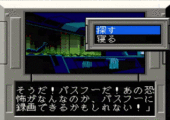
Narrative Foundation and Source Material
The plot of Detonator Orgun is deeply rooted in the "bio-armor" and "mecha-knight" tropes popularized during the late Shōwa and early Heisei eras. Set in the futuristic "City No. 5," the narrative centers on Tomoru Shindo, a university student who experiences recurring dreams of a metallic warrior. These visions materialize when Orgun, a defector from the hostile Evoluder race, arrives on Earth. The Evoluders are a race of beings who have abandoned their biological forms to become living weapons, and Orgun, seeking to regain his humanity or at least protect it, forms a telepathic link with Tomoru.
This connection allows Tomoru to pilot the Orgun armor, leading to a defensive struggle against the "Exterminators" sent by the Evoluder leadership. The game specifically adapts the first two episodes of the OVA—"The Coming of the Warrior" and "The Foreboding of the Battle"—while providing a narrative bridge or preview for the third and final installment. Unlike many mecha adaptations of the period which favored side-scrolling action or tactical combat, Detonator Orgun was designed as a graphic adventure, often referred to in Japan as a "Digital Comic." This choice was intended to preserve the high-detail aesthetic of Masami Ōbari’s character designs and the fluid, albeit violent, animation style of the original production.
Chronology of Development and Release
The development of the Detonator Orgun game ran almost parallel to the production of the OVA series. The first episode of the anime debuted in Japan in early 1991, with the subsequent episodes following throughout the year. By 1992, the Mega CD (known as the Sega CD in North America) was in its infancy, having launched in Japan in December 1991. Hot-B, a developer known for niche titles such as Steel Empire and Insector X, saw the Mega CD as an ideal vehicle for licensed properties that relied heavily on visual fidelity.
The timeline of the game’s release is as follows:
- January 1991: Release of the first Detonator Orgun OVA episode in Japan.
- December 1991: Launch of the Mega CD hardware in Japan.
- July 31, 1992: Detonator Orgun is released for the Mega CD by Hot-B.
- 1993–1995: The game remains a Japan-exclusive title, despite the OVA receiving an English dub and international distribution by Manga Entertainment and Central Park Media.
The decision to keep the game exclusive to the Japanese market was largely driven by its heavy reliance on text and dialogue. As a graphic adventure, the cost of localization—translating thousands of lines of text and re-dubbing the extensive voice acting—was deemed prohibitive by Western publishers, especially for a niche license on a high-priced hardware add-on.
Gameplay Mechanics and Interface
Detonator Orgun utilizes a traditional point-and-click menu interface common to Japanese adventure games of the late 1980s and early 1990s. Players interact with the world through a series of commands:
- Look (Miru): Examines objects or characters in the current frame to gather information.
- Think (Kangaeru): Provides internal monologue from Tomoru, often serving as a hint system for the player.
- Talk (Hanasu): Initiates dialogue with NPCs to advance the plot.
- Move (Idō): Transitions the player between different locations in City No. 5 and Earth Defense Force facilities.
The game is strictly narrative-driven, lacking the action sequences or "twitch" gameplay found in other mecha titles like Assault Suits Leynos or Wolfchild. Progression is gated by the player’s ability to find specific triggers within the environment. This design philosophy places it in the same category as Hideo Kojima’s Snatcher or the Urusei Yatsura adventures, where the primary draw is the consumption of a "playable anime" rather than mechanical mastery.
Technical Specifications and Production Disparities
The technical execution of Detonator Orgun on the Mega CD is a subject of historical scrutiny. The hardware featured a secondary Motorola 68000 CPU and a custom graphics chip capable of hardware scaling and rotation, yet the game’s utilization of these features was limited.
Visual Presentation
The game employs Full Motion Video (FMV) for its cinematic sequences. These are direct captures from the OVA, compressed using the Mega CD’s limited 64-color palette (from a total of 512 colors). The result is a significant amount of "dithering" and pixelation, a common trait of early CD-ROM titles. Despite these limitations, the static backgrounds used during exploration phases are highly detailed, accurately reflecting the cyberpunk aesthetic of the source material. The architectural designs of City No. 5 and the intricate mechanical details of the Evoluder armor are rendered with a level of precision that would have been impossible on a standard Mega Drive cartridge.
Audio Quality Issues
One of the most notable aspects of the game’s production is the inconsistency in its audio engineering. The opening sequence features high-fidelity CD audio, including a powerful synth-heavy score by Kouji Hayama and professional voice acting from the original anime cast. However, as the game progresses, the production values appear to diminish.
- Voice Acting: While early scenes are fully voiced, later segments rely more heavily on text boxes, with voice clips becoming increasingly compressed and "scratchy."
- Music: The soundtrack begins with Redbook CD audio but frequently reverts to the Mega Drive’s internal YM2612 FM synthesis chip for background tracks during exploration. This transition from studio-quality music to 16-bit chiptune music creates a disjointed experience that suggests a rushed development cycle or storage constraints on the disc.
Market Reception and Critical Analysis
Upon its release, Detonator Orgun received a lukewarm reception from the Japanese gaming press. Famitsu and other contemporary magazines noted that while the game was a faithful recreation of the OVA, it offered very little in the way of innovation. The "6 out of 10" sentiment often echoed in retrospective reviews stems from the game’s "quick cash-in" feel, a common criticism for licensed anime titles of the era.
Industry analysts point out that Detonator Orgun suffered from the "transition period" of the Mega CD. Developers were still learning how to balance the massive storage space of a CD (approx. 600MB) with the console’s limited RAM (6Mbits) for video buffering. The lack of interactive action sequences meant that the game appealed only to a very specific demographic: hardcore fans of the OVA who wanted to experience the story at a slower pace. For the general gaming public, the lack of combat in a mecha-themed game was a significant deterrent.
Broader Impact and Legacy
The legacy of Detonator Orgun is tied more to the history of the Mega CD hardware than to the game’s own merits. It serves as a case study in the "Digital Comic" genre that flourished in Japan but failed to gain a foothold in the West. This genre paved the way for the modern "Visual Novel," a format that now dominates a significant portion of the Japanese gaming market and has recently found global success on platforms like Steam and the Nintendo Switch.
The game also highlights the career of Masami Ōbari, whose visual style influenced an entire generation of animators and game designers. His work on Detonator Orgun and later Super Robot Wars helped define the "Obari Pose"—a specific, dynamic perspective used in mecha illustrations that remains iconic today.
In the years following its release, Hot-B faced financial difficulties and eventually exited the hardware-driven software market, making Detonator Orgun one of the final high-profile licensed projects for the company. Today, the game is a sought-after item for Mega CD collectors, not necessarily for its gameplay, but as a cultural artifact of a time when the video game industry was desperately trying to figure out how to integrate cinematic storytelling into the 16-bit ecosystem. For modern players, the game remains an inaccessible relic due to the language barrier and the obsolescence of its FMV technology, yet it remains a fascinating example of the early 90s’ obsession with "multimedia" entertainment.