Farhan hamdan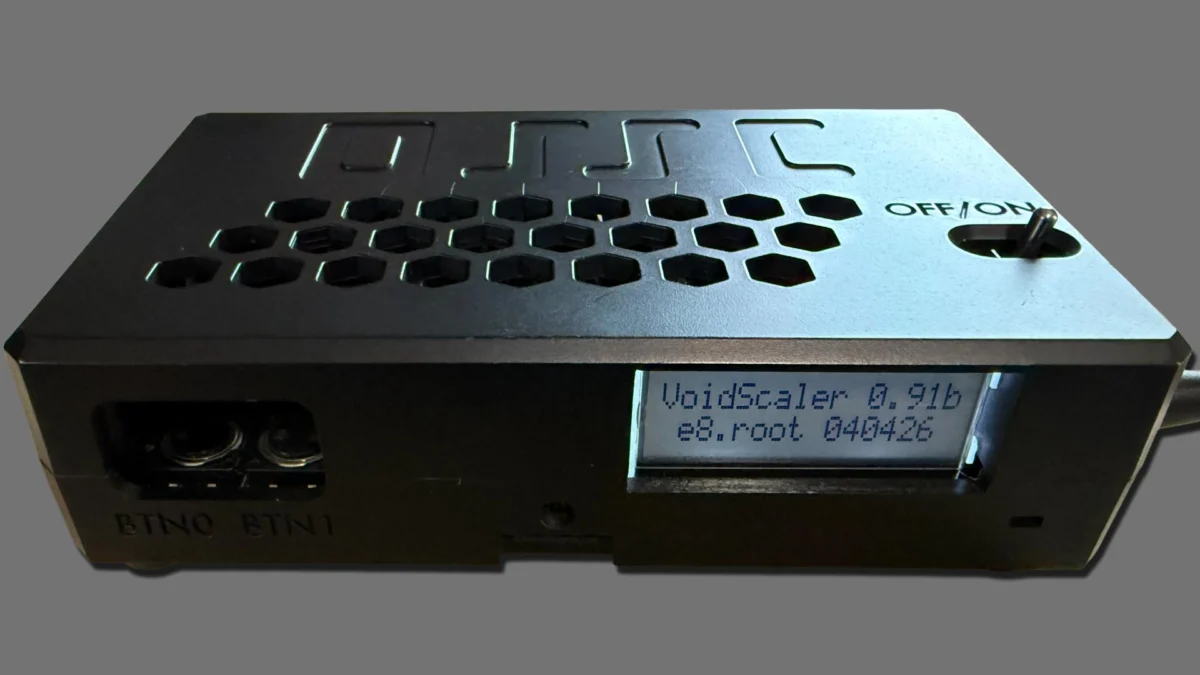
Developer e8root has officially released a significant update to their VoidScaler project, an alternative firmware designed for the acclaimed Open Source Scan Converter (OSSC). This latest iteration transforms the OSSC from its primary role as an upscaler for retro gaming into a versatile downscaler, enabling users to output modern high-definition content to classic Cathode Ray Tube (CRT) displays at their native 15KHz signal frequencies, such as 240p or 480i. The most groundbreaking feature introduced in this update is the ability to run VoidScaler as a secondary, temporary firmware on the OSSC, offering unprecedented flexibility and ease of use for enthusiasts seeking to bridge the gap between contemporary digital sources and beloved analog display technology. This development marks a substantial enhancement for the retro gaming community, providing a seamless method to experience modern content with the unique visual characteristics of vintage display hardware.
The Genesis of the OSSC and the Retro Gaming Renaissance
The landscape of video gaming has undergone numerous transformations, from the pixelated sprites of the 8-bit era to the hyper-realistic graphics of today. However, a significant segment of the gaming community harbors a deep appreciation for the authentic experience of playing classic titles on their original hardware and, crucially, on Cathode Ray Tube (CRT) displays. CRTs offer distinct advantages over modern flat-panel displays, including virtually zero input lag, superior motion clarity, and the natural rendition of scanlines that were an integral part of how many classic games were designed to be viewed. This resurgence of interest, often termed the "retro gaming renaissance," has created a demand for solutions that allow these vintage displays to coexist with contemporary technology.
The Open Source Scan Converter (OSSC), first introduced several years ago, emerged as a cornerstone device for this community. Its primary function is to take the low-resolution, analog video signals (e.g., RGB, component, S-video) from vintage game consoles and line-multiply them into higher-resolution digital signals (e.g., 720p, 1080p, 4x/5x line-multiplied modes) that modern HDTVs and monitors can accept. The OSSC gained widespread acclaim for its pristine image quality, low latency processing, and its open-source nature, which fostered a vibrant community of developers and users dedicated to refining and expanding its capabilities. It effectively solved the problem of connecting old consoles to new displays, preserving the integrity of the original video signal as much as possible. However, the reverse challenge—connecting new content to old displays—remained a complex endeavor.
The Downscaling Conundrum: Modern Signals on Vintage Displays
Modern gaming consoles, streaming devices, and personal computers predominantly output high-definition digital signals through interfaces like HDMI. These signals operate at much higher frequencies and resolutions (e.g., 60Hz, 720p, 1080p, 4K) than the analog, low-resolution 15KHz signals (typically 240p or 480i) required by most consumer CRTs. Attempting to connect a modern HDMI source directly to a CRT is usually impossible without specialized conversion hardware. Prior to VoidScaler, enthusiasts seeking to play modern content on CRTs often resorted to complex setups involving multiple converters, dedicated downscaling devices, or even specialized graphics cards in PCs capable of outputting 15KHz analog signals, each solution presenting its own set of compromises in terms of cost, complexity, or performance. The challenge was to transform a high-frequency, progressive digital signal into a low-frequency, interlaced or progressive analog signal suitable for legacy displays, all while maintaining image quality and minimizing latency.
VoidScaler: A Community-Driven Solution
The VoidScaler project, led by developer e8root, represents a significant community effort to address this downscaling conundrum using existing OSSC hardware. Recognizing the OSSC’s powerful Field-Programmable Gate Array (FPGA) architecture, which is adept at real-time video signal manipulation, the idea was to repurpose its capabilities for the opposite function: downscaling. Instead of line-multiplying, VoidScaler would perform line-de-multiplication and signal conversion, effectively "shrinking" modern digital signals into CRT-compatible analog formats.
The initial iterations of VoidScaler, as first showcased by retro tech expert Marco, demonstrated the technical feasibility and immense potential of this concept. Early adopters found themselves able to display contemporary content, from pixel-art indie games to retro emulators running on powerful hardware, directly onto their cherished CRTs, unlocking a novel visual experience. However, these early versions typically required a full firmware flash, meaning an OSSC running VoidScaler could not simultaneously perform its original upscaling duties without another complete re-flashing. This commitment to a single firmware made it less practical for users who frequently switched between playing retro consoles (upscaling) and modern content (downscaling). The need for a more flexible solution became apparent, leading to the latest, pivotal update.
Revolutionary Dual-Firmware Functionality: The Game Changer
The most impactful feature of e8root’s latest VoidScaler update is the introduction of temporary dual-firmware functionality. This allows VoidScaler to operate as a secondary firmware that can be activated on demand from the OSSC’s menu. Crucially, when the OSSC is power-cycled, it automatically reverts to its primary, official firmware, restoring its original upscaling capabilities. This innovation fundamentally transforms the OSSC’s utility, making it a truly bidirectional video signal processor.
This dual-mode operation offers unprecedented convenience and flexibility. Users no longer need to choose between an upscaler or a downscaler; their OSSC can now fluidly transition between roles with a simple menu selection. For instance, a user could play their Super Nintendo on an HDTV via the OSSC’s upscaling, then, with a few button presses, switch to VoidScaler mode to play a modern indie game from their PC onto a CRT, and finally, power cycle the OSSC to prepare it for another retro gaming session on the HDTV. This eliminates the need for separate hardware, complex flashing procedures, or the use of specialized JTAG programmers for routine switching, significantly lowering the barrier to entry for OSSC owners wishing to experiment with downscaling.

Technical Prerequisites and Simplified Installation Process
To fully leverage the advanced features of the new VoidScaler firmware, particularly the temporary dual-firmware functionality, it is strongly recommended that OSSC units are running official firmware version 1.21 or newer. This specific OSSC firmware update itself brought numerous stability improvements, new profiles, and expanded functionalities, making the modest hardware modification required for its installation a highly worthwhile investment for any OSSC owner. For those with older OSSC units (predating v1.20) who might not wish to perform the hardware modification or update to v1.21, VoidScaler can still be installed, but it will necessitate being the sole firmware on the device, requiring a JTAG programmer for subsequent switching back to official OSSC firmware.
The installation process for the new VoidScaler firmware, particularly for OSSC units capable of dual-firmware operation, has been streamlined for user convenience:
- Firmware Acquisition: The first step involves downloading the latest VoidScaler firmware files from e8root’s official GitHub releases page. It is also highly advisable to download the accompanying remote reference map, which serves as a crucial guide to the various output options and control schemes within VoidScaler.
- MicroSD Card Preparation: The downloaded ‘.bin’ firmware files must be copied to the ‘fw’ directory located on the OSSC’s MicroSD card. A practical tip, widely shared within the community, is to rename these files. The original filenames are often lengthy and can appear truncated on the OSSC’s small front LCD, making it difficult to discern specific versions (e.g., RGBHV, 4:3 aspect ratio). Renaming them to more concise and descriptive labels (e.g., "VS_RGBHV_43_091_040426") greatly enhances navigation and selection within the OSSC’s menu system.
- Firmware Flashing: Once the MicroSD card is reinserted into the OSSC, the device is powered on. Users then navigate through the OSSC’s on-screen menu to ‘Settings’, followed by ‘Firmware Update’. From there, the desired VoidScaler mode can be selected. For example, users intending to connect their OSSC to a CRT via an HDMI to VGA converter would typically choose an RGBHV firmware version.
- Automatic Reboot and Activation: After the flashing procedure is complete, the OSSC will automatically reboot to its main, official firmware. To activate VoidScaler, users simply return to the ‘Settings’ menu and select the option to launch the second firmware. The device will reboot once more, this time entering the VoidScaler environment.
- Configuration and Operation: Within VoidScaler, users can reference the remote map to adjust various output modes and settings. The primary method for establishing a signal often involves cycling through the output mode number buttons until a stable image appears on the connected CRT. A significant advantage is that all these operations, from flashing to initial configuration, can be performed directly via the OSSC’s front LCD panel, eliminating the need to connect it to a modern flat-panel display for setup.
It is important to emphasize that for modern digital sources (such as an HDMI output from a PC or console) to be processed by the OSSC running VoidScaler, an HDMI DAC (Digital-to-Analog Converter) is a prerequisite. This external device converts the digital HDMI signal into an analog component or RGB signal, which the OSSC can then accept and process for downscaling. The OSSC, in its current hardware iteration, primarily handles analog inputs for this specific downscaling purpose.
Broader Implications and Impact on the Retro Gaming Ecosystem
The release of the updated VoidScaler firmware extends beyond a mere technical upgrade; it represents a significant evolution in how the retro gaming community interacts with both vintage and modern technology.
Enhanced Accessibility and Versatility: This update democratizes access to downscaling functionalities for a broad base of OSSC owners. By removing the complexities associated with dedicated hardware or cumbersome firmware flashing, it makes the unique experience of playing modern content on CRTs more attainable. The OSSC, already celebrated for its upscaling prowess, now solidifies its position as a multi-functional video processor, capable of handling signal conversion in both directions, thus catering to a wider array of retro gaming and display setups.
Extension of Hardware Lifespan and Value: The OSSC has been a staple in the retro gaming community for several years. Projects like VoidScaler breathe new life into existing hardware, demonstrating the remarkable longevity and adaptability of well-designed open-source platforms. This continuous innovation through community contributions ensures that the OSSC remains a relevant and valuable tool, prolonging the economic and practical lifespan of units already in the hands of enthusiasts. This serves as a powerful testament to the efficacy of the open-source model in fostering sustainable technology ecosystems.
Fostering Community-Driven Innovation: The VoidScaler project exemplifies the power of community-driven development. Spearheaded by e8root and supported by influential platforms like RetroRGB (run by Bob) and other retro tech experts such as Marco, it showcases how collective passion, technical expertise, and a shared vision can lead to highly specialized and impactful solutions. These solutions often address niche requirements that might be overlooked by larger commercial entities, proving that community collaboration can drive significant technological advancements.
Preserving the Analog Aesthetic in a Digital Age: In an increasingly digital landscape, VoidScaler empowers enthusiasts to preserve and appreciate the distinct visual and experiential qualities of CRT displays when engaging with modern digital content. This is not solely about nostalgia; it’s about recognizing the inherent advantages of CRTs, such as their organic light emission, perfect black levels (in dark scenes), and the authentic way they render resolutions and motion, which contribute to a unique visual immersion that modern flat panels often struggle to replicate. VoidScaler allows this appreciation to extend beyond classic console inputs, bringing a retro sensibility to contemporary games and media.
Future Prospects for Open-Source Hardware: The success and impact of projects like VoidScaler further validate the importance and potential of the open-source model in specialized technology niches. It encourages further experimentation, modification, and development, hinting at a future where existing hardware platforms can be continually adapted and repurposed to meet new challenges and user demands. This model frequently results in solutions that are more precisely tailored, cost-effective, and robustly supported by a dedicated community than proprietary alternatives.
Conclusion
The latest VoidScaler firmware update by e8root represents a significant advancement in the ongoing effort to seamlessly integrate modern digital content with classic analog display technology. By ingeniously enabling temporary dual-firmware functionality on the Open Source Scan Converter, this update not only simplifies the complex process of downscaling high-definition signals to 15KHz for CRTs but also dramatically enhances the OSSC’s overall versatility and accessibility. This development firmly underscores the vibrant innovation within the retro gaming community, showcasing how open-source projects can continually expand the capabilities and extend the lifespan of beloved hardware. For enthusiasts and purists alike, VoidScaler offers an exciting new avenue to experience the best of both worlds, ensuring that the distinctive charm and performance of CRT displays remain a vital and accessible part of the contemporary gaming landscape. The ability to effortlessly switch between upscaling retro consoles and downscaling modern content solidifies the OSSC’s status as an indispensable "Swiss Army knife" for video signals, further cementing its legacy as a cornerstone of the retro gaming experience.