
 Farhan hamdan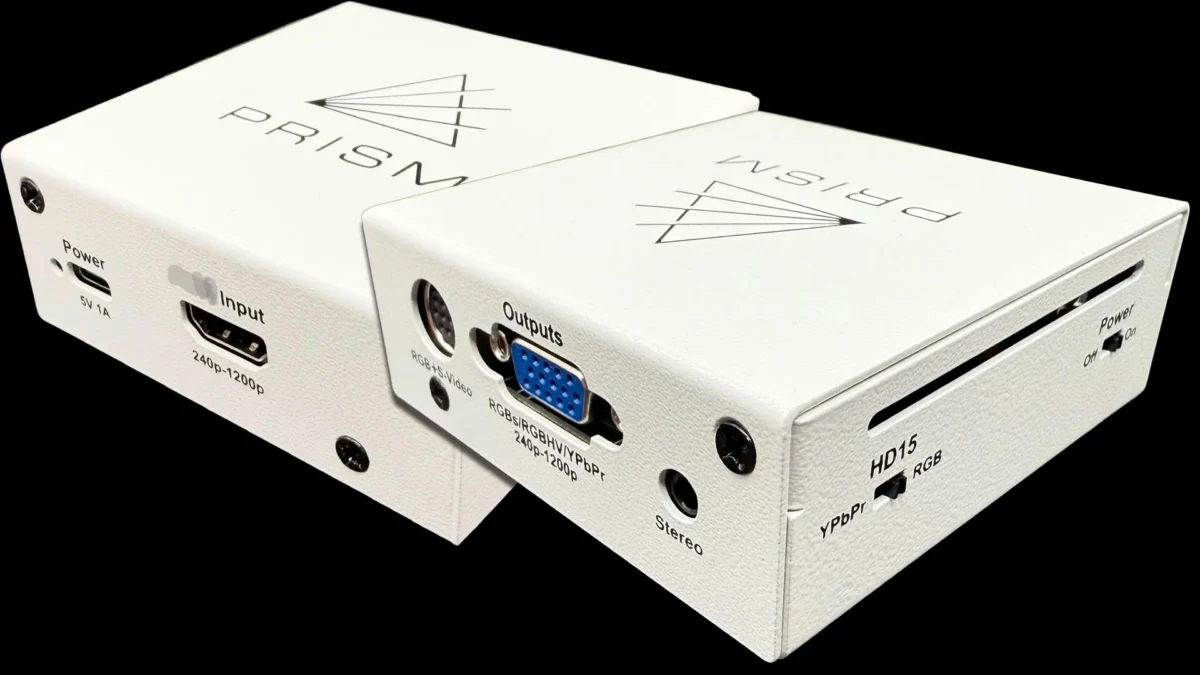
The Reflex Prism stands as a notable innovation in the niche market of digital-to-analog video conversion, specifically engineered to bridge modern HDMI sources with legacy analog display technologies. This device functions as a sophisticated HDMI to analog converter, offering a versatile array of output options that cater primarily to the retro gaming community and enthusiasts utilizing Cathode Ray Tube (CRT) displays. Its core functionality revolves around translating HDMI signals into formats compatible with older monitors and televisions, including VGA and a Sega Saturn-style MiniDIN. The comprehensive feature set and zero-lag performance position the Reflex Prism as a premium solution for users demanding uncompromised fidelity in their analog video output.
Technical Architecture and Output Versatility
At its heart, the Reflex Prism is designed for extensive compatibility with various analog video standards. The VGA output is particularly robust, supporting not only RGBs (Red, Green, Blue with separate sync) and RGBHV (Red, Green, Blue with horizontal and vertical sync) but also YPbPr component video, thanks to an integrated transcoder. This transcoder is a critical component, allowing the device to adapt its VGA output for a wider range of displays, from PC CRTs that typically expect RGBHV, to consumer televisions or professional monitors that might utilize YPbPr. The flexibility of the VGA port alone significantly broadens the device’s applicability, making it suitable for a diverse ecosystem of legacy displays.
Complementing the VGA output is a MiniDIN connector, styled after the Sega Saturn’s video output port. This connector offers both RGB and S-Video outputs, providing essential compatibility for classic gaming consoles and televisions that rely on these standards. RGB via MiniDIN delivers the highest quality analog signal for many retro setups, while S-Video offers a significant upgrade over composite video for displays lacking RGB input. Both the MiniDIN and a separate 3.5mm audio jack provide audio output, ensuring a complete audio-visual solution without the need for additional external components. The inclusion of these multiple, high-quality analog outputs underscores the Reflex Prism’s design philosophy: to offer a comprehensive, single-device solution for complex analog video conversion needs.
Bridging the Digital-Analog Divide: Context and Demand
The necessity for devices like the Reflex Prism stems from a significant technological divergence that began in the early 2000s. For decades, analog video standards such as composite, S-Video, and RGB (including VGA) dominated consumer and professional electronics. These standards, characterized by their continuous electrical signals, were perfectly suited for CRT displays, which render images by firing electron beams onto a phosphor screen. However, with the advent of High-Definition Multimedia Interface (HDMI) in 2002, the industry began a rapid transition to digital video. HDMI, along with its predecessor DVI, transmits video and audio as digital data streams, offering superior image quality, simplified cabling, and support for high resolutions on modern Liquid Crystal Displays (LCDs) and Organic Light-Emitting Diode (OLED) screens.
This transition left a gap for enthusiasts who wished to continue using legacy CRT displays, particularly within the burgeoning retro gaming community. CRTs are highly prized for their unique visual characteristics, including scanlines, true black levels, and zero input lag, which are crucial for an authentic experience of classic video games. Modern digital sources, like the MiSTer FPGA project or Raspberry Pi devices running custom software such as RePlayOS, are capable of generating pixel-perfect video signals at resolutions and refresh rates native to vintage consoles. However, these sources typically output via HDMI. Connecting an HDMI output to a CRT display, which natively understands only analog signals, requires a high-quality, low-latency converter. Generic, inexpensive HDMI-to-VGA adapters often introduce noticeable input lag, perform undesired scaling, or produce sub-optimal image quality, thereby degrading the authentic retro experience. The Reflex Prism directly addresses this demand by providing a high-fidelity, zero-lag conversion path, preserving the integrity of the original signal.
Optimized for Performance: Zero Lag and Resolution Matching
A defining characteristic of the Reflex Prism is its commitment to a zero-lag conversion process. Unlike many general-purpose converters or scalers, the Prism does not internally scale or buffer the incoming HDMI signal. This direct pass-through approach ensures that no additional latency is introduced, a critical factor for competitive retro gaming where even a few milliseconds of delay can impact gameplay. This design choice, however, comes with a specific operational requirement: the source device must output the exact resolution and refresh rate that the target analog display is expecting.
This is a crucial distinction from downscalers, which actively convert higher resolutions (e.g., 720p, 1080p) to lower ones (e.g., 240p, 480i) suitable for CRTs. The Reflex Prism is not a downscaler; it is a digital-to-analog converter (DAC). This means that if a user intends to connect a MiSTer FPGA, a Raspberry Pi, or a PC to a 15kHz CRT monitor (common for arcade games and many home consoles), the source must be configured to output a 15kHz signal. Similarly, for a 31kHz VGA monitor (PC CRTs), the source must output a 31kHz signal or higher. Platforms like the MiSTer FPGA project and Raspberry Pi devices, when configured with specialized software such as RePlayOS, excel at generating these precise, display-native resolutions and refresh rates, making them ideal companions for the Reflex Prism. This synergy allows for the digital signal to be perfectly tailored for the analog display before conversion, ensuring optimal picture quality without compromising latency.

Advanced Configuration and User Interface
While the Reflex Prism offers a plug-and-play experience for basic HDMI to VGA conversion, its advanced features and broad compatibility necessitate several configuration options. For standard use, connecting an HDMI source to the Prism and then to a VGA display typically requires no user intervention, unless the user wishes to switch the VGA output to YPbPr component video mode.
Integration with the MiSTer FPGA project, a popular open-source hardware emulation platform known for its low-latency and high-accuracy simulations of classic systems, often requires specific adjustments. When utilizing MiSTer’s Direct Video mode, which bypasses internal video processing for direct analog output, users have two primary methods for configuration: either physically toggling internal switches on the Reflex Prism itself or modifying the MiSTer.ini configuration file. The latter is generally considered more convenient for most users. Specific recommended MiSTer.ini tweaks for seamless operation with the Prism include:
vga_mode=rgbcomposite_sync=0
These settings instruct the MiSTer to output an RGB signal suitable for the Prism, managing sync signals appropriately. However, the Prism’s extensive capabilities mean that hardware-level adjustments might be preferred or necessary depending on the specific setup and desired output.
Accessing these hardware settings involves opening the device’s enclosure, a process described as somewhat cumbersome. Inside, users will find several configurable elements:
- NTSC/PAL Jumper: This jumper allows users to select the appropriate video standard for the S-Video output, crucial for compatibility with displays worldwide.
- Power Jumper: An additional power jumper is present, though its specific function and common use cases were not detailed in initial observations.
- Hidden Sync Switch: A discreet switch is available to toggle sync from the HD15 (VGA) port.
- DIP Switches: A bank of DIP switches provides control over sync combining modes and a passthrough mode. These switches allow for fine-tuning how sync signals are handled, which is vital for ensuring compatibility with a wide array of analog displays that may expect different sync configurations (e.g., composite sync on green, separate sync).
The internal placement of these critical configuration options, while perhaps simplifying the external design and reducing manufacturing costs, has been noted as a minor inconvenience. For users who frequently switch between different source/target environments or experiment with various settings, the need to repeatedly open the enclosure could be a drawback. An external array of DIP switches or toggles would significantly enhance usability for power users and those utilizing the Prism as a versatile diagnostic or conversion tool.
Performance Metrics and Test Results
Rigorous testing of the Reflex Prism has consistently demonstrated its high-quality performance across its advertised capabilities. The RGB output levels and voltage were found to be consistent and accurate, crucial for ensuring proper color reproduction and signal integrity on connected displays. Specifically, the SCART sync voltage was well within acceptable limits, remaining below the maximum thresholds that could potentially damage some displays. Similarly, the VGA sync voltage was precisely where it should be, guaranteeing stable and reliable synchronization for PC CRTs. Further re-testing with various sync options configured via the internal DIP switches confirmed that all modes performed exactly as expected, indicating robust and well-engineered sync handling.
The device’s compatibility extends to niche video modes, an important consideration for advanced retro video applications. It successfully processed and outputted signals such as 480p72 and 1080p72. These particular resolutions and refresh rates are significant for achieving proper cadence when displaying certain types of CRT videos, allowing for flicker-free and historically accurate playback on appropriate CRT monitors. This level of compatibility underscores the Prism’s utility beyond standard gaming applications, positioning it as a valuable tool for video enthusiasts and content creators working with legacy displays.
One notable point, while not a performance flaw, is the quality of composite video output. Although the Reflex Prism technically outputs a composite signal through its Saturn-style MiniDIN, the quality is described as "terrible." It is important to acknowledge that the product page explicitly states that composite video output is unsupported, meaning the device performs precisely as advertised, without misleading consumers. However, for a device offering such a comprehensive suite of analog outputs, the lack of a usable composite video signal is perceived as a missed opportunity. Given the ubiquity of composite video inputs on older consumer televisions, a high-quality composite output could have further broadened the Prism’s appeal and versatility, potentially offering a single-device solution for nearly all legacy analog video needs.
Market Positioning and Value Proposition

The Reflex Prism is not positioned as a budget-friendly HDMI to VGA adapter, and its pricing reflects its advanced features and specialized capabilities. For users who simply require a basic HDMI to VGA converter, numerous cheaper alternatives exist in the market. However, these alternatives often lack the zero-lag performance, the extensive range of analog output options (RGBs, RGBHV, YPbPr, S-Video, separate audio), and the precise signal handling that the Prism offers.
The Reflex Prism targets a specific demographic: enthusiasts and professionals who need a robust, high-fidelity digital-to-analog converter for multiple scenarios involving legacy displays. Its value proposition lies in its ability to deliver uncompromised signal quality and versatility. It is an ideal companion for advanced retro gaming setups, particularly when paired with devices like the MiSTer FPGA or PCs configured for 15kHz output, or even the HDMI-out of a dedicated downscaler. In such configurations, the Prism allows for high-quality RGB, VGA, and S-Video signals to be sent to a variety of CRT displays, maximizing visual fidelity and preserving the authentic experience. The investment in a Reflex Prism is justified by its comprehensive feature set and its role in creating a pristine analog signal chain from modern digital sources.
Implications for the Retro Gaming Ecosystem and Future Development
The introduction and continued development of devices like the Reflex Prism hold significant implications for the retro gaming community and the broader field of historical hardware preservation. As modern digital displays become increasingly dominant, the ability to accurately and efficiently interface contemporary digital sources with legacy analog displays becomes critical for sustaining the authenticity of retro experiences. The Reflex Prism contributes to the longevity of CRT technology as a viable display option, allowing new generations to appreciate classic games and media as they were originally intended.
The concept of a "pro" version, as suggested by community feedback, highlights potential avenues for future development. A hypothetical Reflex Prism Pro could address the current minor inconveniences, such as relocating all configuration toggles (NTSC/PAL, sync options) to the exterior of the device for easier access. Furthermore, improving the composite video output to a usable standard and breaking out composite, S-Video, and audio into dedicated jacks could create an unparalleled "Swiss Army knife" of analog video conversion. Such a device, while likely carrying an even higher price point, would cater to virtually every conceivable analog display scenario, solidifying its position as an indispensable tool for enthusiasts, collectors, and preservationists alike. This ongoing innovation in bridging digital and analog domains ensures that the rich history of video games and media remains accessible and enjoyable on its native hardware for years to come.
In conclusion, the Reflex Prism is a highly capable and meticulously engineered HDMI to analog converter, perfectly suited for the discerning retro enthusiast. Its zero-lag performance, extensive output options (VGA with RGBs/RGBHV/YPbPr, MiniDIN with RGB/S-Video), and precise signal handling make it a premium choice for connecting modern digital sources like the MiSTer FPGA to beloved CRT displays. While the internal placement of configuration switches and the quality of composite video output present minor areas for potential refinement, the device’s overall performance and versatility firmly establish its value in the specialized landscape of high-fidelity analog video conversion.
Supporting Resources:
- Reflex Prism: https://misteraddons.com/products/reflex-prism-hdmi-to-analog
- VGA DAC: https://amzn.to/44HsIu0
- HD15-2-SCART: https://retrorgb.com/hd15-2-scart-adapter.html
- MiSTer FPGA project: https://retrorgb.com/mister.html
- RePlayOS v1.5.0 for Raspberry Pis: https://retrorgb.com/replayos-v1-5-0-for-raspberry-pis.html
- Downscaling information: https://retrorgb.com/downscaling.html
- Raspberry Pi for 24p on PC CRTs: https://retrorgb.com/raspberry-pi-for-24p-on-pc-crts.html
For those seeking detailed performance verification and in-depth testing, two livestreams documenting the evaluation of the Reflex Prism are available, providing comprehensive visual proof of its capabilities and operational nuances.








